
Does the Massachusetts ADU Law Make an Unbuildable Lot Buildable?
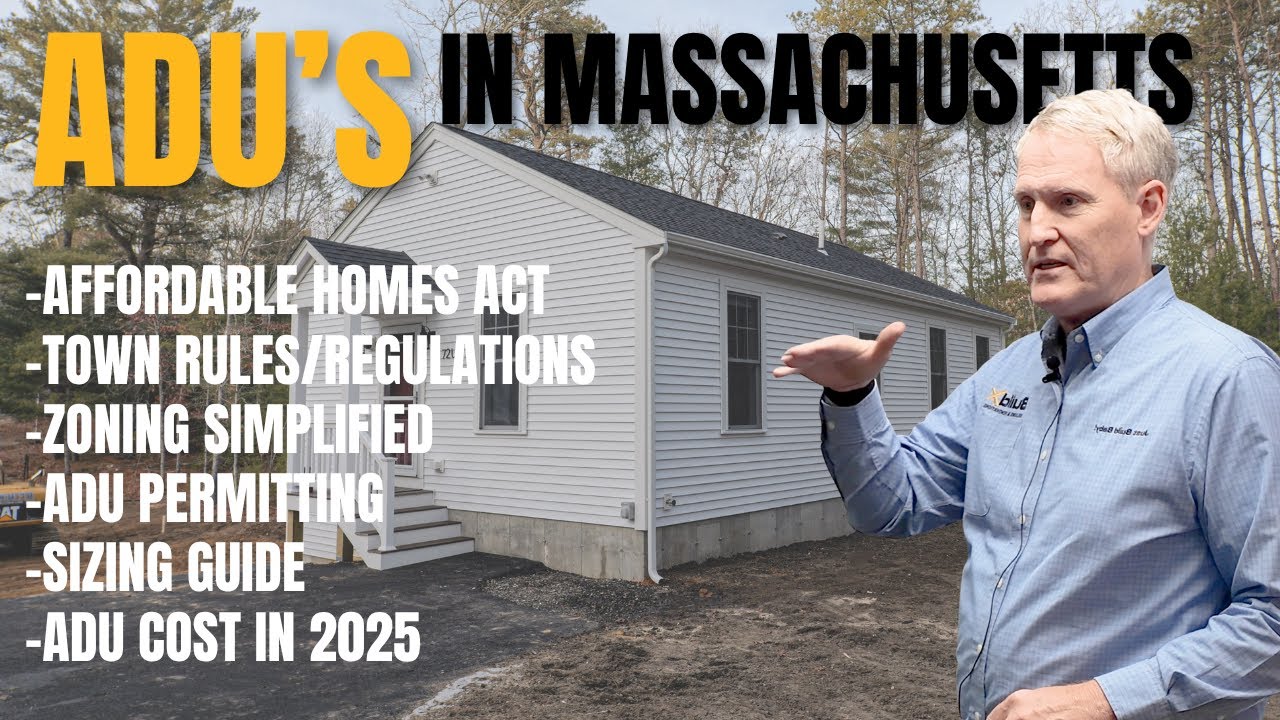
Watch: Massachusetts ADU Law Explained: The Affordable Homes Act (2025 Update)
Years ago when you asked about building an in-law apartment or a second house in the backyard, your town said no. The reason was a parking issue, or the setback, or someone took a quick look at your septic system from behind a desk. So you ruled the idea out. Then the Affordable Homes Act passed, and the state laws now overruled the town's so you began to think about it again. There is one question that needs to be answered for sure, and it's short but costly to get wrong. Does the new law help your particular lot?
My name is Buz Artiano, and I am the founder of BuildX. We've built dozens of ADU projects across Massachusetts, mostly around the South Shore and Plymouth County areas. We are the only team you need: we do the design, permitting, and construction. So we see every phase of a project from the first site visit up until you move in. We evaluate septic constraints, zoning issues, utility connections and the requirements for a permit from the city. Massachusetts allows one accessory dwelling unit by right in single family zoning areas, although municipal building code, health code, and dimensional requirements still apply to every project. You can review the state requirements at mass.gov. We've also had to walk away from lots that wouldn't hold a second home, and that's part of this business that nobody puts in their brochure.
That's the one question our team hears most often. Paul Crossman, who gives our Massachusetts ADU seminars, gets asked almost every time if the new law made difficult lots easier to build on. His answer is no. The law changed who has to say yes but it didn't change what the property can support. Those are two different questions and dealing with them separately will save a family six months and several thousand dollars for engineering costs.
Quick Answer: No. The Affordable Homes Act changed how a Massachusetts town has to review an ADU but not what your property can physically and legally have. A lot that failed because of the dimensional setbacks, or septic issues, or the available area for a private well, will also fail for those same reasons today. What the law took away was the town's choices: your town can't require a special permit, make the unit be attached, or force you to use its own parking rules. If your project was denied because of one of those town rules, it's worth a second look. If it was denied because of the land, then nothing's changed.
In This Article
- Did the Affordable Homes Act Make Hard Lots Buildable?
- What Did the Law Actually Change?
- Which Constraints Still Apply to Your Lot?
- What Would Make My Lot Unbuildable for an ADU?
- Was Your Blocker a Lot Problem or a Town Rule?
- Can a Sewer or Septic Path Keep My Lot Viable?
- When a Design-Build Company Is the Wrong First Call
- Get a Straight Answer on Your Lot Before You Spend Another Dollar
Did the Affordable Homes Act Make Hard Lots Buildable?
No. Paul Crossman said this at one of our seminars: if it was an unbuildable lot before, it's an unbuildable lot now. The Affordable Homes Act didn't add extra land to your lot, move the leach field or change your property lines. It rewrote the approval process necessary to build a second dwelling in a single-family zoning district. That's just a change in procedure and procedure wasn't what stopped a difficult lot.
The confusion is understandable because the law is complicated. Section 8 of the Affordable Homes Act changed the state Zoning Act so that no local ordinance or by-law can prohibit, unreasonably restrict, or require a special permit for one ADU in a single-family residential zoning district. That law took effect statewide on February 2, 2025. You can read the state's summary of the law at mass.gov. The same section that grants the protection also says that the unit still has to comply with reasonable regulations, and that would include Title V.
The phrase that is new here is "by right." By right means the town reviews your application against fixed written standards and issues the permit if you meet them. It doesn't mean the standards went away but it does mean nobody gets to arbitrarily vote on whether they like your project or not.
What Did the Law Actually Change?
Three hurdles from the town were done away with and each of them stopped ADU projects before 2025.
The first is discretionary approval. Before the law passed, a family in a single-family area had to get a special permit or variance, and that meant there would be a public hearing and a board vote. A neighbor who had an objection could stop the project. A town can't require a special permit or other discretionary zoning approval now for the use or rental of an ADU that meets the state requirements.
The second is the attached-only requirement. Many Massachusetts towns used to allow in-law apartments only if they were attached to the main house, and didn't allow detached backyard ones. State law did away with that restriction. Attached or detached is now a matter of design instead of a zoning question.
The third is the town parking formula. In densely populated towns, parking requirements were used to block added apartments. The formula required than a normal typical driveway would hold, and so the project would stop there. The state set a parking standard that municipalities can't go over, and that takes the local formula out of the decision completely.
What you should notice about those three things is that each one is a rule about who decides. Not one of them has to do with the ground.
Which Constraints Still Apply to Your Lot?
Every restriction that applies to the land itself is still there, and the statute was clear about it. The same language that protects by-right approval also keeps your town's authority to enforce a set of requirements. Four of them decide if your lot is going to work for an ADU.
- Same lot. The accessory dwelling unit has to sit on the same lot as the main house. You can't fix a small lot by using the corner of an adjoining piece of land.
- Dimensional setbacks. Towns keep their authority over setbacks and also over the size and height of the structure. Setbacks are the minimum required space between a house and the property lines. If there isn't a space that meets the guidelines on your property there's no place for an ADU.
- Title V. Title V is the state sanitary code that regulates on-site septic systems, found at 310 CMR 15.000. The Department of Environmental Protection issued information on how those rules apply to ADUs, published at mass.gov.
- Land area on a private well. A property that gets its water from a private well and disposes of sewage with a private septic system has to meet a land-area requirement that's tied to nitrogen loading. We plan around about 10,000 square feet of land for every bedroom on the system. On town water, this rule doesn't apply at all.
If you put the two sides next to each other it becomes clear why families can read the same information and reach opposite conclusions about their own property. The left column is procedure. The right column is land.
| What the Affordable Homes Act removed | What it left in place |
|---|---|
| Special permits and other discretionary zoning approval | The same-lot requirement |
| Town rules that require the unit to be attached | Dimensional setbacks, bulk, and height |
| Local parking formulas that go above the state standard | Title V septic compliance |
| Owner-occupancy and family-relationship requirements | Land area limits where a private well serves the property |
What Would Make My Lot Unbuildable for an ADU?
The state or our own seminar actually defines the word unbuildable, so it's useful to be precise. The list of restrictions above are four ways to fail and knowing which one you're dealing with decides who you should call next.
- Setback failure: using front, side, and rear setbacks, there isn't a legal building footprint left, and making the unit attached doesn't fix it either.
- Septic capacity failure: the added bedrooms increase the design flow to the septic system, and the system in place can't be brought up to the current construction standards with the space that's available.
- Land-area failure: the property has a private well and a private septic system, and it doesn't hold enough square footage for the total bedroom count.
- Same-lot failure: the buildable ground you were counting on isn't on your lot.
New Construction standards is the phrase to watch out for because it means full compliance with the current code is required for the total number of bedrooms on the property, instead of the old standard your system was approved for.
Other conditions can stop projects too. Wetlands jurisdiction, frontage requirements, slope, ledge, and conservation restrictions all are in force and they are not listed in the ADU section of the Affordable Homes Act. The list above isn't every reason that a lot can fail. It's only the list of restrictions that the new law was thought to be done away with but didn't.
Was Your Blocker a Lot Problem or a Town Rule?
This is the checklist that decides your next move, and most families do it from memory. Think back to the exact reason you were told no.
- The town said an in-law apartment had to be attached to the house. That was a town rule, and it's now gone.
- The town's parking formula made you have spaces your driveway couldn't hold. That was a town rule, and it's capped now.
- A board voted the project down, or a neighbor's objection ended it at a hearing. That was discretionary approval, and towns don't have that anymore for an ADU that's compliant.
But if the answer involved a surveyor, a septic engineer, a perc test, or a file at the Board of Health, then that's a land issue. The 2025 change doesn't change those. Families who lump those two categories together may spend a lot of time and a design fee just to confirm what a request of the records would have told them in a week.
Can a Sewer or Septic Path Keep My Lot Viable?
Sometimes, and this is a situation where a lot that looks iffy may turn out to be fine.
If your property is on town sewer, towns have to allow the connection, and that does away with the biggest issue on most lots before it ever becomes a problem.
If your property is on a private septic system, the question is the capacity. Where the current system has capacity for the added bedrooms, it can be added to instead of replaced. If it does not, the Department of Environmental Protection guidance is specific about what happens. The ADU will count as new construction if it increases the design flow to the septic, and design flow is calculated at 110 gallons per day per bedroom. Once that threshold is exceeded, the system has to meet current New Construction standards for the total number of bedrooms on the property, not just the ones you are adding.
We will inspect the septic before we quote, and the order is important. On a lot with a marginal septic system, the difference between adding into an existing tank or rebuilding a system for the whole property is the difference between a project that works on paper and one that doesn't. It could be an additional five figures to the budget before a single wall goes up. Most estimates a family gets treat the septic as just part of the budget to be confirmed later. We treat it as a determining factor. If a family has to hear that their land won't support an ADU, they should hear it in week one, not after they've paid an architect.
When a Design-Build Company Is the Wrong First Call
We build accessory dwelling units for a living, so you'd expect us to tell you that yours is possible. But if you have a lot that's failed once, that's not always the honest answer.
If your property has a private well and a private septic system on a small lot, then your first call should be to a septic engineer and your local Board of Health, not a builder. They have the information that decides the outcome, and no amount of design work can change it. If your lot has a wetlands or conservation issue, your conservation commission will have that answer. And if the setback leaves no space on the lot, no builder in Massachusetts can fix that for you.
We also think you should talk to more than one builder. A family that's been told no once deserves a second opinion, and a company that discourages you from getting one tells you something about itself.
By right doesn't mean fast, either. Our experience across Massachusetts towns has been good, but it's also been slow in certain areas, because city staff are still figuring out how the rules apply to real properties. Patience is the most useful thing a family can have during this process.
Get a Straight Answer on Your Lot Before You Spend Another Dollar
The decision in front of you is narrow. You need to find out if the thing that stopped you was a town rule or a land restriction. If it was a town rule, the Affordable Homes Act already dealt with that, and your project needs a fresh look with the new information. If it was the land, that answer hasn't changed, and the best thing to do is confirm it quickly rather than spend more time hoping otherwise.
We'll access your Board of Health septic file, do the setback math using your actual property lines, and tell you plainly whether a second dwelling will fit before you spend anything on design.
Walk through a completed ADU or Request a Free Consultation
Call us: (781) 627-7000