
Is Adding Solar to Your ADU Worth the Extra Cost?
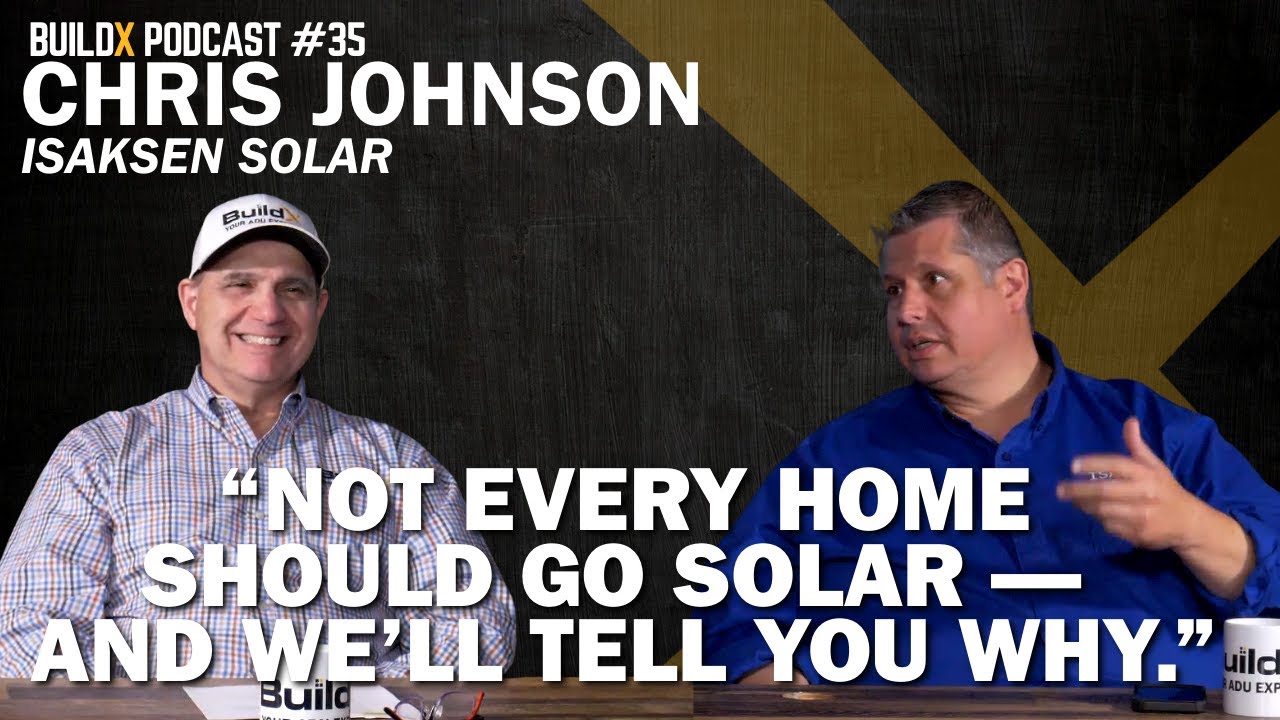
Watch: How Solar Really Works for Builders, Homeowners, and ADUs | BuildX Podcast #35
You're already looking at $250,000 or more to build an ADU. The last thing you want is another expensive add-on that seems like a good idea but never actually pays for itself. Solar panels promise to give you significant results, but you've probably heard just as many people talk about systems that don't perform the way they're supposed to, or they were sold too big of a system, and the amount of time for their payback plan keeps getting extended. If you're going to spend another $30,000 to $40,000 on top of an already expensive project, you need to know exactly what you're getting and whether the numbers are going to work out in your favor.
My name is Buz Artiano, and I am the founder of BuildX. We've built dozens of ADU projects across Massachusetts, mostly around the South Shore and Plymouth County. Our process covers design, permitting, and construction under one roof, and that includes coordinating with your solar people before the foundation is poured. We work with Massachusetts permitting requirements, septic constraints, and local zoning variances every single day. What we're going to talk about in this article comes from our hands-on experience building ADUs every day.
Solar on an ADU is a completely separate conversation than solar on an existing home. When you're building new, you have flexibility and wiggle room in your design that existing home solar panel projects don't have. You can face the roof in the direction of the sun, you can pre-run conduit inside the walls during framing, and make sure you get the right size electrical panel to handle the panels from the start. The question is whether all that will save you enough money over time that it justifies spending all that money upfront. That's what we'll talk about in this article, we'll show you real numbers from projects we've worked on.
Quick Answer: For most Massachusetts ADU projects, adding solar is worth the extra cost if you plan it all out while you're still in the design phase. A residential solar system is about $40,000, and you pay it back over 8 or 9 years. After that, you're supplying your own power at no cost for at least another 15 years since the systems usually have a 25-year warranty. The main variables that tell whether your system will be efficient are whether your ADU's roof faces the right way, what the pitch is, and how many trees there are. If your builder brings in a solar consultant before starting construction, the system can be designed to be the most efficient from the start.
In This Article
- Does Solar on an ADU Actually Pay for Itself?
- What Drives the Cost of Solar on an ADU?
- Why Does Planning Solar During the ADU Design Phase Save Money?
- What About the Roof? Does Solar Damage a New ADU Roof?
- What Happens If My Utility Company Says No?
- How Long Will the System Last, and What Does the Warranty Cover?
- Is Solar the Right Call for Every ADU?
- Should You Add a Battery to Your ADU Solar System?
- Your ADU Roof Is a 25-Year Asset. Plan It Accordingly.
Does Solar on an ADU Actually Pay for Itself?
Yes, actually most of the time it does. Based on projects we've worked on with solar installers in Massachusetts, a standard residential solar system costs approximately $40,000 and gives you an 8 to 9 year return on investment. That means if you install a solar system on your new ADU in 2026, it would be giving you free electricity by 2034 or 2035. From then on, you don't have to pay for your electricity, you make it for free yourself.
And by the way we're not guessing on that. Solar installers keep track of how well their systems are performing, and the data matches up with the information given at the time of sale. One of the installers we worked with said the production and usage numbers match the estimates when you look at them over a year. Even though we can't predict the sun, the numbers are still what the solar company promised when you average it over a year.
The things that can affect your payback time are roof orientation, pitch angle, tree coverage, family size, and whether you heat with electricity, gas, or propane. A home that runs entirely on electricity will use more power and have faster payback. A home that also uses gas will pull less from the solar system. When you meet with your installer and talk about a design, he'll take all of that into account on your estimate.
What Drives the Cost of Solar on an ADU?
The total cost of a solar installation depends on the size of the system and how much power the ADU needs. What size system you need depends on the household's electricity consumption, the available roof area, and how much of the roof gets sun exposure.
The $40,000 average is for a standard residential system. Your ADU may need a smaller system depending on square footage, how many people will be living there, and whether it shares its electricity with the main house. A smaller system costs less but also produces less power, so your payback time stays about the same.
But there are things that can add to that $40,000. If the transformers on your street can't handle the extra power your system sends back to the grid, the power company might make you pay for a transformer upgrade that can cost $8,000 to $20,000. Most people don't expect this. Your solar installer submits an application to the utility company, and they decide whether your project can move forward. That approval process takes approximately 4 to 6 weeks, and the installer handles everything for you.
You might also have to trim or remove trees if you've got big ones that cast shade on significant parts of the roof. Solar installers create a heat map of your property with satellite images and they get information on the sun's path so they can figure out the best place for the panels and flag anything that's in the way.
Why Does Planning Solar During the ADU Design Phase Save Money?
This is where new-construction ADUs have a huge advantage over solar installations on homes that are already built. When you're building from scratch, your builder and solar company can get together and coordinate things before the foundation goes in. That's going to help save you money on conduit routing, roof orientation, and electrical panel sizing.
We bring solar consultants into the design process at BuildX before we decide which way the ADU should face. They look over the plot plan and give us a recommendation in about three days. If we can increase the efficiency of the panels by turning the ADU just a few degrees on the lot, then we want to talk about that before we start digging. Once the building is in the ground, you don't have options like that anymore. We've seen projects where all they did was turn the ADU a little bit during design and it turned a basic solar setup into a high-performing system because it was able to capture the sun on two sides of the roof instead of just one. On a low-pitch roof, that means you're grabbing about 80 percent of available sunlight on each side instead of 99 percent on only one side. Your electricity production can actually be higher with that kind of layout because you're using more of the roof.
Conduit is the other place where planning ahead saves you a lot of money. When solar is part of the build plan, we pre-run conduit from the basement to the attic before the walls are closed up. When solar installers have to go back and add that conduit later, they have to install it on the outside of the house. That means you can see it from the street and it also costs more to install. We've heard stories where conduit was put in during the framing but then it got buried under the spray foam insulation because the builder and the insulation people weren't in communication. At BuildX, the solar conduit routing is part of our framing checklist so that will never happen.
What About the Roof? Does Solar Damage a New ADU Roof?
We hear this question all the time. Modern systems use something called a "hug," which is a mount with an adhesive backing that also screws through the roofing material. The spot where the screw goes through is sealed with a rubber gasket behind the mount. They're much better than the older systems that required prying up shingles and hitting rafters. The current technology for mounts doesn't need a rafter attachment. The adhesive-plus-fastener combo distributes the weight without damaging the roof.
For a new-construction ADU, the timing actually works out great. The roof is brand new, so you've got a full shingle warranty, and the solar system has its own 25-year manufacturer warranty plus a 10-year workmanship warranty from the installer. The system's inverter, which is the main part that will most likely need replacement, usually has a 15-year warranty, but reputable installers will extend that to 25 years so it matches with your panel warranty.
If you ever need roof work done, the solar company can remove the panels, store them on-site on pallets, and reinstall them after the roof is repaired or replaced. Just make sure you work with a company who has its own service team for this. Some companies have wait lists of several months just to come out and remove panels. The installer we work with handles everything themselves, which keeps things on a better timeline.
What Happens If My Utility Company Says No?
For some reason nobody seems to talk about this when it comes to selling solar. Even after you decide you want the system and sign a contract, the power company is the one who actually decides whether you are able to install solar or not. The issue is whether the transformer can handle it or not. Every neighborhood has transformers on the street that handle the electrical load for the surrounding homes. When a solar system produces more power than the house needs or uses, the extra flows back to the grid through those transformers.
If the transformer can't handle that flow, the power company will tell your installer that a transformer upgrade is required, typically costing $8,000 to $20,000. At that price, a lot of people just walk away from the project. Your installer will let you know what the power company allows at the very beginning, so you'll know if it's possible before any equipment is ordered. It usually takes 4 to 6 weeks to get an answer from the power company after the application is submitted.
This doesn't happen that often. Most applications are approved without any transformer issues. But it does happen, so you shouldn't budget for solar without getting that approval from the utility company first. A good installer will handle the whole thing for you, and you shouldn't pay anything until you get that approval back.
How Long Will the System Last, and What Does the Warranty Cover?
A properly installed solar system is designed to produce power for 25 years or more. The warranty structure breaks down into two layers. The panel manufacturer provides a 25-year warranty covering the panels themselves. The installer provides a 10-year workmanship warranty covering the installation, wiring, and mounting hardware.
The inverter, which converts the DC power from the panels into usable AC electricity, is one of the main parts of the system that doesn't last as long. Most inverters have a 15-year manufacturer warranty. But reputable installers will actually extend that themselves so that it matches the 25-year panel warranty. That way you're covered for the full system for the whole 25 years, you won't get a surprise replacement bill in 12 or 15 years.
The maintenance on a solar system is very little, because there are no moving parts. The panels just sit on the roof and produce power. Some people want to clean them, but cleaning them too much can actually cause problems. Even a tiny pebble caught under a squeegee can scratch the panels and void the warranty. For most installations, rain cleans them enough.
Is Solar the Right Call for Every ADU?
No. We coordinate solar installations on lots of ADU projects, but we don't recommend them for everybody. There are a lot of situations where the extra cost for solar just isn't worth it.
If your lot has heavy tree coverage from large mature trees that you don't want to cut down, a solar system might not produce enough power to be worth the money it costs to install it. If your roof orientation is limited and has to face mostly north, the efficiency of the panels goes way down. If the utility company says you have to do an expensive transformer upgrade, that can add enough to the cost that the payback period is too long to even make sense. Also if your ADU is small, designed just for occasional use, and won't use much electricity, a solar system may be overkill.
We always recommend getting at least three solar quotes, even from companies other than the one we work with. Multiple quotes keep everyone honest and give you a better idea of what's possible on your property. If the numbers don't work for your situation, we want you to know that upfront, not find out later after you've already spent the money.
Should You Add a Battery to Your ADU Solar System?
A solar battery stores the extra power produced during the day for use at night or during power outages. You don't have to have batteries, they're an optional upgrade that adds cost to the project, but also makes it more efficient.
In Massachusetts, MassSave currently offers 0 percent interest loans up to $25,000 specifically for battery installation. Again, that's for the battery only, not the panels. The 0 percent panel loans that they had a few years ago aren't available anymore.
The thing that most ADU owners don't know about is that batteries can't share a wall with a living space. They typically go on the outside wall of a garage or in a special utility room that has plenty of clearance. In New England, outdoor battery installation is not recommended because the cold temperatures cause the batteries to not perform as well and it speeds up the deterioration of them. If your ADU doesn't include a garage, you might need to add a small mechanical room or mudroom specifically for the battery. And remember there has to be three feet of clearance in front of it, just like an electrical panel.
If the main home already has a generator that can power the ADU, you probably don't need a battery for backup power. Your solar installer and your builder should evaluate this together during the design phase.
Your ADU Roof Is a 25-Year Asset. Plan It Accordingly.
Solar on a new-construction ADU is very different from solar on an existing home. You have control over the way the roof faces and its pitch, the conduit routing, and the electrical infrastructure. You make those decisions while you're still in the design phase and they determine whether solar gives you a great return or whether it becomes more expensive than it's worth. If the math works for your property, an 8 to 9 year payback on a system that produces free electricity for 25 years is a no-brainer. The key is involving the right people at the right time, before the foundation is poured.
We will review your property's solar potential, coordinate with a vetted installer, and show you exactly how solar fits into your ADU project cost and timeline.
Tour a completed ADU to see solar integration firsthand | Request a Free Consultation
Call us: (781) 627-7000