
When Do I Need to Bring a Solar Installer into My ADU Build?
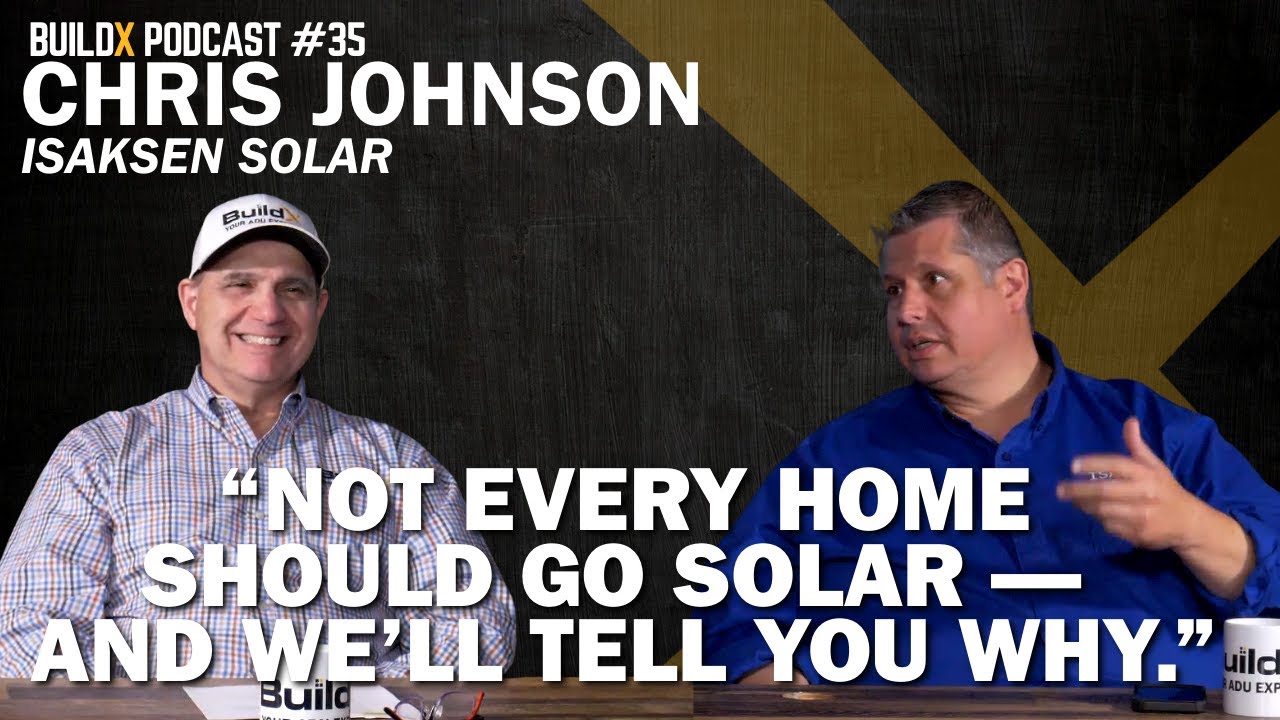
Watch: How Solar Really Works for Builders, Homeowners, and ADUs | BuildX Podcast #35
Solar is usually at the bottom of the budget when it comes to priorities. It's the decision that families think about and decide to come back to later, after the foundation is poured, after the framing is up, after they can finally see what's left. That idea seems financially reasonable but it costs money in real life because by the time a homeowner is ready to talk about panels, how much solar will cost has already been determined. The roof planes are built and the walls are closed. And you haven't talked to the utility yet.
My name is Buz Artiano, and I am the founder of BuildX. We've built dozens of ADU projects across Massachusetts, mostly around the South Shore and Plymouth County areas. We are the only team you need: we do the design, permitting, and construction. So we see every phase of a project from the first site visit up until you move in. We evaluate septic constraints, zoning issues, utility connections and the requirements for a permit from the city. There's a construction schedule that every trade has to fit into and that includes the solar. The families who get it right are those who think of it that way from the very first. Massachusetts allows one accessory dwelling unit by right in single family zoning areas, although municipal building code, health code, and dimensional requirements still apply to every project. You can review the state requirements at mass.gov.
The deadline for an ADU solar project isn't the utility's and it's not the installer's either. It's when the insulation crew shows up at your ADU, because everything solar requires from a construction standpoint must be inside before the insulation is put in. There are three things that make up that deadline and when they get out of order there will be costs after the build is finished.
Quick Answer: Bring the solar installer in during design, before the ADU plan is final. Going backward from an install, the review of your design takes three to five days, utility approval takes about four to six weeks, and the wait for the installation can be up to three to four months from the date you apply. Those are one installer's own estimates. The construction deadline is tighter than all of them. Conduit must be pre-run when the building is watertight and before the insulation goes in, because after that the way to is either to be surface-mounted or cut back into finished walls.
In This Article
When Does the Solar Installer Actually Need to Be in the Room?
At the design stage, before the ADU plan is final. Not after the foundation, not after framing, and not during the last review of the budget. The first working meeting you have with a solar installer will be a review of the plan, and the only things they need from you are the set of drawings and the plot plan, which is the survey drawing showing the size of the ADU, the lot lines, and the setbacks.
That first step is quick and it doesn't cost anything, which is why it's sometimes skipped. There isn't a contract yet and no deposit's been made. Chris Johnson, Director of Business Development at Isaacson Solar, talked to us on the podcast and described his company's initial meeting the same way we do it from the builder's side: they ask for the design and the plot plan at once, and the sooner it gets there, the better the answer. The meeting doesn't need anyone to drive anywhere either. We have held these as a video call with the homeowner, the installer, and our project manager.
What this gives is a plan for the solar on an ADU that isn't built yet and that's the whole value of doing it now. Once the ADU is built, the roof planes are fixed and every decision after that is a workaround. We have said this to families more than once: we don't want to build the ADU and then call the solar company, only to be told that a different positioning would have made more power for the same money.
What Does the Solar Calendar Actually Look Like?
Three separate timings are involved in an ADU solar project and they don't all start at once. The first is when the installer does a design review of your plan. The second is utility approval, which is the utility deciding if the equipment on your street can have power flowing back into it. The third is the install line, which is the wait for an available crew. A fourth thing is the solar permit and that is at the same time as the utility review instead of after it.
The figures below are Isaacson Solar's own numbers given to us when we spoke. They're not the industry average. Every installer has a different schedule and every utility territory has its own backlog, so think of these as an outline of a calendar rather than as your calendar and then make sure you get your installer's information in writing.
| Step | How long it runs | When the clock starts |
|---|---|---|
| Design review of your plan and plot plan | Three to five days | As soon as there's a drawing |
| Utility approval | About four to six weeks | After the system design is set |
| Solar permit | Alongside the utility review | Filed at the same time, not after |
| Install slot | About three to four months | The date you apply, not the date you're approved |
The last row is the one that surprises families. The install line is measured from the application date, not from the approval date. That makes the application date the only date you can control, and it's the reason the discussion about solar needs to happen in the design phase instead of a closing budget meeting. Seasonal demand can tighten the queue more because installers know there will be the same annual rush at the same time each year and the same size crews will have to handle it.
Why Does the Conduit Have to Go In Before the Insulation?
Conduit is the empty pipe the solar wiring travels through later. Nobody does solar wire during framing. What does go in during construction is the pathway, going from the electrical panel up through the building to the attic, so that when the panels get there the wire has somewhere to go that's not on the outside of the ADU.
The opportunity opens the day the building is watertight, which is the milestone when the roof, the windows, and the exterior doors are all installed and the shell is dry inside. The opportunity closes when the insulation crew gets there. On a small ADU those two dates aren't very far apart.
Here's what makes the timing unforgiving instead of just an inconvenience. The conduit itself isn't difficult or expensive. It's a path made from the panel up through the inside wall cavity to the attic. It needs to sit above the insulation so the path stays accessible instead of buried. In our order of things, it goes in with the electrical rough, the stage where the electrician sets boxes and pulls wire through open framing before anything gets covered. With the walls open it is a short project, but with the walls closed it's demolition. We put it on the electrical rough checklist for the same reason we put blocks behind bathroom walls for grab bars that no one has ordered yet. The cheapest future job is the one you left a way to accomplish.
The case of failure is well documented and not unusual. Chris said that stubs were left in place and then covered when the insulation went in, spray foamed over before anyone could come back to connect them. Once closed-cell foam covers a stub, you have to open up the assembly to find it.
The Cost of Waiting Until the Building Is Finished
Late solar shows. When the pathway doesn't exist inside the building itself then the wire has to go on the outside and installers say that 'afterthought solar' is visibly worse for just this reason. Conduit on an outside wall is obvious. It's at an elevation you see every day and matching the paint won't hide it.
The construction cost is the other half of it. If you have to cut a path back into a finished building, it means you have to open the drywall, run the solar, and patch, prime, and repaint. And you are doing all that inside an ADU that's either occupied or ready for someone to move in. That work won't cost the same as the price of doing it during the electrical rough. It also comes at the worst possible financial moment, after the ADU is finished and after the family has stopped paying for the construction.
The cost to the schedule can be even more. Because the waiting time is measured from the date of the application, a family that starts the solar process at the end of the construction might have months of waiting on a finished, occupied ADU. The building works and the lights are but the roof sits empty during a season it could have been generating electricity. The panels were not the slow part, the paperwork and waiting time were.
Who Runs the Conduit, Our Team or the Solar Company?
Either one will work. Chris said this: it's up to the builder. Some builders take care of the electrical themselves and pre-run the conduit. Others have the installer do it and schedule that to work on the build.
We handle it on our projects because it's inside an electrical rough that we're already scheduling and inspecting. That adds it to the checklist that our electrician is already working on. Who makes the decision before the framing starts matters more than who does the work. Three things are decided at the design meeting:
- Where the conduit starts, meaning the panel location
- Where it terminates on the roof plane
- Who does the work, and when is it scheduled during construction
If your builder can't answer those three questions, the conduit isn't on the schedule.
When Solar Is Not the Right Call on This Build
We coordinate solar on ADU projects, so you expect us to encourage you to get solar panels. We build plenty of ADUs without solar, and for some of the families that's the correct outcome.
The honest version of our advice is not to buy solar. It's to decide during design, and even if the answer is not yet, build the pathway anyway. A pre-run conduit on an ADU that doesn't get panels is not an expensive item on a construction budget. A finished ADU with no pathway is a renovation. Those two are not close to the same, which is why our actual recommendation is about the pathway instead of the purchase.
There are also families who shouldn't deal with solar at all during the construction. If the ADU has to be finished by a fixed date, if a parent's moving in on a schedule that can't be changed, then adding a utility review and an outside install crew to the construction has a coordination risk for a benefit you can still get later at a higher price. We've told families to skip it. Put the conduit in, move your family into the ADU and put panels on the roof next year.
When Should You Start the Solar Conversation on Your Own Build?
The answer comes earlier than it feels like it should. Solar on a new ADU isn't a budget decision that can wait until the end of the project. It's a design decision with a construction deadline and the deadline's the day your walls get filled with insulation.
If you're planning an ADU and solar is anywhere on your list, make sure you talk about it at the design meeting. Find out when the building will be watertight, ask when insulation is scheduled, and get the conduit onto the electrical checklist. If you decide against panels later you've lost almost nothing. If you choose panels, you've kept every option open.
We'll put the solar install on your actual construction schedule, set the conduit run before the insulation goes in, and get the installer into the design before your plan is unable to be changed.
See a finished ADU in person or Request a Free Consultation
Call us: (781) 627-7000