
Can You Build an ADU Without a Monthly Mortgage Payment?
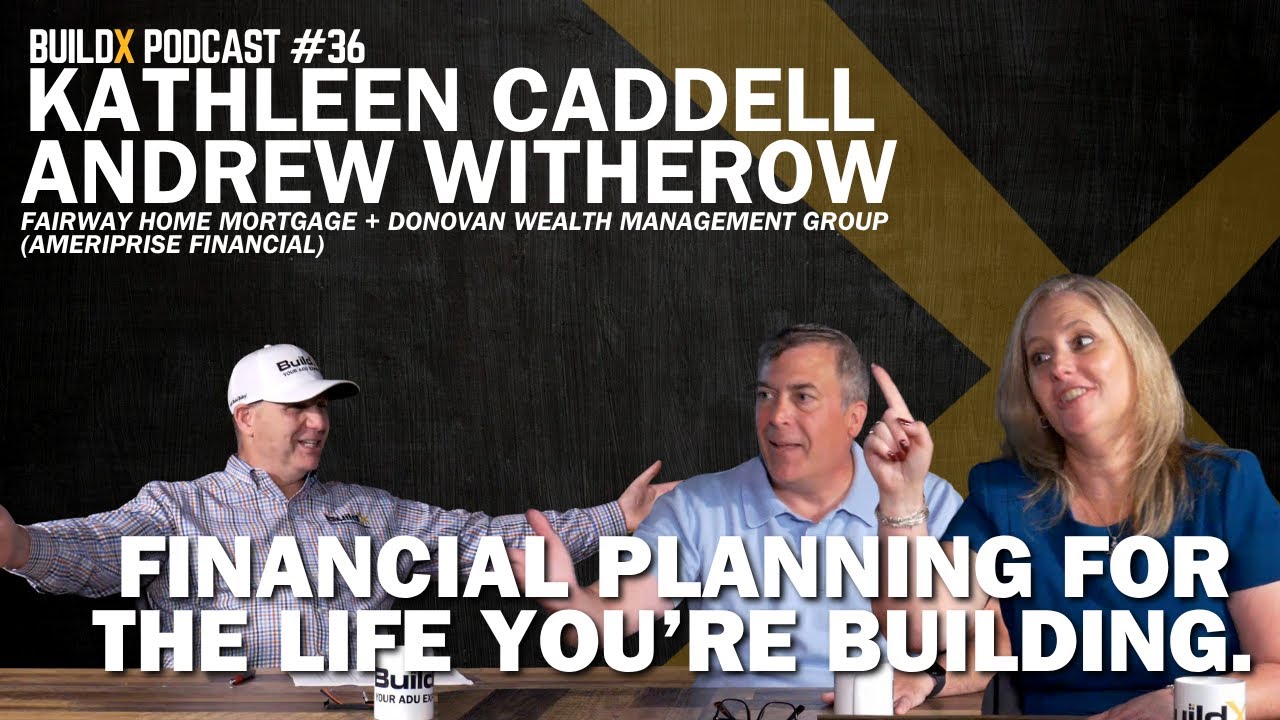
Watch: The Wealth Strategy Every Homeowner Needs to Hear: Mortgages & Finance Planning | BuildX Podcast #36
You've always been told that building something means borrowing money and making a monthly payment on it until it's paid off. So when you start thinking about adding an ADU to your property, the first thing you think about is how you can afford a monthly payment on your fixed income? If your Social Security and pension are barely enough to cover your expenses, having to make another payment every month on a construction loan isn't possible. Because of this exact worry thousands of people in Massachusetts will not even call a builder to ask questions.
My name is Buz Artiano, the founder and CEO of BuildX, and we have built dozens of ADUs in the state of Massachusetts, mostly around the South Shore and Plymouth County. We do the design, permitting, and construction all in one place, which means we will help with septic evaluations, lot coverage constraints, and all the permit requirements before we ever give you a price quote. About half of the families we talk to are parents or grandparents with fixed incomes. They want to downsize to an ADU or move someone in their family closer to them. But almost everyone that we talk to asks about the amount of the monthly payment.
So we have someone working with us who is a senior mortgage consultant with more than 21 years of HECM experience and has also been a financial advisor for 24 years. He can explain how you can actually build an ADU without having to make a monthly mortgage payment. You will see how the whole thing works, what it will actually cost, what the laws are, and an actual example that shows how it affected one of our clients. All we want to do is make sure you know if this financing option is something you should look into.
Quick Answer: Yes. A Home Equity Conversion Mortgage (HECM) will let someone 62 and older pay for their ADU construction with no monthly mortgage payments for life. You only have to pay off the loan when you move out of the house. But you have to keep paying property taxes, homeowners insurance, and maintaining the property. Closing costs are about 3 percent of the home's current value, including a 2 percent federal insurance premium. The HECM is insured by the Federal government through HUD, and that means that the government guarantees you will not be forced to sell or make payments on the ADU no matter what the market is.
In This Article
- Can You Really Build an ADU and Never Make a Mortgage Payment?
- How Does a HECM Work for ADU Construction?
- What Does It Cost to Open a HECM?
- What Does This Look Like in a Real Scenario?
- Do I Qualify for a HECM?
- What Are the Risks and Downsides of Using a HECM for an ADU?
- Is a HECM the Right Financing Choice for Every ADU Project?
- Your Fixed Income Does Not Have to Be the Barrier
Can You Really Build an ADU and Never Make a Mortgage Payment?
Yes. A Home Equity Conversion Mortgage, known as a HECM (pronounced "heckum"), is a federally insured reverse mortgage available to homeowners aged 62 and older. The critical distinction between a HECM and a traditional mortgage is that no monthly principal or interest payments are required for the life of the loan. The loan becomes due only when the last borrower permanently leaves the home, whether through sale, moving, or passing.
The federal government backs this through HUD. One of our experienced mortgage professionals explained that the U.S. government guarantees that no matter what happens to the economy, to home values, or to you financially. They can never force you to sell your home or require you to make payments for the rest of your life. That guarantee extends to your spouse as well, as long as they are on the loan with you.
But there are three things you have to always do. You have to keep paying your property taxes and your homeowners insurance. And you have to keep the property in good condition. As long as you do those three things, you can stay in your home with zero mortgage payments for life. HUD outlines the full HECM program requirements at hud.gov.
How Does a HECM Work for ADU Construction?
A HECM converts part of your equity into money that you can use, but without requiring monthly repayment. The amount you can get is called the principal limit, and it's calculated using three things: your age, your spouse's age, and the current value of your home. At 65, a homeowner can usually get 30 to 40 percent of their home's equity through a HECM.
For ADU construction, there are multiple ways you can get the money. You can take a lump sum at closing and use that money to pay for the ADU. You can also establish a line of credit that your builder pulls money from as construction moves forward. Or you can combine the two and take a lump of cash upfront for construction and leave the rest in a line of credit for later. The line of credit is a really cool feature of a HECM because it grows over time at the loan's interest rate plus half a percentage point, even if you never use it.
Here's what that looks like in real life. If you open a HECM at age 65 with a $200,000 line of credit and don't pull any money from it for 20 years, the available balance can get up to $1,000,000 or more at the current rates. Nope, it's not a typo. The growth rate compounds because it goes right along with the loan's interest rate, and the older you get, the more equity you can use. That's why most mortgage professionals will recommend that you open a HECM when you're 62, even if you don't think you're going to build anything for several years. The earlier you start, the more the available balance grows, and the more money you have available when you need it.
What Does It Cost to Open a HECM?
The HECM isn't free, you have to understand the upfront cost so you can decide whether it makes financial sense for your situation. There's two parts to the closing costs.
First, there's a federal insurance premium of 2 percent of your home's current appraised value. You pay that to HUD, not to the bank or the mortgage company. It's what pays for that federal guarantee. That guarantee protects you from ever being forced to sell your house or make payments. On a $600,000 home, you would have to pay $12,000.
Second, there are basic closing costs that are similar to any mortgage. They include things like appraisal, title insurance, recording fees, and origination charges. That adds about another 1 percent, which means your total closing costs would be about 3 percent of the home's value. On that same $600,000 home, you are looking at around $15,000 to $18,000 in closing costs.
Here's the part that surprises a lot of people. Those closing costs can be financed into the HECM itself. You don't have to pay for them out of pocket. The lender just subtracts the closing costs from your equity, and your loan balance starts at that amount. So on the $600,000 home, your initial loan balance is approximately $12,000 to $15,000, and you have no monthly payment.
We evaluate all the possible financing options before we quote an ADU project. When someone is on a fixed income, the first thing we do is connect them with a HECM specialist and a financial planner before we even start looking at floor plans. We've seen families commit to a construction timeline before they really even know what their financing options are, and that creates pressure that benefits no one. The 3 percent closing cost is a real number, and on a property worth $500,000 to $700,000, that's $15,000 to $21,000. But it's a lot better than a traditional mortgage that comes with monthly payments of $1,300 or more for 15 to 30 years. If you do the math, the HECM is a great option for homeowners over 62 who plan to stay in their home.
What Does This Look Like in a Real Scenario?
We'll give you some actual numbers, they're very convincing. Here's a real scenario from a Massachusetts homeowner that will show you how the HECM gets rid of the monthly payment issue.
A woman in her early seventies was still working full-time just so she could pay her mortgage. She owned a home that was worth about $636,000 with about $70,000 left on her mortgage. Her monthly payment was $1,300, which took up almost two-thirds of her income. She thought about selling the house and downsizing, but she loved her home and she didn't want to move. She also looked at some condos, but between the sale prices and HOA fees, downsizing was actually more expensive.
Her financial advisor and mortgage person put together a HECM that did three things for her. First, the HECM paid off her existing $70,000 mortgage, which got rid of the $1,300 monthly payment right off the bat. Then, she received $30,000 in cash at closing for some much needed renovations and maintenance. Third, she got a line of credit for approximately $100,000 that will grow at 7.125 percent every year so she can use it later if she needs to.
The financial stress that was taken off of her made a huge difference. It was transformative. She went from spending two-thirds of her income on housing to having no mortgage payment at all. She has an extra $1,300 in cash every month now, and she got $30,000 to fix up the house immediately. And remember, she also now has a growing line of credit to keep as a safety net. She stopped working just after closing because she didn't need the income to cover her mortgage anymore. Her financial advisor said that the HECM let her have real choices for the first time in years.
Do I Qualify for a HECM?
The HECM is a federally regulated loan with very specific requirements. You need to understand whether you qualify before assuming it will be an option for your ADU.
The basic requirements are pretty simple. You must be at least 62 years old and the property has to be your primary residence. You also have to have a significant amount of equity in the home, usually at least 50 percent, but the exact amount depends on how old you are and what the current interest rates are. If you already have a mortgage, the HECM has to be enough to pay it off, because you can't have two mortgages on the same property at the same time.
The other good thing is that you won't be looked at financially under a microscope. The lender will verify that you can keep paying your property taxes and homeowners insurance and look at your credit history, but the HECM doesn't have the same credit score requirements as a regular mortgage. And all borrowers are required to complete a HUD-approved counseling session before closing. The counseling session is to make sure you understand how the loan works, what it costs, and what it means for you long-term before you commit.
If your spouse is under 62, they can still be protected. Current HECM rules allow a spouse who isn't on the loan to stay in the house after the other passes, as long as they meet certain conditions. This is an important detail for couples where one person is 62 or above and the other isn't.
What Are the Risks and Downsides of Using a HECM for an ADU?
There's no financing options that are perfect, and the HECM is no exception. You have to understand the downsides as well as the upsides, especially when you're making a decision that affects your family's largest asset.
A HECM is actually a little different than a normal loan. You don't make monthly payments, interest just gets added to your balance. So after a while, the amount you have to pay back grows a lot. So, if you take out a HECM when you're 65 and you stay in your home until you're 90, you're going to owe a lot more than you originally borrowed. Basically, you don't have monthly payments now, but the amount you owe gets bigger later.
The upfront costs are higher than a regular mortgage. Between the 2 percent federal insurance premium and normal closing costs, you're paying around 3 percent of your home's value before you even get access to any of your equity. On a $600,000 home, that comes out to about $18,000. Those costs are real, even if you roll them into the loan.
The loan has to be paid off when the last borrower leaves the home for more than 12 months. That's important for families who are planning long-term care. If you go into a nursing facility and don't go home within 12 months, you have to pay back the loan. But the clock resets if you go home even for a short time, so that gives you some flexibility if you ever go back and forth between home and rehab facilities.
The last thing is, the HECM cuts into the equity your children will inherit. When the loan is due, your kids have options though. They can pay off the balance and keep the property, refinance into their own mortgage, or sell the home. If the home's value is less than the loan balance, the federal insurance covers the difference. Your kids can never be stuck owing more than the home is worth. But the equity left for them will be less if you take out a HECM.
Is a HECM the Right Financing Choice for Every ADU Project?
No. We work with HECM-financed ADU projects all the time, and we can tell you that it's definitely not the right thing to do for every family. If you're under 62, the HECM isn't even available to you. If you think you might sell the house in the next five to seven years, the upfront costs may not be worth the short-term benefit. If you have savings of more than $200,000 and can pay for the ADU with cash or a traditional loan without it having an effect on your monthly bills, then getting a HECM makes things unnecessarily complicated.
The HECM makes the most financial sense for homeowners who have a lot of equity but not a lot of cash reserves. If you own your home outright or have quite a bit of equity, and you're on a fixed income, and you can't afford a monthly mortgage payment, the HECM gets rid of that issue so you are still able to build. It's a specific solution for a specific situation, it's not recommended for everyone.
We always recommend working with a qualified HECM specialist and an independent financial planner before making any decisions about this. The mortgage consultant checks your eligibility and sets up the loan. The financial planner helps you decide whether the HECM is the right call for your specific situation by evaluating tax implications, estate planning, and long-term care considerations. We connect our clients with both because believe it or not, getting the financing wrong is more expensive than getting the construction wrong.
Your Fixed Income Does Not Have to Be the Barrier
The monthly payment question is the first thing most fixed-income homeowners ask, and it can stop everything from moving forward. The HECM can be a solution to this problem so you can build an ADU, get rid of your mortgage payment, and never have to make one again. It has real costs and real pros and cons, and it's not for everyone. But for people who are over 62 and have a lot of equity in their home and limited monthly cash flow, it gets rid of the biggest obstacle between where you are now and the ADU your family needs.
We will connect you with a HECM specialist and a financial planner, evaluate your property's ADU feasibility, and give you a clear picture of what construction would cost before you commit to anything.
Tour a completed ADU to see the finished product | Request a Free Consultation
Call us: (781) 627-7000