
Can You Build an ADU in Your Own Backyard and Move Into It Yourself?
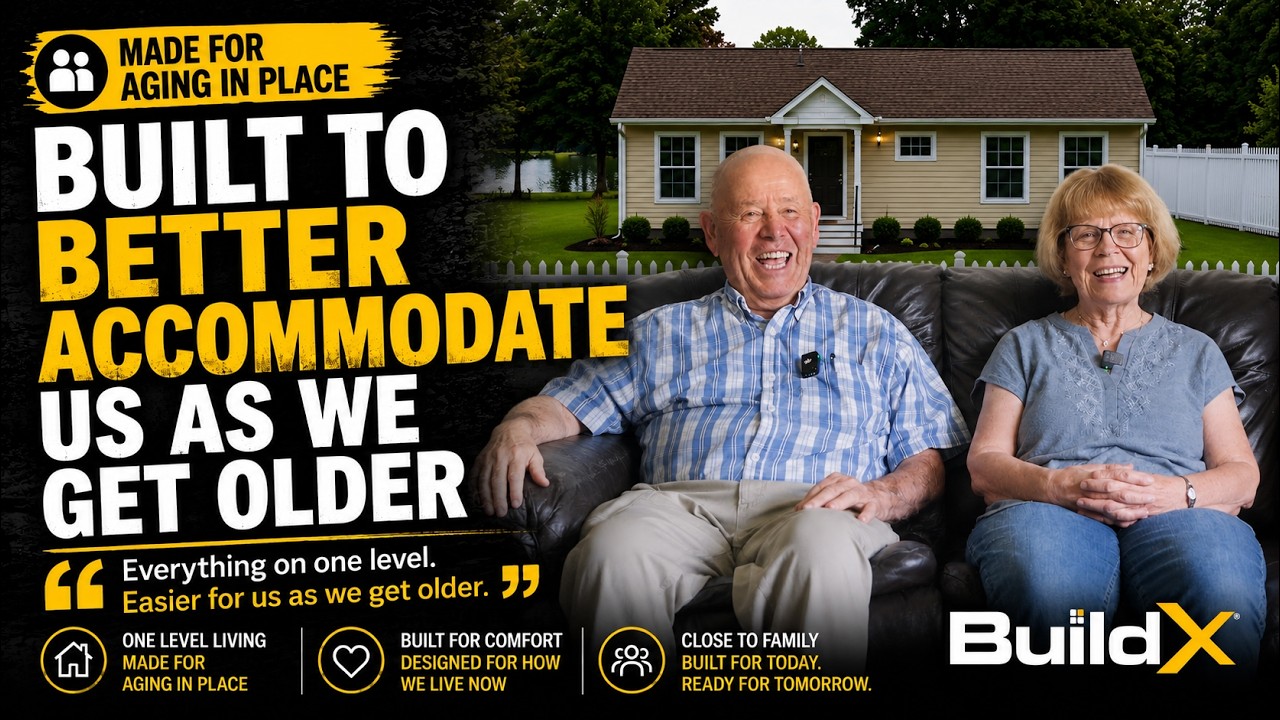
Watch: How Peg and Jim Duggan Are Staying in the Home They've Loved for 42 Years
A lot of conversations about downsizing into a smaller home start with the same things. Someone runs comps on the house, they see a great listing on a condo a couple towns over. The stairs have gotten harder with age, and the yard has gotten more difficult to maintain. And of course moving to a smaller home means a different address. For someone who has spent 40 years on the same property, moving can be really scary. The house is too big to manage. The property is not.
My name is Buz Artiano, founder of BuildX. We've built dozens of ADUs all over Massachusetts, but most of our jobs have been on the South Shore and in Plymouth County. We've got finished homes in Pembroke and Marshfield that other homeowners have walked through before deciding what to do with their own land. We handle everything, that means design, permitting, and construction. So we've been the ones to deal with the building department when a lot raises questions about setbacks, septic capacity, or lot coverage. That order is actually pretty important. What you can build on your property gets decided by what the land allows, after that you can decide what you want.
Peg and Jim Duggan are BuildX clients. We are building their 900-square-foot ADU in Rockland, on the lot they've owned for 42 years, and they are the ones who will be living in it. Jim said that their lot is "One of the best lots on this pond out here." Peg simply said they just don't want to go anywhere else.
Now of course a builder would want to share the stories of families who had a good experience with them. We are sharing the Duggans' story specifically because of how they found us. Someone they know mentioned an open house for an ADU in Pembroke, so Peg went to see it. Then she went to see a finished house in Marshfield and ended up talking with the homeowner who had built it. Peg decided that's what she wanted to do while she was there at the house, before she ever set foot in our office or even spoke with us.
Quick Answer: Yes. Massachusetts homeowners can build an accessory dwelling unit on land they already own and live in the new unit themselves. State law does not require the owner to occupy either the ADU or the main house, so you can live in either one. Peg and Jim Duggan are doing exactly that in Rockland, trading a house of 42 years for a 900-square-foot, single-level home on the same lot. The limits on building an ADU are not personal, they are decided by setbacks, septic capacity, and lot coverage. The size cap decides whether your property supports a second unit.
In This Article
- Can You Legally Move Into the ADU Instead of the Main House?
- What Do You Keep by Staying on the Lot You Already Own?
- The Single-Level Argument for Building Small After Four Decades in One House
- How Does Building and Staying Compare With Selling and Moving?
- How Much House Do You Actually Get in 900 Square Feet?
- When Selling Is the Better Decision
- What Would It Take to Stay Where You Already Are?
Can You Legally Move Into the ADU Instead of the Main House?
Yes. Under the Affordable Homes Act, a protected-use ADU is a self-contained second home on the same lot as the main home, and the law doesn't require owner occupancy of either one. The law does not assign you to the larger building. You can review the state's current ADU requirements at mass.gov.
What happens is the lot ends up having two homes rather than one. The law says you can have one ADU per single-family lot, and the main house has to remain a dwelling. Who occupies it is up to you. Building code, health code, setbacks, and the town's dimensional requirements still apply in addition to what the state needs. So it depends on your property, not the law, whether you can build an ADU and live in it on your property.
Jim Duggan describes the plan in very simple terms. "I'm Jim, I live in Rockland. Building an ADU for us, so that we could live in it."
What Do You Keep by Staying on the Lot You Already Own?
A sale changes the house and the land into one. The house can be replaced, but the land and the location can't. When you've lived 42 years in one place it teaches you things that nobody else will know if you decide to move. Like how the driveway slopes in the winter, which one of the neighbors has a generator, a pharmacist that knows you by name and the cost of having a view of the water. Peg Duggan said this: "We don't want to go anywhere else. We love it here, we've been here for 42 years. And now we have the opportunity."
There are practical reasons as well as personal ones. In our area, a single-story house on a manageable lot is a very difficult thing to find, which is the reason so many people have to compromise on what they really want. The right size home in the wrong town, or the right town in a building with a shared hallway. If you build on land you already own that will eliminate the whole location and search issue in one decision.
The Single-Level Argument for Building Small After Four Decades in One House
Jim Duggan described what will change with an ADU. "It means that everything will be on one level. And smaller, so it will be a lot easier for us as we get older." All of that relates back to the maintenance on the house. With an ADU you only have one floor to heat and clean. Laundry doesn't have to go up and down stairs. A roof, a driveway, and a heating bill sized for two people rather than for the house they bought four decades ago when they weren't the only ones living there.
We design ADUs differently when they will be lived in by the owner, not rented out or used as a guest house. When the owners are the ones living there and they plan on staying there for a very long time, we make sure the floor is as close to grade so there's no step coming into the front door. We make the hallway between the bedroom and the bathroom 42 inches wide instead of the standard 36 inches. That's because we know that a walker and a wheelchair will fit through it. We put the main bathroom on the same wall as the bedroom so that there's less plumbing and it's a shorter walk to the bathroom. And we add special wood blocking inside the bathroom walls so that grab bars can be added later and they will be very secure. Doing that only takes about an hour as long as we do it before we put the sheetrock up. Adding it afterward means tearing up a finished wall and then having to repair it afterwards. That's the difference between just building a small house and designing a home that will accommodate the people who live there as they age.
How Does Building and Staying Compare With Selling and Moving?
Either way you end up in a smaller, easier to manage home. They're different because of what you have to give up to get there. You don't see the difference in the sale price. We made a chart so you can easily compare the things that we talk about with couples weighing their options. It is a series of decisions, not just a cost estimate, because every property is different.
| Decision Factor | Selling and Moving | Building and Staying |
|---|---|---|
| What happens to the land | It goes to whoever buys the property | You keep it |
| Where you end up | Wherever there happens to be availability | The lot you already know as home |
| Who controls the layout | The previous owner | You control the design |
| What sets the timeline | Markets and the bank mostly | Permitting and the construction schedule |
| What remains on the property | Nothing you own | A second home that you keep and have as an asset |
| The main risk | Moving to a place you aren't familiar with | The lot might not be able to support a second unit |
The last row is the one that can stop the process. Selling can have risks you find out about later, like what it's like to live in a certain place in the winter. We tell you clearly the risks of building in the beginning of the process, when we inspect the property and look at where the septic system is, how much of the lot is already covered, and where the setbacks will put a second building. When you build, you can get the answers before you've spent a lot of money and that's why you need to be asking questions early instead of guessing.
How Much House Do You Actually Get in 900 Square Feet?
Peg Duggan's answer on size is this: "Right, 900 square foot." That's the largest ADU under the state's by-right protection, and it can look different on every lot. A protected-use ADU cannot exceed 900 square feet or half the gross floor area of the principal dwelling, whichever is smaller. A 1,600-square-foot main house would let you build an 800-square-foot ADU. Each town can decide to allow more than that, but they can't limit the size to less than that. You can read all the details at mass.gov.
Nine hundred square feet on one level can comfortably fit two bedrooms, or one bedroom plus an extra room with a different purpose, along with a full kitchen, laundry, and one or two bathrooms. If you compare that to a house where two people have been cleaning and maintaining rooms that hardly ever get used, even though total square footage is less, the usable square footage actually goes up.
When Selling Is the Better Decision
We build ADUs for a living, so you would expect us to argue that building beats selling every time. But the truth is that it doesn't. Three situations when building an ADU may not be the right move, and we'll tell you that before anyone signs a design agreement.
- If you want out of property ownership entirely, an ADU doesn't do that, you stay an owner, with a roof, a septic system, a driveway to maintain and a tax bill attached to your name.
- If you need to turn the equity in your home into cash, building an ADU turns your equity into another structure, not cash, which is not the right move for a family that needs the money for other things.
- If the lot can't support a second unit because of septic capacity, wetlands, setbacks, or lot coverage limits, then you have no choice in the matter, and we make sure you know that upfront before you pay us anything.
There's actually one more thing, and no amount of good design solves it. If you want to leave the neighborhood rather than the house, building an ADU would not be an advantage. An ADU is worth it when the place is the part you are trying to hold onto.
What Would It Take to Stay Where You Already Are?
The decision is smaller than you might think. It comes down to whether the thing you want to keep is the house or the land. For anyone who has been in one place for four decades, they usually are attached to the land, not the building.
Peg Duggan said it in one sentence: "And we have the opportunity to stay here. So building this home will enable us to do that." If you want to know whether your property gives you the same opportunity, you need answers about the property itself. Things like the setbacks, the septic, and what the lot coverage leaves you. That can all be figured out in one day, no need to take a gamble on anything.
We will walk your property, check what your setbacks, septic capacity, and lot coverage allow, and show you what a single-level ADU looks like on your land before you commit to anything.
Walk through a completed ADU or Request a Free Consultation
Call us: (781) 627-7000