
Is Building an ADU Cheaper Than Buying a House?
Watch: He Built an ADU in MA During This Housing Crisis, Here's Why He Chose BuildX
If you're a parent with an adult child that's struggling to find an affordable home in Massachusetts, or a young adult looking at $600,000 listings for a basic two-bedroom, you already know the cost doesn't work. Rent keeps going up and getting the money for a down payment seems impossible. And the idea of owning anything looks less likely every year. The question that families across the state keep asking is this: is there a cheaper way to get a real home without moving away from family?
My name is Buz Artiano, and I am the founder of BuildX. We've built dozens of ADU projects across Massachusetts, mostly around the South Shore and Plymouth County areas. We are the only team you need: we do the design, permitting, and construction. So we see every phase of a project from the first site visit up until you move in. We evaluate septic constraints, zoning issues, utility connections and the requirement to get a permit from the city. The question of cost is one we hear all the time, because the families that we deal with are comparing real costs, not wishful thinking.
The honest answer is that building an ADU isn't always cheaper than buying a house, but for the right family on the right property, it can save hundreds of thousands of dollars in the costs of housing and keep the family together. This article will give you real numbers, the things that can change the price and the tradeoffs you need to know about before you decide which way makes sense for your situation.
Quick Answer: In most cases, yes. Massachusetts homes regularly sell for $500,000 to over $1,000,000, while a completed ADU on family land usually costs between $250,000 and $400,000, including the site work, septic, and finishes. An ADU doesn't give you traditional equity the same way a standalone home does, and you have to have land you already own or have access to. But for families looking at monthly housing costs, closeness, and long-term flexibility, the cost is usually cheaper for an ADU.
In This Article
- Is an ADU Actually Cheaper Than Buying a Home in Massachusetts?
- What Drives ADU Costs Up or Down?
- What Does Buying a Home in Massachusetts Actually Cost?
- What Are the Real Tradeoffs of Building Instead of Buying?
- Is Building an ADU the Right Choice for Every Family?
- Your Family, Your Property, Your Numbers
- What Does an ADU Cost on Your Property?
Is an ADU Actually Cheaper Than Buying a Home in Massachusetts?
For most families that we work with, the total cost of a completed ADU is $250,000 and $400,000. That includes the site preparation, foundation, framing, full mechanical systems, septic work, interior finishes, and the permits. A comparable home that stands alone in the same town with two bedrooms, kitchen, bathroom and living room, normally will sell for $500,000 to over $1,000,000.
There is a cost difference but it comes with conditions. An ADU requires land. In most cases, that means building on property your family already owns. You are not purchasing a separate lot, paying a real estate agent's commission, or competing in a bidding war. Those are savings that are substantial. But you are investing in construction which also has cost differences as well.
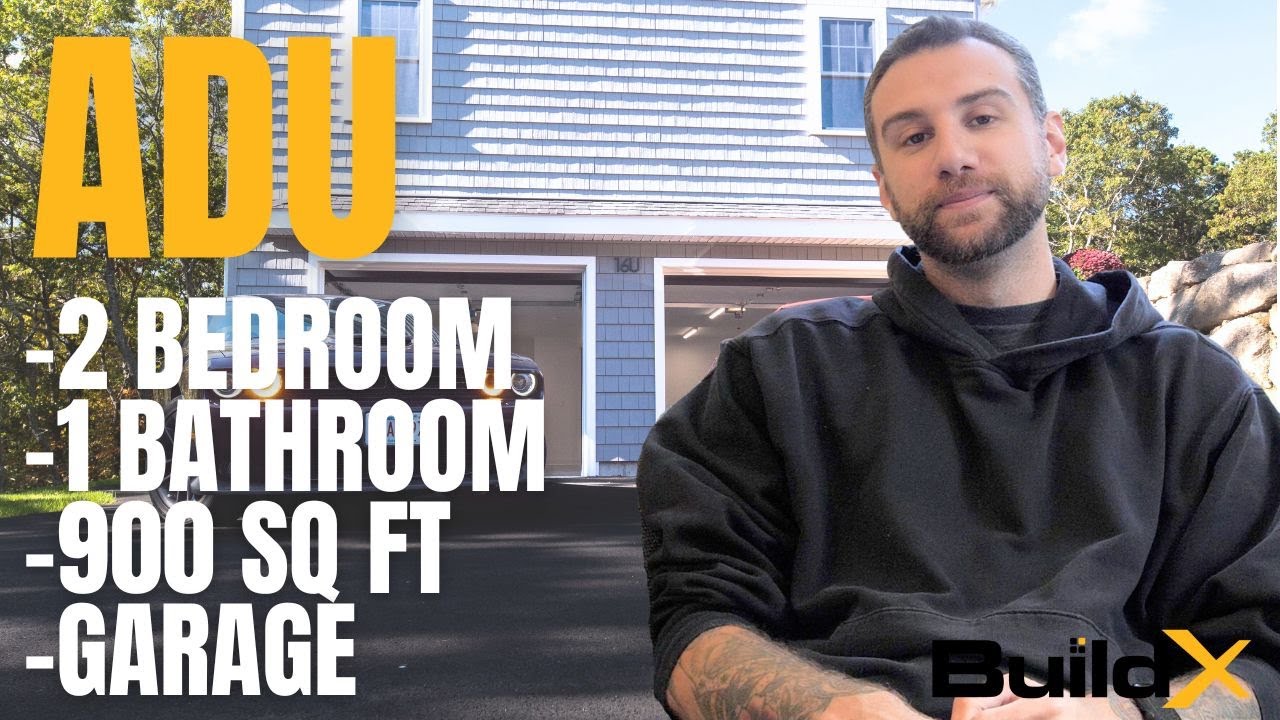
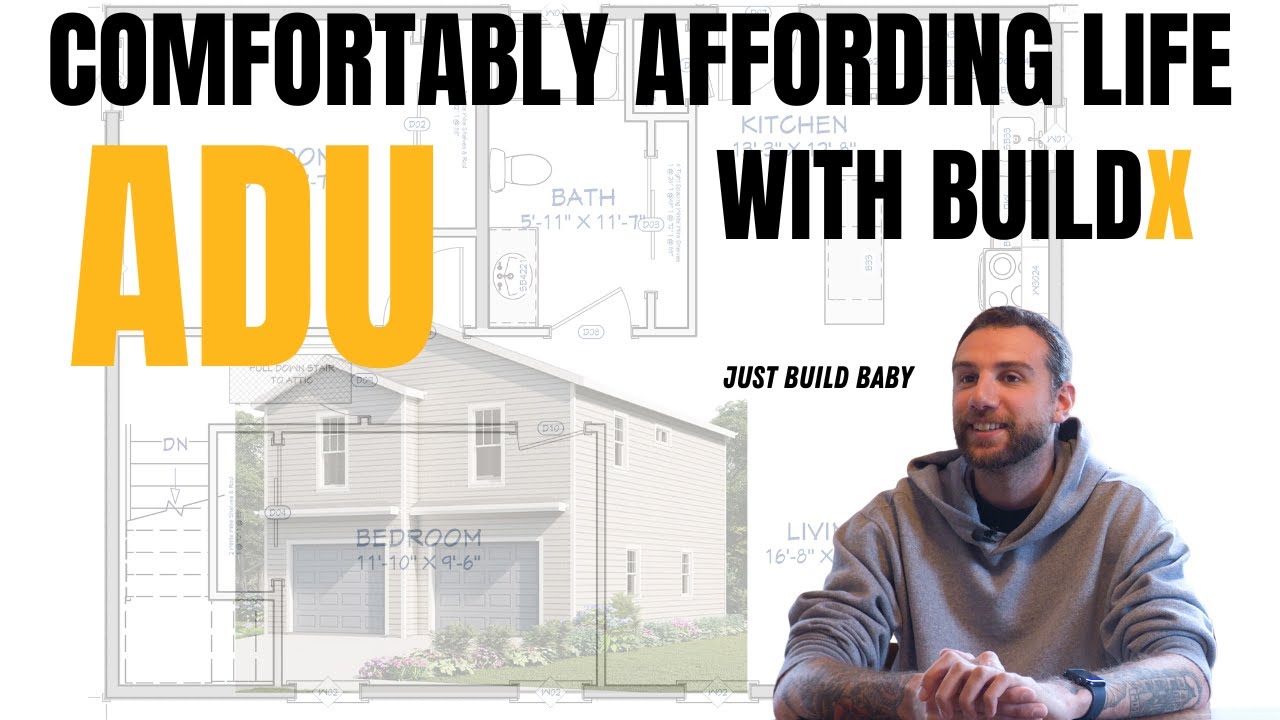
George Barber, a BuildX client in Plymouth, said this when he began looking at his options: houses in Massachusetts cost $500,000 to $1,000,000 for a simple two-bedroom, one-bathroom home, and for a lot of people, that is just not affordable. George was 28 when he and his family decided to build a 900-square-foot, two-bedroom, one-bath detached ADU with a two-car garage underneath, on his parents' property at 16U Jessica Way. He had never built anything before and he didn't even know what an ADU was until a few months before construction started.
Watch: Why We're Building an ADU Instead of Buying Another Home | BuildX Testimonial
What Drives ADU Costs Up or Down?
Three factors will decide where in the $250,000 to $400,000 range your ADU will be and understanding them from the first will prevent the kind of sticker shock that stops projects.
Septic and utilities. This is the single biggest unknown. If the septic system you have now is the original one and was put in years ago you might need a full replacement for the property to be in compliance with Title V compliance and get the necessary permit. On George's lot in Plymouth, the septic system was the original for the 30-plus-year-old house so we had to put in a brand-new tank and leaching field for both the main house and the ADU. Thankfully, Plymouth has sandy soil so the conditions were favorable but on properties where the soil is clay, or there are ledges, and difficult drainage issues, just the septic work alone can add $40,000 to $60,000 to the project. We investigate the septic before we give anyone a price quote, because that single item can determine whether a detached ADU is going to work financially on that property.
Site conditions. Hills, ledges, mature trees, drainage patterns, and access to a driveway can all affect cost. A flat, clear lot with good soil costs less to get ready than a sloped site that has to have retaining walls, lots of grading, and engineered drainage. George's lot needed a retaining wall and a separate driveway off the existing one, but the natural slope actually worked in his favor by letting us build a garage-under design that enlarged the living space above.
Size and finishes. Massachusetts lets ADUs be built up to 900 square feet by right under the Affordable Homes Act. Within that size range, the difference in cost between builder-grade basics which are standard cabinets, laminate counters, vinyl flooring, and custom things like granite countertops, stainless steel appliances, and special fixtures can raise the price by tens of thousands of dollars. George chose a granite countertop, stainless steel appliances, a custom bluish-gray cabinet set, and black accent hardware. He also had us put in a shower head at seven feet so it would work for his 6-foot-4 frame. Those are choices, not requirements, and they affect total cost. You can review the full ADU by-right requirements at mass.gov.

Watch: Behind the Build: ADU Construction Walkthrough
What Does Buying a Home in Massachusetts Actually Cost?
The purchase price on the listing is not the total cost of buying a home. Closing costs in Massachusetts are about 2% to 5% of the purchase price. So on a home that costs $600,000 that will add $12,000 to $30,000 more before you move in. Property taxes, homeowner's insurance, and private mortgage insurance (PMI, the extra monthly fee lenders charge when your down payment is less than 20% of the home's value) also add thousands every year to the cost.
Down payments are the biggest obstacle. A conventional 20% down payment on a $600,000 home is $120,000 in cash. Even if you get an FHA loan, a federal mortgage program that allows lower down payments, backed by the Federal Housing Administration, you will have to have $21,000 at 3.5% down, as well as monthly mortgage insurance premiums that will have to be paid for the life of the loan. For a 28-year-old in Plymouth, coming up with that much money while paying rent is a difficult financial problem.
An ADU built on family property gets rid of several of those costs entirely. There is no down payment on a lot you already own and there isn't a bidding war. There is no real estate agent commission that you have to pay. The financing is usually a home equity line of credit called a HELOC which is a revolving line of credit secured by the equity in the existing home against the existing property, and has lower closing costs than a traditional mortgage. The monthly payment goes toward the construction cost, not a $600,000 purchase price.
What Are the Real Tradeoffs of Building Instead of Buying?
Building an ADU is not an exact replacement for buying a traditional home and pretending it is won't help you make a good decision. Here are the tradeoffs you need to think about carefully.
Equity works differently. When you buy a standalone home, you own a separate asset that gains value by itself and can be sold on the open market. An ADU adds value to the property it is tied to but isn't a separate asset you can sell independently. If your goal is to build equity in something you can sell on its own in five years, a traditional home purchase might work for that goal better, even if it is higher priced.
You need access to land. For an ADU you have to have a lot that will qualify. If your family doesn't own property in Massachusetts, or if the property won't work for an ADU because of the size of the lot, setback issues or limitations of the septic system, the comparison doesn't work. The ADU decision only works when the land is already part of the picture.
Closeness is a feature, not a bug, but it isn't for everyone. Living 50 feet from your parents works beautifully for some families but can cause tension for other families. George Barber said that his experience was exciting, and his family situation made the arrangement natural. But that isn't always the case. Before you compare costs, be honest about whether the living arrangement itself is something your family really wants.
Construction takes time and attention. Buying a house means choosing from among homes on the market. But building an ADU means navigating design choices, getting permits, septic evaluations, and a construction timeline. We spent roughly three months with George discussing plans and budgets before actually starting the construction process. At BuildX, once we break ground, our goal is to complete the project in 100 days with all selections decided on upfront. That is faster than many new construction timelines, but it has to have active participation from the homeowner during the design phase.
Is Building an ADU the Right Choice for Every Family?
No. We build ADUs, so you should expect us to favor this solution. But the truth is, an ADU isn't the right thing for a family that needs to relocate to a different town for work, or that wants a standalone asset that can be sold on its own, or that doesn't have a suitable property to build on. If your situation needs a traditional home purchase, that's the right move, and no saving money on construction changes that.
Where an ADU works well is in a specific situation, like when a family already owns land in Massachusetts, has a housing need they can't solve at current market prices, and wants family members close. George Barber's situation is a textbook example. He was 28, unable to afford a house in Plymouth, and his family had property with room to build. The ADU gave him a two-bedroom, one-bath home with a two-car garage for a fraction of the cost of a similar standalone house. He didn't think building a house was something he would ever do. Now he lives in one.
Your Family, Your Property, Your Numbers
The question of whether an ADU is cheaper than buying a house depends on your land, your family's needs, and your property's site conditions. For many Massachusetts families, the cost gap between a $250,000 to $400,000 ADU and a $500,000 to $1,000,000 home purchase is the difference between waiting another 10 years and solving the problem now.
What Does an ADU Cost on Your Property?
We will walk your lot, evaluate your septic and utility situation, and give you a clear cost picture before you make any commitment.
See it in person: Tour a completed BuildX ADU or Request a Free Consultation
Call us: (781) 627-7000