
Why Did This Duxbury Couple Build an ADU Next to Their Grandkids Instead of Buying a Retirement Home?
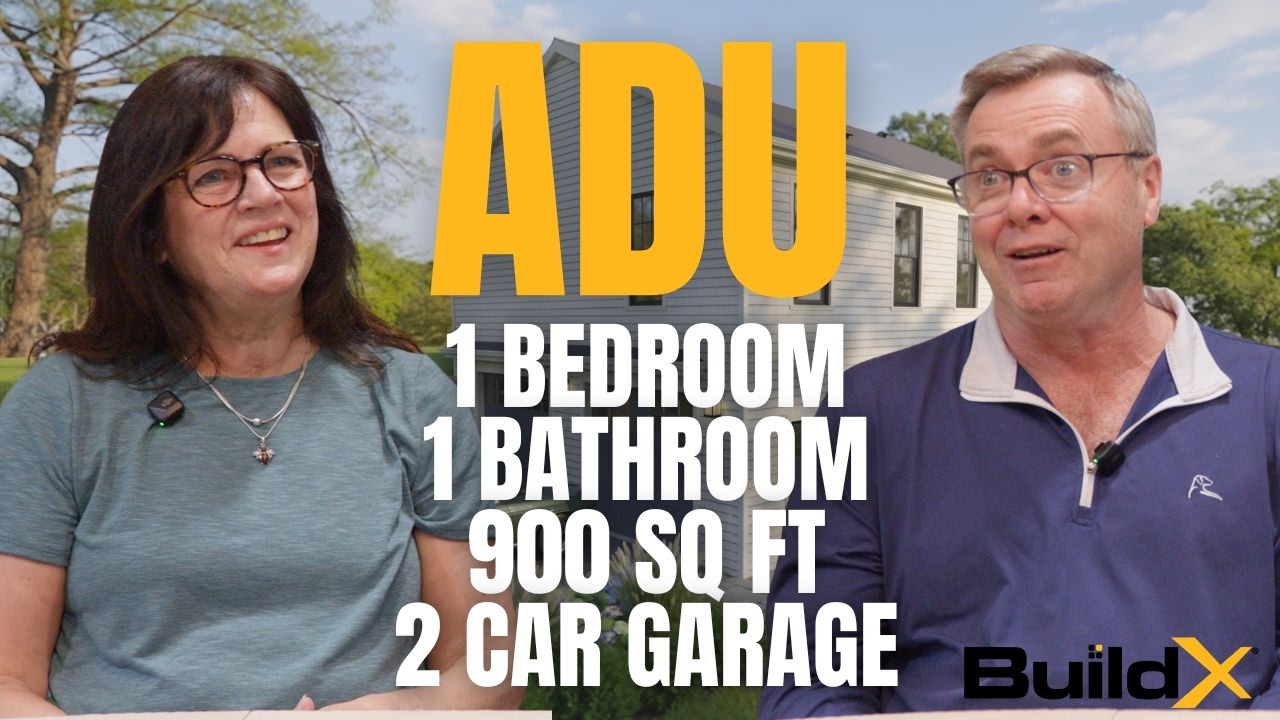
Watch: Retiring Next Door to Their Grandkids, The McCarthy Family's ADU Story
Most people think about retiring and moving somewhere else. You sell the house you raised your family in, and go somewhere smaller, maybe close to a beach or lake, and start over on your own property. For a lot of couples getting close to that decision there's a worry that goes with the excitement. If you build a house on your adult child's property instead of buying your own place, does that mean you've given up your own home? Are you handing over the equity on your own home that you spent thirty years building? These are fair questions, and they are the reason most people don't seriously consider an ADU until someone they trust shows them how it can work.
My name is Buz Artiano, and I am the founder of BuildX. We've built dozens of ADU projects across Massachusetts, mostly around the South Shore and Plymouth County areas. We are the only team you need: we do the design, permitting, and construction. So we see every phase of a project from the first site visit up until you move in. We evaluate septic constraints, zoning issues, utility connections and the requirement to get a permit from the city. After enough of these projects, you learn that the hardest part of an ADU is rarely the construction. It is helping a family get comfortable with a decision that does not look like the one their parents made.
Beth and Joe McCarthy are BuildX clients. We're building their ADU on their daughter's property in Duxbury, right off Route 44, so they can retire close to their grandchildren instead of buying a separate home on the Cape or in the Plymouth area. Beth and Joe are a retired couple who had decided to move to the coast, then changed their minds when their daughter and son-in-law moved from Hingham to a decent-sized lot in Duxbury. Their house is still in the process of being built at this time, which is one reason why their ideas are worth reading. They aren't looking back on a finished project through rose-colored glasses, they're in the middle of it.
You'd assume that a builder would share stories from families who had a good experience, and we aren't an exception. We're telling the McCarthys' story because they did their homework. They looked for competitors, compared their options online, and they chose our company for reasons they talk about in their own words. Their honest perspective on why they made this choice is more useful to you than anything we could say about ourselves.
Quick Answer: Beth and Joe McCarthy decided to build an ADU on their daughter's Duxbury instead of buying a separate retirement home so they could sell their large house, use some of their equity now and keep the rest for later. They also wanted to live next door to their grandchildren and if they build on family land it will let them stay close enough to help take care of the children while still having their own home. They found BuildX by seeing our sign off Route 44, and they kept finding us being recommended when they searched. They went ahead and got a second quote because the professionalism gave them confidence.
In This Article
- Why Would You Build on Your Child's Land Instead of Buying Your Own Retirement Home?
- Does Building on Family Land Mean Giving Up Your Home and Your Equity?
- How Did the McCarthys Choose Their Builder?
- What Happens When the Town Pushes Back on Your Plan?
- When Building on Family Land Is Not the Right Move
- Ready to See Whether an ADU Fits Your Family's Next Chapter?
Why Would You Build on Your Child's Land Instead of Buying Your Own Retirement Home?
The McCarthys began where a lot of other retirees do. Joe said: "We did think about purchasing a home maybe on the Cape or actually in the Plymouth area, so that was kind of the first conception on retirement, move towards the coast." That's the normal idea for retirees in this part of Massachusetts: sell the family home, buy something smaller near the water, and enjoy your retirement.
Two things changed this idea. Their daughter and son-in-law moved from Hingham to Duxbury and bought a decent-sized piece of property. And then Joe, who was driving down Route 44, saw our sign. Beth checked into it, and the idea changed. Rather than buying a whole separate house and having all the costs that come with that, they could build the right size home on land the family already owned.
Joe described the reasons as looking to the future. "Get rid of the larger property, utilize some of our equity, and have equity left over in order to use later in life." That's something that a lot of people miss. For the McCarthys, building on family land wasn't about not spending their savings. It was about getting the right size for their house so more of their money was available for the years ahead.
If you've been thinking of retirement as a move to the coast, and then there's a change in your own family that makes you wonder whether there's a closer option, then you are where Beth and Joe were just a few months ago.
Does Building on Family Land Mean Giving Up Your Home and Your Equity?
This is the one objection to almost every version of this decision. Building on your child's property might feel like you're moving in with them and losing your independence. For the McCarthys it wasn't that way and the reason is because of what they are actually building.
The ADU the McCarthys are building is a complete home by itself, with its own entrance, its own kitchen, and its own living space. It isn't a bedroom inside someone else's house. For Beth, that difference was the whole point: "Building right there, an ADU rather than a separate home, allows us to be right there where the kids are and the grandchildren are starting to happen along, and we'll be able to easily help them when they need help with childcare, being right there at the property."
When we design an ADU for a parent moving that will be living on an adult child's lot, privacy is a design requirement, not an afterthought. We situate the entrance away from the main house where the lot allows it, we put the living space and bedrooms so each house can have its own lifestyle. We plan outside entrances so the two homes seem like neighbors instead of just one house that has an add-on. This comes from building enough of these to know what actually makes a shared-property arrangement feel good a year later. The families who do well are those whose ADU works like a real home, close enough to help but separate enough to breathe. Making sure those things are written down correctly is what protects the relationship once everyone is living there.
On the question of equity, what the McCarthys did is worth thinking about. They didn't want to give up their net worth by building on their daughter's land. They were getting rid of a larger house they didn't need, putting part of the money into a smaller home, and keeping the rest for later. We aren't financial advisors, and every family's finances are different, but the plan the McCarthys chose is a common reason this plan works for retirees: it turns a big, expensive house into a smaller home plus money left over.
If the thought of building on your child's land makes you worry you might be giving up your independence for closeness, the design is where your fears will be calmed. A well-planned ADU keeps you close without moving you in.
How Did the McCarthys Choose Their Builder?
Here is the part that surprises people. The McCarthys never got a second quote.
For a purchase this size, that might not seem sensible. Joe knew it: "Normally, you're spending this kind of money, you at least get a second or third quote. But again, back to the professionalism that came through, I felt like, okay, better the devil you know than the devil you don't." We earned that confidence with our consistency, not some sales pitch. Beth kept looking: "We looked around a lot online and tried to find competitors or other people doing similar things in other areas, but we just kept coming up against BuildX as being the one that everybody was recommending."
Professionalism showed up in ways that they could see. Joe put it this way: "They come across very professional, they look professional, they act professional. That gives you a little bit of comfort in knowing that everything's not a contractor with his hoodie over his head. And then you get back to seeing the ADUs, you see the quality of work, you really are getting a good value for your money." Beth felt the same way about the finishes: "Even choosing countertops and cabinets and flooring, better quality than I expected when we went into it."
They also thought about a modular home, the way that many of those who want to downsize do. But they were skeptical of the online price. Beth said: "It seems like an inexpensive way to do it at the beginning, but there's so many pieces to it that aren't coming with those packages. Once you break it all down, you realize there's a lot more than just that price you're finding online." Joe discussed the same thing, saying that a custom build can be "from the extremely high to the moderate and low, so you can really outfit it to your budget." For the McCarthys, custom didn't mean unaffordable. It meant control over how they spent their money.
Once the project started, the communication was the same as the first impression. Beth: "Every Friday we get an update that tells us where we are. Casey's been very helpful and Harry's been helping us, so they've been pretty good at keeping us up to date." When we asked them to describe BuildX in three words, they said professional, trusting, and innovative.
What Happens When the Town Pushes Back on Your Plan?
One of the biggest fears that families have when starting an ADU is the town. There are lots of permits and the rules are not the same from one town to the next. The McCarthys came across this. Their plan had some pushback and needed changes, and they did not have to deal with that alone.
Beth described it this way: "They stepped in and really took over with all the town things, going through the town meetings. We had a little bit of pushback with our plan, we had to change a few things, and they went to all the town meetings. I have actually talked to other people who had to do that on their own, and it's really hard when you don't know exactly how it works in every town. I felt comfortable that they knew what they were doing and they were able to walk us through step by step."
That difference between families who deal with the town themselves and families who have a builder do it is real, and it's worth understanding why. Massachusetts now allows a single ADU by right on most single-family lots under the Affordable Homes Act, which is a big part of why Beth found out this option is available now and, in her words, kind of a new thing in this area. You can review the state framework at mass.gov. By right at the state level doesn't mean automatic at the city level. Building code, health code, septic rules, and dimensional requirements still apply to every town, and that's exactly where plans can get changed and meetings are scheduled. Handling that process is part of what we do, so a change from your town is our problem to solve instead of yours.
When Building on Family Land Is Not the Right Move
We build ADUs, so you'd think we would tell every family that building on a child's property is the answer. It isn't always the answer and we are honest when it's not.
This situation only works when everyone really wants it. A parent should want their own independent home, and the adult child should want their parents close by. Shared property is a long-term arrangement, and the emotional side needs to be considered just as much as the building side. It also has to be physically possible. Some lots can't support another home once you figure in septic capacity, setbacks and lot coverage, and a good design won't change what a property can hold. Before the family decides, they need to answer two questions: does everyone want this, and can the land support it. If the answer to either one is no, a separate downsized home might be a better way to go and we will say so.
For the McCarthys, both answers were yes. Their daughter wanted them close, the grandchildren were on the way, and the property had enough room. When these things are a yes, then this decision becomes the clear winner for your family like it was for theirs.
Ready to See Whether an ADU Fits Your Family's Next Chapter?
The McCarthys didn't start out planning to build next to their grandkids. Their original plan was to buy near the water but they changed course when a closer, smarter option was given to them. What made them comfortable wasn't a promise, it was seeing the work, hearing us recommended everywhere they checked and watching us deal with the town so they didn't have to. If you're thinking about a retirement move and wondering whether building on family land could give you closeness while still letting you have your own home, then the next step is to talk about your own situation and your specific lot.
We'll look at your family's plans and your child's lot together, walk through what the land can support, and give you a clear picture of whether building beats buying for your next chapter.
Walk through a completed ADU in person or Request a Free Consultation
Call us: (781) 627-7000