
How do you finance an ADU if you own your home free and clear?
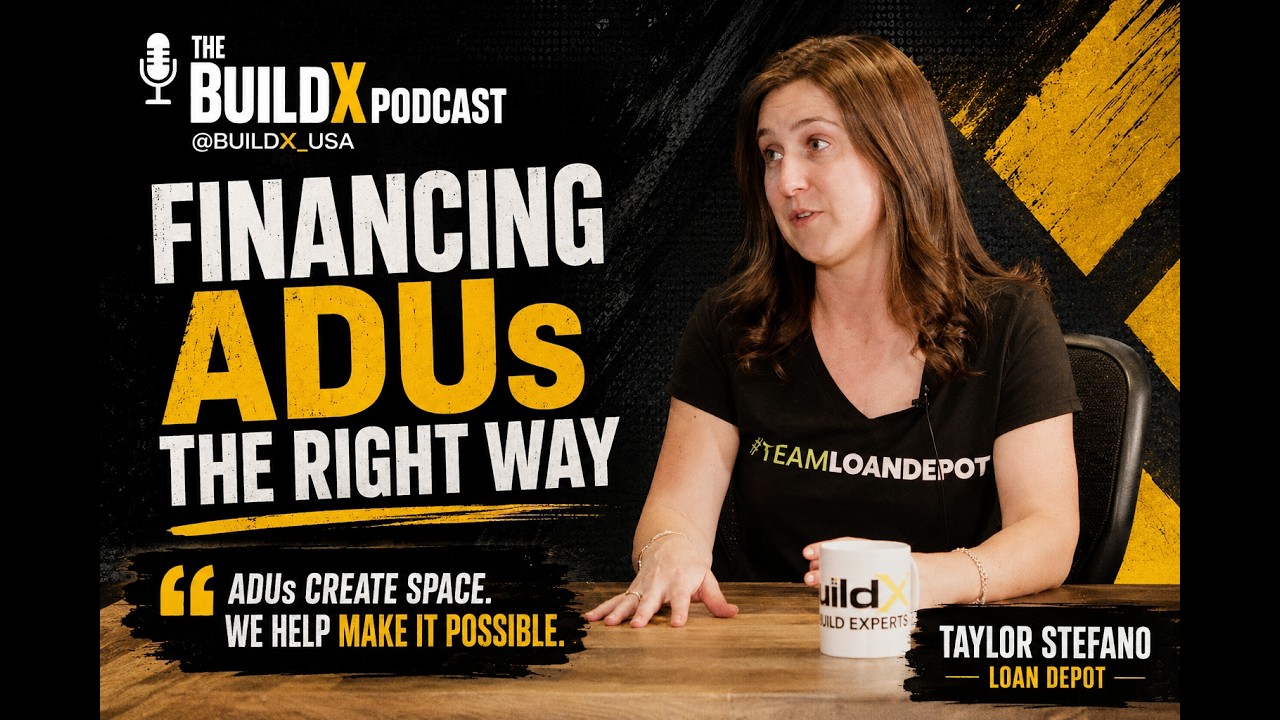
Watch: ADU Financing: How Families Build Together Without Buying Another House (with Taylor Stefano)
You've spent years paying off your house. You don't have a mortgage, the deed is clear, and owning it outright is a good feeling you've worked hard for. Now you want to build an ADU either for aging parents or an adult child who can't find anything affordable, or maybe to use as a rental. The question that keeps most homeowners from moving forward is always the same one: does building an ADU mean putting a mortgage on your home again, now that you own it free and clear? For many people that seems like a step backward.
My name is Buz Artiano, and I am the founder of BuildX. We've built dozens of ADU projects across Massachusetts, mostly around the South Shore and Plymouth County areas. We are the only team you need. We do the design, permitting, and construction. So we see every phase of a project from the first site visit up until you move in. We evaluate septic constraints, zoning issues, utility connections and the requirement to get a permit from the city. And we spend a lot of time on one subject that decides whether any of it happens: how the project gets paid for. To discuss the money issue we talked to Taylor Stefano, a loan consultant at Loan Depot, and went through the real refinance process starting from the first phone call to the check at closing.
Here's the part that surprises people. If your home's paid off, you aren't looking at a lot of confusing options. There is one path and it's faster and cheaper than most homeowners expect. One couple who went through it in June 2026 kept their savings, put a mortgage back on a house they owned and ended up about $400,000 ahead of the alternative. This is why.
Quick Answer: If you own your home free and clear, the normal way to pay for an ADU is a cash-out refinance. With no mortgage, a HELOC or second mortgage has nothing in front of it, so you can take out a new first mortgage on the home and get the difference in cash at closing. Closing costs are usually about $4,500, roughly 1 percent of the loan, on a 30-year fixed mortgage and it can close in about a month. In one June 2026 deal, a couple with no mortgage got a loan for $350,000, kept $100,000 in savings, moved into the new ADU, and moved their adult children into the main house.
In This Article
What Is the One Financing Path When Your Home Is Paid Off?
A cash-out refinance. When your home is paid off, this is the way to do it, and it's really the only standard one. That is because a home equity line of credit, or HELOC, and a fixed-rate second mortgage are second in line after an existing first mortgage. When you own your home free and clear, there isn't any mortgage, so the best move is to put a new first mortgage back on the home and take the cash you need out of it. In simple terms you get a mortgage on a property you already paid off. It's a standard 30-year loan, the same kind you paid off before and you come away from closing with a check.
That check is the money that pays for the ADU. You take it to your builder and the ADU gets built. There isn't any construction loan and no draw schedule of money to manage. A cash-out refinance just puts a new mortgage on the home and pays you the equity you get as cash at closing. You can review how the product works at consumerfinance.gov.
What Does It Actually Cost to Refinance?
Four things decide how much it will cost and you should know all four before you look at a single quote.
The first is closing costs. On a refinance, closing costs which are the lender fees, title work, appraisal, and recording charges add on to the loan, will be about $4,500. As a rule that comes out to be about 1 percent of the loan amount. It isn't hidden and it doesn't disappear to zero. It's the cost of doing the transaction, and the lender should give you a quote listing every charge as a line item before you decide on anything.
The second one is the rate. When we made this deal, the rate on this kind of financing was at about 6.625 percent. That was in June 2026. But rates change all the time so use this number as a reference but not a promise. Check the current number with your lender before you plan your budget around it.
The third is the term. This is a 30-year fixed mortgage. Fixed means the rate doesn't change for the term of the loan, so your principal and interest will be the same in the first year as it is in the twentieth year. It is very predictable.
The fourth cost is never listed on a quote because it isn't a fee. It is called 'carry'. On a cash-out refinance there isn't a schedule to draw money out so that means full loan amount goes to your account at closing and you start paying principal and interest on all of it right away, even though most of that money stays in your checking account waiting for the build to use it. The longer it sits there, the more interest you pay on money you aren't using yet. Those four numbers, closing costs, rate, term, and carry, are the ones that make the deal.
One Real Family's Numbers, Start to Finish
To make this more clear, here is a real deal with the family kept anonymous. The couple had owned their home for a long time and didn't have a mortgage on it, they owned it free and clear. Their adult children, a young family, were having trouble finding a house in their price range that didn't need a lot of work. And the parents didn't want to buy a separate house at a higher interest rate. So they decided to build an ADU. The parents are moving into a new 900-square-foot detached ADU, two bedrooms and a bath and a half, and the children are moving into the main house for the extra space. Here's how the money part worked.
| The Deal | Numbers |
|---|---|
| Home status | Owned free and clear, no mortgage |
| The ADU | 900 sq ft, 2 bed, 1.5 bath, detached |
| Total cost to build | About $450,000 |
| Cash the family had in savings | About $100,000 |
| Amount refinanced (new mortgage) | $350,000 |
| Closing costs | About $4,500 (near 1% of the loan) |
| Rate (as of June 2026) | About 6.625% |
| Term of the Loan | 30-year fixed |
| Time between phone call to check in hand | About one month |
The build ran about $450,000. Our units usually cost between $320,000 and $420,000 depending on size and finishes, and this one was on the more expensive side. The family had $100,000 in savings, so they only needed to borrow $350,000. That is the amount that the closing costs and the rate apply to.
Here's where the builder's cost estimate matters more than most people realize. We quote the actual, total cost up front, line by line, because the loan will be given based on that number. When a builder gives the family a low price just to get the job, the refinance will be for that amount, so the money runs out somewhere around drywall. Then the family is left with an unfinished ADU asking a lender for more money, and that's a far worse conversation than the first one. We have seen it happen on ADU builds that we were called on to fix later. Fitting the loan to an honest finished cost the first time is the difference between one easy closing and a second emergency loan at a worse interest rate.
The reason a couple without a mortgage was willing to get a loan back on their paid-off house is because of the alternative. If the kids had gone out and bought their own house at current interest rates, the family would have spent probably $400,000 more between the two households than they did by building one ADU and changing who lives where. Their combined monthly housing cost went from around $6,000 to around $3,000, and the parents and the kids were able to live on the same property again. That is the entire reason for this move. The new mortgage isn't the cost, it's the way to avoid a much bigger one.
Are You Stuck With Today's Rate?
No. The rate you get today isn't the rate you have to keep. After you've made about four payments on the new mortgage, a good lender will start checking the interest rates for you and check the numbers on refinancing again when they go down. The rule that the lenders we work with use is to refinance when the rate goes down by half a point to a full point, because below that the savings don't change the cost.
When you can break even, it's easy to see. On a $400,000 note, a one-point drop in the rate saves about $400 a month. The closing costs to refinance again will be the same $4,500. So after about a year of payments, what you've saved will equal the cost of refinancing and after that it is money in your pocket. That's why a higher rate today is a risk that is manageable, not a permanent one. You aren't locked in at 6.625 percent for 30 years unless interest rates never fall again.
What Should You Budget for Before You Close?
This is the fourth cost from earlier, the one that isn't a fee. Because the full $350,000 is what you will get at closing and there is no draw schedule, you start paying principal and interest on the entire loan right away, even though the builder doesn't need most of the money for weeks. Every month the cash just sits in your account, you're paying interest on money that you aren't using yet.
The way to keep that cost down is timing. Find a builder before you close, not after, so the money goes to work quickly instead of just sitting there. A build that begins within a few weeks of closing won't waste much money. A loan that closes while you are still shopping for a builder can use months of interest on the full balance for no reason. This isn't a reason to avoid the refinance. But it's a reason to get the financing and the builder both lined up.
When Does a Cash-Out Refinance Not Make Sense?
We help families through this refinance all the time, so you might think we'll tell you a refinance is always the answer. It isn't. If you have enough money in a retirement account, checking, or savings to pay for the ADU without borrowing, then paying cash avoids the closing costs and there's no interest, and that can be a better idea. If the current rate doesn't work for your budget and you have a flexible timeline, waiting for rates to drop before you start building is a reasonable choice, not a failure of nerve. And if putting any mortgage back on a paid-off home is something you just don't do, that is an answer too. The peace of mind that you get with a clear deed has a value only you can determine. The cash-out refinance is the right thing for certain situations: a home that's paid off, an ADU you want to build now, and not quite enough cash to do it without help. When that is the situation, it's easy, fast and has been proven. When it isn't, one of the other choices will work for you better.
Putting a Paid-Off Home to Work for Your Family
For a homeowner without a mortgage, the way to build an ADU isn't complicated. It is a cash-out refinance, based on the actual finished cost, at an interest rate you can refinance later on and a timeline that's based on your builder's schedule. The couple who did it kept their savings, kept their family close, and came out well ahead of buying a second house. The only real question left is what the facts are about your property and your family.
We will walk through your equity, connect you with lenders who handle ADU refinances, and size the loan to the real finished cost so the money does not run out mid-build.
See a finished ADU in person or Request a Free Consultation
Call us: (781) 627-7000