
What Happens to Your ADU If You Don't Have an Estate Plan in Massachusetts?
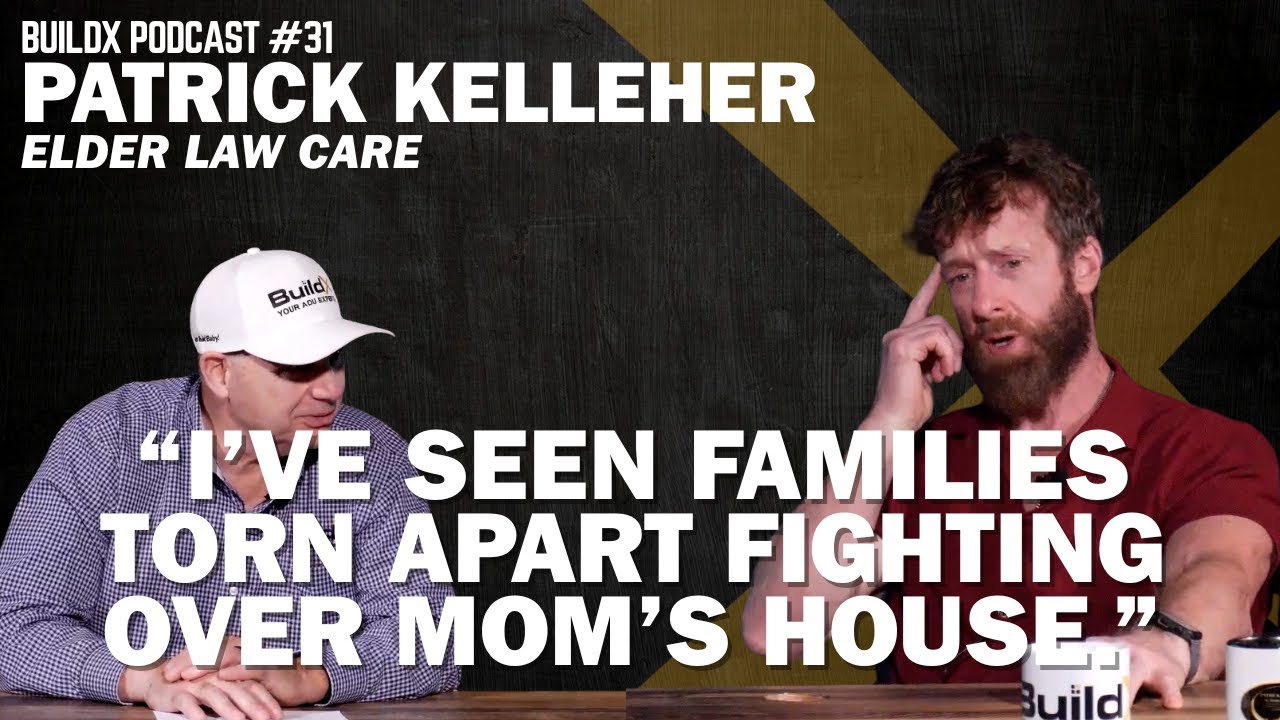
Watch: Elder Law Secrets, Special Needs Trusts & Condo-izing ADUs: Patrick Kelleher | BuildX Podcast #31
You're about to invest $250,000 to $400,000 in an ADU on your property. You've already thought about the design and the financing. You've even given some thought to logistics like septic and permitting. But there's one question a lot of people seem to forget about until it is too late. What happens to that ADU when you die? If you don't really know, you're not the only one. According to elder law professionals who work with Massachusetts families every day, 70 to 80 percent of homeowners have no estate plan at all. That means your ADU, your property, and everything else you own could be vulnerable to things like probate court, estate taxes, creditors, and nursing home costs as soon as you're gone.
My name is Buz Artiano, and I'm the founder of BuildX. We've built dozens of ADU projects across Massachusetts, mostly around the South Shore and Plymouth County. We handle design, permitting, and construction under one roof, and we work with families every week who are trying to deal with septic issues, lot coverage limits, and zoning requirements. But we're different from other builders, we think about what happens after the project is finished as well. Because if you spend six figures on an ADU and your estate plan doesn't figure that in, you may be creating bigger financial issues than you're trying to solve.
In this article we'll walk you through what actually happens to an ADU when there's no estate plan in place. We're also going to talk about the four specific threats that can eat up all your family's assets, and what you can do right now to make sure your investment is protected. We're not qualified to give any legal advice, this is what we've noticed after building a lot of ADUs for Massachusetts families and seeing what happens when the legal stuff isn't dealt with early enough.
Quick Answer: Without an estate plan, your ADU and the property go through Massachusetts probate court. Which introduces some threats to your assets. You can face things like probate delays and costs, Massachusetts estate tax (which kicks in at a $2 million threshold), creditors, and nursing home costs, which can be as much as $18,000 a month. The ADU stays as part of the property's title, so if you transfer the main house into the right kind of trust, the ADU comes with it. If you don't do it this way, your family will have to deal with a long and expensive legal process instead of having an asset.
In This Article
- What Actually Happens to Your ADU If You Die Without a Plan?
- What Are the Four Threats That Can Consume Your ADU Investment?
- Why Does a Will Not Protect Your ADU?
- How Does a Trust Protect Your ADU and Your Property?
- When Should You Start the Estate Planning Conversation?
- Is Estate Planning Necessary for Every ADU Project?
- Your ADU Is an Investment. Make Sure It Is a Protected One.
What Actually Happens to Your ADU If You Die Without a Plan?
When a Massachusetts homeowner dies without an estate plan, the state actually has an official plan for that. Elder law professionals call it "the government plan," and it's what a lot of families get stuck with. Around 60% of Americans don't even have a will, and that number is much higher for people without an estate plan.
Here's what "the government plan" would do. Your property, including the ADU, goes to what's called "probate court." Probate is a public legal process where a judge oversees who will get your estate following Massachusetts laws that decide who will inherit everything. That process can take months or even years and it will cost money. During that time, your family will not be able to sell the property, refinance it, or make any decisions about the ADU without the approval of the court.
The ADU is part of the main house, it's not a separate entity. It's on the same title and the same property. Whoever inherits the property also gets the ADU. If your estate plan (or lack of one) doesn't specify who gets what, the ADU goes to probate court along with the rest of the property and the main house and the family has no control over how it's distributed.
That's the whole problem. You paid six figures for a structure so you could keep your family close, but if you don't have an estate plan, the outcome is determined by strangers in a courtroom instead of a family discussion.
What Are the Four Threats That Can Consume Your ADU Investment?
Elder law attorneys talk about four main threats that can eat up your assets. They call it the "four-headed monster," and every one of them can take a huge bite out of your ADU investment.
The first threat is probate court. A will does not protect your assets from probate. A will goes through probate. That means legal fees, court costs, all your assets becoming public knowledge, and you can't control the timeline of any of it. For families with an ADU on the property, probate can stop everything including decisions about who lives there, who maintains it, and whether the property can be sold.
The second threat is Massachusetts estate tax. Massachusetts is one of 12 states with its own separate estate tax, and the threshold is $2 million. That includes your home, your ADU, your retirement accounts, investment accounts, life insurance, and any other assets you have. Let's add all that up. Let's say you have a home worth $800,000 to $1,000,000, you build an ADU that is worth $250,000 to $400,000, add your IRA and 401(k), and a life insurance policy, and you're looking at a $2 million to $4 million estate. If you don't do some serious planning and put all that in a revocable trust, your family could owe a couple hundred thousand dollars in taxes to the state of Massachusetts. You can review current estate tax requirements at mass.gov.
The third threat is financial creditors and predators. Unprotected assets could be vulnerable to lawsuits, divorce settlements, and creditors. If one of your children goes through a divorce after inheriting the property, the ADU you built for your family could get all tangled up in that and they might have to sell the property in order to split everything up.
The fourth threat is nursing home costs. A nursing home in Massachusetts can cost $18,000 a month. If you or your spouse needs long-term care and your assets aren't protected in something like a trust, the home and the ADU can both be taken in order to pay for the nursing home costs. Families who didn't plan ahead have had to stand by and just watch their parents' property be completely lost to costs for long term care. But all that can be prevented with the right legal structure.
All of these threats are real and scary, but the great news is that they can all be prevented. But that requires planning things out before it's too late.
Why Does a Will Not Protect Your ADU?
Many families assume that having a will is enough, but it absolutely is not. A will is a set of instructions for the probate court. It tells the court what you wanted, but the court still has to go through the whole process. During that process, everything is frozen, you can't do anything except sit and wait for as long as it takes the court to come to a decision and process everything.
A will doesn't protect you from estate taxes, nursing home costs, or creditors. Elder law attorneys say a will is "woefully insufficient to properly protect what you worked hard for."
There's a huge difference between a will and a trust and most families believe they have a plan when all they really have is a document that starts a long legal process. If your goal is to keep the ADU in the family, keep the property out of court, and protect your assets from these big threats, a will doesn't do any of that, you have to put everything in a trust.
We see this disconnect all the time when we do consultations. People will spend months planning the design, the layout, and the financing for their perfect ADU, but when we ask if they've talked to an elder law attorney about the ADU and getting an estate plan in place, all of a sudden everybody is quiet. The ADU is on the same deed as the main house. It goes right along with the rest of the property. If the property is not in a trust, the ADU is just as vulnerable as the main house. That's something that most families don't even think about until after the ADU is finished, and by then, the things are already more complicated. We always talk about this stuff early because we've seen too many families get caught off guard, and the fix is so easy if you just deal with it before the construction starts.
How Does a Trust Protect Your ADU and Your Property?
A trust is a legal structure that keeps your assets from going to probate court. When your property is put into a properly structured trust, the ADU is automatically part of it. Elder law attorneys say that the ADU is "the cousin or the little brother or sister to the main house." Whoever you name in the trust as the beneficiary of the property gets the ADU as well.
The trust actually does four important things. It keeps everything completely out of messy probate court. It will give you the structure to help plan the estate tax and can save your family hundreds of thousands of dollars. It protects your property from creditors and divorce issues. And if planned with the right lookback timing, it can protect the home and ADU from nursing home rules that make you reduce your income or assets in order to qualify for Medicaid benefits.
The words to remember here are "properly structured." A trust is not a generic document, it has to be created around your family's specific situation and circumstances like who lives in the ADU, who helped pay for it, who will be the parents' caregiver, and how the remaining assets are split up. That's why elder law attorneys always recommend a family meeting before they create the trust, so that everybody understands the plan and agrees to the terms while everyone is still healthy enough to have the conversation.
Massachusetts allows you to build one ADU under the Affordable Homes Act. But the legal protections for that ADU once it's finished are all up to you. The state will let you build it, but it's 100% on you to protect it. You can review the by-right ADU requirements at mass.gov.
When Should You Start the Estate Planning Conversation?
You need to start your estate planning before you start any construction. Elder law attorneys advised us to always do this in the third quarter of life, not the fourth. The "third quarter" means while you are healthy, competent, and still able to make decisions. The "fourth quarter" means after a fall, a diagnosis, or some other unfortunate event that causes you to not be able to plan.
One elder law attorney we work with told us about what happened with his family. His father took a bad fall at home in his late years and had to be taken to the hospital. He was later moved to a rehab facility, and then to a nursing home. The family had not planned for all that. The attorney, who practices estate law professionally, had to scramble to deal with issues he didn't expect to happen to his own family.
If that can happen to an estate planning attorney's family, it can definitely happen to yours. The timing is really what makes the difference between a family that is protected and one that's not, it's not usually money or how complicated the process is, it's all about the timing. If you deal with this stuff before the ADU is built, you will have options. But if you wait until a bad health event or a death happens, your options are very limited.
Is Estate Planning Necessary for Every ADU Project?
Not every ADU project has to have a complicated legal process behind it. If you're building a small attached unit for rental income and your total estate worth is way under that $2 million threshold, it's not as urgent to have an estate plan as it is for a family building a $350,000 detached unit for an aging parent on a property that's already worth close to a million dollars.
We're not elder law attorneys, and we're not qualified to give legal advice. We are builders who have done this enough to have seen lots of families go through this process, so we've learned when the legal stuff really matters. If your ADU is part of a multigenerational family plan, if one of your children will be living in the unit and contributing financially, if your estate is anywhere near the $2 million threshold, or if a family member has special needs or receives government benefits, the estate planning conversation has to happen. It's the thing that makes sure your ADU investment actually ends up exactly how you want it.
If none of those situations apply to you, it's still worth it to talk to an elder law attorney one time. A lot of people find out during that first conversation that their estate is closer to the tax threshold than they thought.
Your ADU Is an Investment. Make Sure It Is a Protected One.
You're not building an ADU just to have an extra home, you're building it to keep your family together, to give a parent independence, to create a home for a child who cannot afford one, or to generate income that will contribute to your retirement. Every one of those goals depends on what happens to the ADU after you're gone.
The construction side is our job. The legal side is yours. But we'll tell you when it's time to have that conversation, because we know what happens when families skip it.
We will walk through your property, your family situation, and your goals, and help you understand where estate planning fits into the process before construction begins.
Tour a completed ADU to see what we build or Request a Free Consultation
Call us: (781) 627-7000