What Happens If Your New Home or ADU Fails the Blower Door Test in Massachusetts?
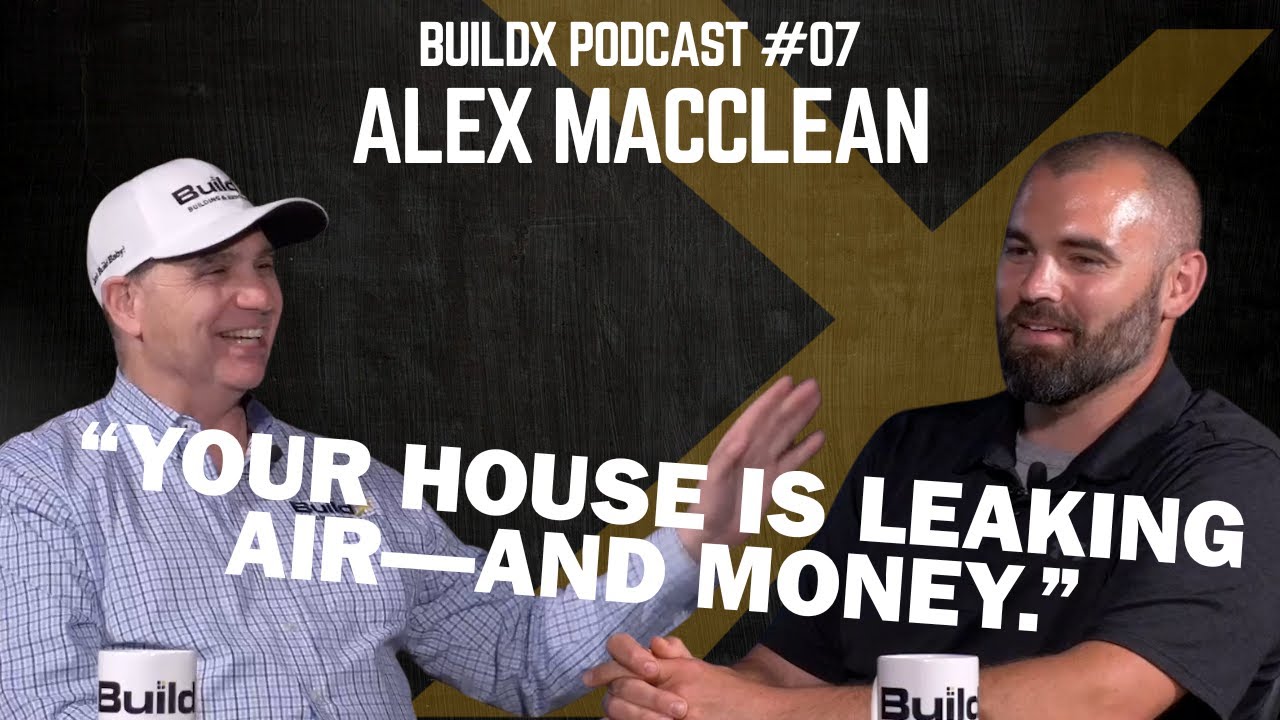
Watch: Your House Is Leaking - Here's How to Seal It Right w/ Alex MacLean | BuildX Podcast #07
You have spent months watching your ADU being built. The framing is done, the drywall is up, the finishes have been put on, the appliances are installed. The list is complete and everyone is happy. And then the HERS rater comes to do the final blower door test, pressurizes the building, and the number comes back at 2.75 air changes per hour. The code Massachusetts requires that number to be 1.5 ACH so the ADU just failed. You are all prepared to move and your ADU can't get the certificate of occupancy.
My name is Buz Artiano, and I am the founder of BuildX. We've built dozens of ADU projects across Massachusetts, mostly around the South Shore and Plymouth County areas. We are the only team you need, we handle design, permitting, and construction. So we see every phase of a project from the first site visit up until you move in. We deal with septic constraints, zoning issues, and the state's new ADU laws.
When the ACH in the Massachusetts Stretch Energy Code went from 3.0 to 1.5 it changed things for every builder in the state. We include proactive air sealing in our standard ADU building because we have seen what happens when builders skip it.
This article tells you exactly what a blower door failure is in a finished home, what it costs to fix it after it fails and why the new 1.5 ACH limit surprises many builders. It also gives you ideas of what you can do before construction starts to make sure it never happens to your family.
Quick Answer: If your new home or ADU doesn't pass the blower door test after the building is finished, every surface inside has to be covered with plastic before air sealing to correct it can start. Appliances have to be pulled into the middle of rooms or taken out completely. This process costs many times more than getting the air sealing during construction, which runs roughly $1.00 to $1.50 per square foot. Massachusetts now requires 1.5 air changes per hour under the Stretch Energy Code and if you don't get a certificate of occupancy, no one can move in. The best to deal with air tightness is at the drywall stage, not after the final walkthrough.
In This Article
- What Does a Blower Door Failure Actually Look Like in a Finished ADU?
- Why Does the 1.5 ACH Threshold Catch So Many Builders Off Guard?
- What Happens to Your Move-In Timeline If You Fail?
- How Much Does It Cost to Fix a Blower Door Failure After the Fact?
- What Can You Do Before Construction Starts to Prevent a Failure?
- Is Proactive Air Sealing the Right Call for Every Project?
- Do Not Gamble on Your Blower Door Test
What Does a Blower Door Failure Actually Look Like in a Finished ADU?
A blower door test tells you how much air leaks through the building structure when the structure is pressurized. The HERS rater will put up a fan in the doorway, pressurize the ADU to a certain pressure, and measure how many air changes happen per hour. In Massachusetts, to pass the test there must be no more than 1.5 ACH. If the number is above that, the building fails.
When a finished building fails, the options become less very quickly. The best way to fix it is to use an aerosol air sealer that is put into the pressurized space to find and fill leaks from the inside. But in a home that's already finished, that means every surface that the sealant could touch has to be protected.
In our experience, that means you have to cover all woodwork, trim, flooring, countertops, and cabinets with plastic sheeting. Appliances have to be pulled to the middle of the room and wrapped up, or taken out of the ADU completely. The prep work alone for a finished home is much more than the work needed when the building is still at the drywall stage. We tell every homeowner we work with that the covering and prep of a house after its finished is about 10 to 20 times the cost of doing it when the walls are just bare sheetrock.
And the worst part is that you still have to pay for the air sealing itself in addition to all that protection work. The sealing cost doesn't go down because you waited. You are paying the same $1.00 to $1.50 per square foot for the sealant, plus the entire cost of protecting a finished inside.
Why Does the 1.5 ACH Threshold Catch So Many Builders Off Guard?
The Massachusetts Stretch Energy Code changed the blower door requirements from 3.0 ACH down to 1.5 ACH. That sounds like a small difference when you read it, but in reality it changed the science of building that's now required to pass.
When it was 3.0 ACH, most builders could achieve that with standard construction practices, careful caulking, and paying attention to penetrations. But now at 1.5, every detail matters because each electrical box, plumbing penetration, rough window opening and framing joint can be a potential failure point. The margin for error goes down dramatically.
Builders who were okay dealing with 3.0 now find themselves failing at 2.5 or 2.75 if they are using the same building practices they have always used. The old approach no longer works. That is not a criticism of those builders but it's just realizing that the code changed faster than many construction practices were able to adapt.
We decided at BuildX to include aerosolized air sealing as something we use in every project. The reason is very simple: on a 900-square-foot ADU, including this air sealing in the list of materials while building costs about $1.00 to $1.50 per square foot and adds about $900 to $1,350 to the project cost. If you don't do it and then fail the blower door test after finishes are done, means you have to go back and fix it. That including the additional rework involved can cost $10,000, $20,000, or more depending on the scope. We don't want to save $1,000 at the beginning and then cost ourselves $30,000 and an unhappy homeowner later on. That is why we tell everyone thinking about building an ADU that if your builder doesn't include air sealing in their cost estimates, you need to ask them why.
What Happens to Your Move-In Timeline If You Fail?
If you ADU fails the blower door test that will keep you from getting the certificate of occupancy. And without a CO, you can't legally live in the ADU. No one moves in.
The time it takes to fix the failure of the blower door test depends on when the installer is available, the size of the work needed, and how far above the 1.5 ACH the building is. In most cases, you can expect to have a delay of two to four weeks minimum from the date of the test that failed to a successful retest. That period of time includes scheduling the installer, getting the finished interior prepared, doing the sealing, time for it to cure, and then scheduling the HERS rater to come back.
During that time, the homeowner just has to wait. If they sold a previous home to pay for the ADU, they may not have a place to live. If the ADU is for an aging parent, arrangements for their care will have to be put off. If a lease is ending, there is no backup plan. As one situation we have seen happen: stop the moving truck, because this is the only way forward.
How Much Does It Cost to Fix a Blower Door Failure After the Fact?
The cost of air sealing during construction compared to air sealing after the ADU is completed isn't even close to the same.
The table below shows both scenarios for a typical 900-square-foot ADU in Massachusetts. The proactive cost means that the air sealing was done during the drywall process with just bare walls and no finishes. The cost to fix a failed test later on includes interior protection of the interior, removing the appliances, lots of labor costs and then sealing again.
| Scenario | Estimated Cost (900 sq ft ADU) | What It Includes |
|---|---|---|
| Proactive air sealing at drywall stage | $900 to $1,350 | Aerosolized sealant is put on bare sheetrock. No protection needed. Not much cleanup. |
| Remedial air sealing in a finished home | $10,000 to $30,000+ | Full protection of the inside (plastic, tape, labor), appliance removal or wrapping, sealant application, cleanup, Another HERS rater test. |
The other option rather than aerosolized sealing is spray foaming the whole building, which can add $10,000 to $20,000 to the project depending on size and difficulty. For a 900-square-foot ADU, aerosolized sealing during the drywall stage is the least expensive way to pass the blower door test.
What Can You Do Before Construction Starts to Prevent a Failure?
You can prevent a failure if you make these three decisions before or during the early stages of construction.
Choose a builder who includes air sealing in their baseline specifications. This is the one most important step. If your builder doesn't include a line item for air sealing or envelope sealing, you need to ask why. The cost of adding it from the very first is just a small fraction of the cost to fix it later. We include it on every BuildX project because the math does not make sense any other way.
Insist on testing at the drywall stage, not just at the end. The time to discover that your building is at 2.5 ACH instead of the 1.5 necessary to pass the test is when the walls are still open. Then the installer can seal effectively without doing any protection work, or having to take out appliances. And there is no risk to your finishes. By the time finishes are complete, the cost and difficulty of fixing it multiplies.
Ask your builder whether they own or have ready access to a blower door kit. Builders who can check on air tightness throughout construction, not just the day of the final test, can find problems when they are still cheap and easy to fix. If the plumber drills a new hole on Tuesday, the builder can do a blower door check on Wednesday and catch any leak before insulation goes in. That is the normal house builders hold themselves to. For standard construction that have to follow the 1.5 ACH code, it is becoming what is expected.
Is Proactive Air Sealing the Right Call for Every Project?
We include aerosolized air sealing in every BuildX ADU because of the Massachusetts energy code requirements and the cost of fixing a failed test we talked about above. But there are situations where a different approach would be sensible.
If the project uses a full spray foam envelope, aerosolized sealing may be unnecessary. Spray foam will insulate and seal so a building with closed-cell foam on all outside walls and the roof deck might pass the blower door test without any other sealing. The balance is that spray foam costs much more at the beginning, usually about $10,000 to $20,000 more than fiberglass or rockwool insulation together with aerosolized sealing.
If the builder is using an energy efficient design with continuous outside insulation and careful treatment for each penetration, they might get below-1.0 ACH with just those construction practices by themselves. Those projects normally use their own blower door kits to check during the build.
For most standard and high-performance ADU construction in Massachusetts, air sealing with aerosol during the drywall stage is still the most cost-effective guarantee against a blower door failure.
Do Not Gamble on Your Blower Door Test
The blower door test isn't just a formality. It is a hard pass-or-fail test between you and your certificate of occupancy. At 1.5 ACH, the margin for error in Massachusetts is tighter than it has ever been but those builders who have a plan for it during construction will pass. However, the builders who just hope for the best at the end might have a nightmare to deal with: a finished, beautiful home that no one is able to move into.
The decision isn't whether to spend the money. The decision is whether to spend $1,000 during construction or $20,000 after the fact. That isn't a close call.
We will walk through your project's insulation plan, the approach to air sealing, and energy code requirements so you know exactly what it takes to pass the blower door test before construction starts.
See how we handle air sealing in a completed ADU or Request a Free Consultation
Call us: (781) 627-7000