
Are Modular ADUs Really Cheaper Than Stick-Built?
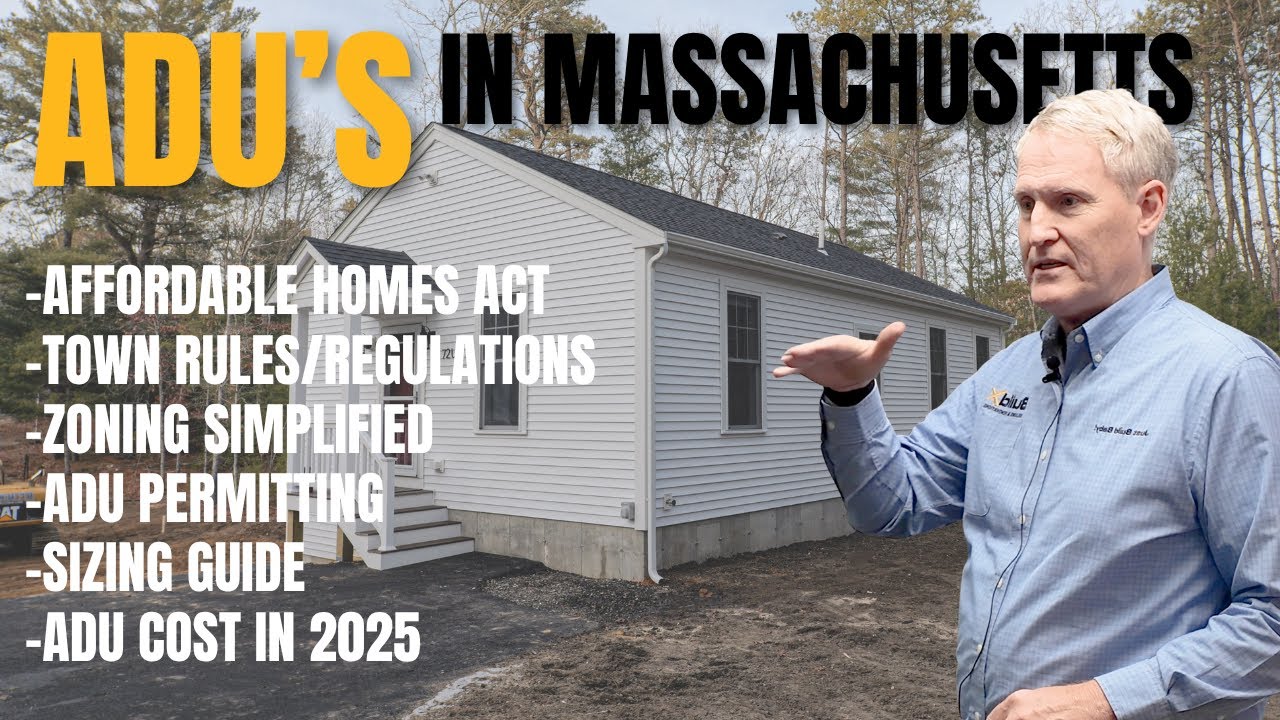
Watch: Massachusetts ADU Law Explained: The Affordable Homes Act (2025 Update)
If you've been researching ADUs in Massachusetts, you've probably seen ads for modular ADUs starting at $120,000 to $150,000. Sounds great right?! Especially when custom-built ADUs will run $250,000 to $350,000 on average. So of course the assumption is that buying a modular ADU will save you money. Unfortunately, most people believe that they really can save over a hundred grand by going with a prefab unit. Believing the ads and not understanding what the total cost really is can end up being a very expensive mistake.
My name is Buz Artiano, and I am the founder of BuildX. We've built dozens of ADU projects across Massachusetts, mostly around the South Shore and Plymouth County areas. We are the only team you need, we handle design, permitting, and construction. So we see every phase of a project from the first site visit up until you move in. We deal with septic constraints, zoning issues, and the state's new ADU laws. We've also done something that most companies haven't. We've actually partnered with modular companies before and we've seen in person exactly how it ends. There have been thousands of dollars in extra costs that the homeowners didn't expect and major quality issues that couldn't be fixed.
This article will explain how modular home pricing works and what it does and doesn't include. Once you add up all the hidden costs, you end up paying just as much as you would with a custom ADU that's built on site. If you're comparing options right now, the numbers we're going to show you will change how you look at the quotes you receive.
Quick Answer: No. Modular ADUs are not cheaper when you add everything up for a full installation. A modular unit advertised at $120,000 to $150,000 typically becomes $350,000 to $450,000 after adding site prep, foundation, permits, utility connections, septic work, and the inside finishes. That's the same amount, or actually even more in a lot of cases, than a custom site-built ADU. BuildX has worked with two modular companies on real projects. The homeowners only ended up saving about $15,000, and they weren't happy with the unit or the quality.
In This Article
- Are Modular ADUs Actually Cheaper When You Add Up Everything?
- What Does a Modular ADU Price Actually Include?
- What Happened When We Actually Tried Modular?
- What Quality Differences Should You Expect Between Modular and Custom-Built?
- What About the Time Savings? Does Modular Build Faster?
- Is There Any Situation Where Modular Makes Sense?
- How Do You Compare Modular and Custom-Built ADU Quotes Accurately?
- Know What You Are Actually Paying For Before You Sign Anything
Are Modular ADUs Actually Cheaper When You Add Up Everything?
They're really not. When a modular company quotes $120,000 to $150,000, they're selling a manufactured box that has walls, roof, and a basic shell with a few interior finishes. That price almost never includes the work you have to do in order to make it into a livable home that's legally on your property.
We've evaluated every modular company in the eastern part of the country. We've built or worked on projects with two of them. Based on that experience, we did some math, and the numbers only show possible savings of about $15,000 over a custom site-built ADU that's the same size. That's a savings of $15,000 at the very most, that's not a starting point. And that $15,000 comes with a lot of tradeoffs. You'll be sacrificing quality on materials and finishes, and you don't have any flexibility in the overall design. Unfortunately, most people don't know this until the unit is dropped off and it's too late.
When you add site prep, foundation, permits, engineering, utility connections, septic compliance, and the interior finishes that these modular companies leave out of their price, that $150,000 home ends up costing $350,000 to $450,000 installed. That's the same price as a fully custom-built ADU, and a lot of times, it's even more expensive to install the modular home.
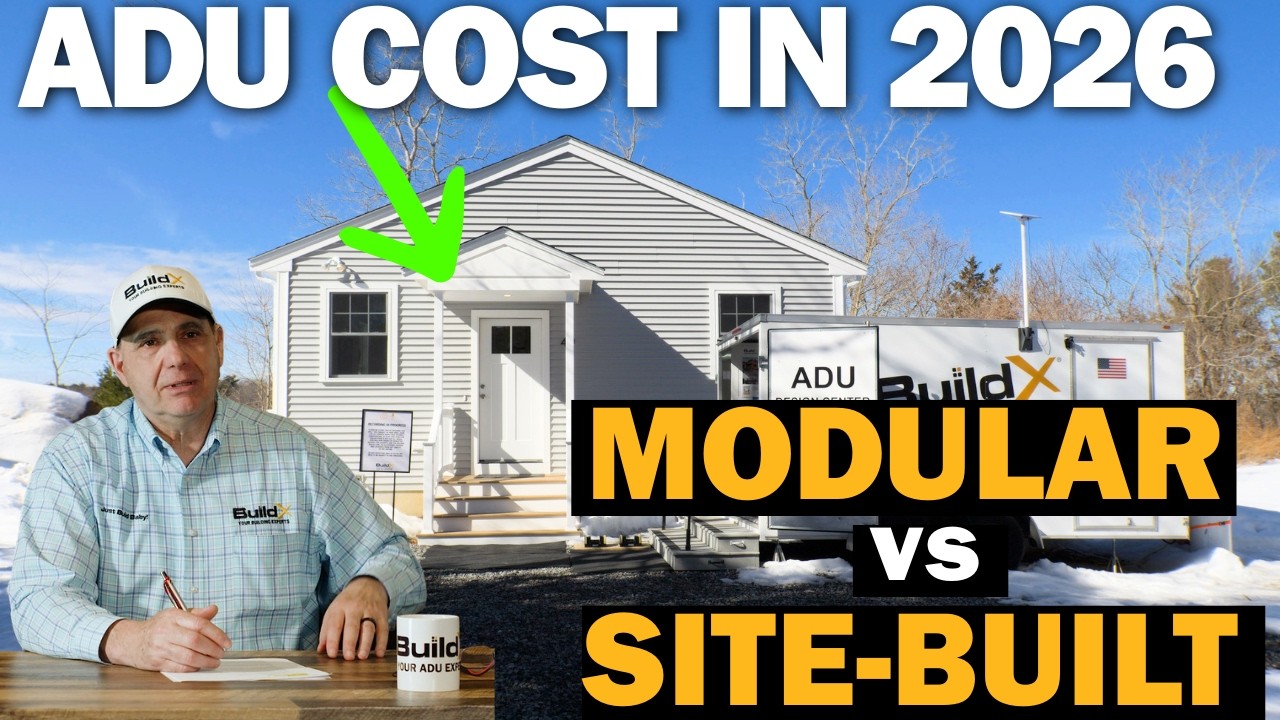
Watch: The Hidden Costs of Modular ADUs (Before You Sign Anything)
What Does a Modular ADU Price Actually Include?
In order to compare prices from different companies, you have to understand what is not included on advertised modular home prices. The $120,000 to $150,000 price that you see will only be for the manufactured building itself. Here's what you still have to have, but isn't usually on the price sheet.
Site preparation: Since your backyard isn't a nice smooth parking lot, it could need clearing, grading, and prepping for the foundation. Depending on site conditions, this costs $10,000 to $30,000.
Foundation work is a completely separate thing. Every ADU needs a foundation, no matter what, and modular companies don't pour them. Budget $25,000 to $50,000 for a foundation.
Permits and engineering are always required, it doesn't matter what kind of construction you're using. Every ADU in Massachusetts needs permits, and every site needs engineering. That's another $5,000 to $15,000.
Sewer or septic connections depend on your property. If you're on septic, Title V determines what's possible on your lot. If you have to expand your septic system, that can run $20,000 to $50,000. If you're on town sewer, it won't be that high, but it's still not included in the modular price.
Utility connections for water, electric, and possibly gas add $10,000 to $25,000.
Interior finishes are where you really see the quality lacking. A lot of modular units come as just shells. You still have to install flooring, cabinets, countertops, fixtures, and paint. Some units do include the finishes, but for the most part they're very low-grade. Things like laminate countertops, MDF trim (medium-density fiberboard, a pressed wood product that looks like real wood but isn't strong like wood), and primer on the walls, so you still have to paint everything before you move in.
You can't skip these steps. A modular unit and a custom built ADU both require every one of those things. Modular home companies just change around the wording, but you're still building a house.
What Happened When We Actually Tried Modular?
We've worked on projects with two different modular companies. Both times the homeowners were unhappy at the end. Things that we thought would be included in the package weren't. Just basic things like grab rails in bathrooms, drawer pulls, and normal hardware that every finished home has. The homeowners had to buy and install all of that separately on their own after the unit was installed.
We've also had families come to us after they had spent three months working with a prefab company. They had already put down a deposit and scheduled for the delivery when they got an invoice for "site readiness". It had things listed like site preparation, foundation, permits, utility hookups, and finish work and the total amount was another $180,000! That's on top of the $165,000 they were already paying for the unit itself. The total of both invoices was more than what a custom ADU from BuildX would have cost them. They ended up walking away from their deposit and cancelling the whole thing.
Modular pricing is misleading on purpose, it's not an accident. A modular company just makes and delivers a box. They don't manage any site prep, your permits, your septic, your foundation, or your utility connections. Those are all done by separate contractors, all on different time frames and with separate invoices. When we quote a project, we include absolutely everything from permits all the way through paint because we've learned that when homeowners are slammed with a bunch of hidden costs it can throw the whole project off the rails. A modular quote that lists $150,000 is accurate for the box. But the box is only one of the many steps you have to complete before you have a legal, livable ADU on your property.
What Quality Differences Should You Expect Between Modular and Custom-Built?
Now you know about the cost differences, but there are also differences in the design and the choice of building materials that have a huge effect on how the finished ADU will truly look and feel and how efficient it will be.
Material transparency is something that just can't be fixed when you're working with a prefab company. When we build on site, we pick every single material that we use. We know the insulation type, the sheathing, and the fasteners. With a modular unit, we have no way of knowing what kind of materials they used inside the walls. Everything arrives sealed, and unless you start tearing down walls, there's really no way to check or verify the quality of the materials they used to build it.
Interior finishes in modular units are usually very low quality. Expect laminate countertops rather than quartz or granite, MDF trim rather than solid wood, and ceiling heights of 6 feet 7 inches rather than the 9-foot ceilings, which are what make an ADU feel like a real home and not a shed.
Design flexibility is extremely limited. Modular construction means you only have boxes to work with. When they put the two boxes together, it creates a wall that's at least 8 inches thick where it connects. You lose inside space this way. The layout is limited to what fits inside two boxes, you can't customize it for the people who will be living there.
Aesthetic integration is the issue families notice first. A factory-built box isn't going to match your house. A site-built ADU can match your roofline, siding, and windows so it looks like it's always been part of the property. A modular unit looks like a box that was dropped in the backyard.
Massachusetts has some of the most complex building codes in the country. We know the energy code, the stretch code, the Title V rules. A modular company shipping from out of state isn't going to know all of this stuff until the unit is already on your property and you're already in violation of code before the inspector even shows up.
What About the Time Savings? Does Modular Build Faster?
This is the second assumption that pushes people in the direction of modular. People always think that if the unit is built in a factory, it should be finished and arrive faster. But that isn't the case.
The factory build itself may take less time, but that's only for the box. You still must have site preparation, foundation work, utility installation, and permitting before it can even be delivered. After it's delivered, you still need interior finish work, inspections, and utility connections. The total project timeline from first permit application to move-in day ends up being about the same as a custom ADU built on site.
There's also a payment timing issue that most people don't expect. When a modular unit arrives at your property, you pay for that unit in full before they will set it on your foundation. That's a significant upfront cost when the project is a long way from being done. With a site-built ADU, payments are usually tied to phases of construction being completed, which gives homeowners more control over the draw schedule.
Is There Any Situation Where Modular Makes Sense?
We're a custom site-build company, so that's obviously our recommended method. We aren't biased, our recommendation and knowledge on the subject comes from researching every modular company in the northeast and working with two of them. What we tell you comes from our experience with real projects and real people.
There may be scenarios where a modular ADU makes sense for someone. If the property has easy access for a crane and delivery truck, and the site is already prepared, and the person doesn't need custom design, and the total installed cost is less than a site-built ADU, modular could be the right choice. Up to this point, we haven't seen that even be the case, but it's definitely a possibility.
The most important thing is making sure that you're comparing total installed costs, not advertised prices. Any modular company that won't give you a written, all-in estimate that includes site work, foundation, permits, utilities, septic, and finishes is giving you a very inaccurate price.
How Do You Compare Modular and Custom-Built ADU Quotes Accurately?
The only way to compare accurately is to make sure that both quotes include the same prep work. When you evaluate a modular quote against a site-built quote, ask whether these things are included:
- Site survey and engineering
- Site clearing and grading
- Foundation design and construction
- All building permits and inspections
- Septic or sewer connection
- Water, electric, and gas connections
- Complete interior finishes including flooring, cabinets, countertops, fixtures, and painted walls
- Exterior finishes that match your existing home
- Your own local project manager who is your point of contact and personally handles the entire project
If a modular company doesn't include everything on that list in their quote, the advertised price isn't a correct number and can't be compared to a stick-build. Massachusetts requires compliance with Title V for septic, the state energy code, and all local building codes. All the same requirements apply to modular homes as they do to a stick build. You need to check and make sure your quote includes all of these things. Under the Affordable Homes Act, ADUs are permitted by right, but building code, health code, and size requirements are still regulated by your town. You can review the full requirements at mass.gov.
Know What You Are Actually Paying For Before You Sign Anything
The modular vs. stick-built question comes down to the total installed cost for a finished, livable and legally permitted home on your property. The advertised price of a modular home doesn't include all the things you need for that. When you account for every cost that sits outside that advertised price, modular ADUs land in the same range as custom-built, and the homeowner has less control over materials, design, and the build process.
We will walk through your property, your site conditions, and your goals, and give you a turnkey number that includes everything from permits through paint. No hidden invoices after the fact.
Tour a completed custom-built ADU in person or Request a Free Consultation
Call us: (781) 627-7000