
Can you share a multi-generational home or build an ADU together with a friend when you have no spouse or children?
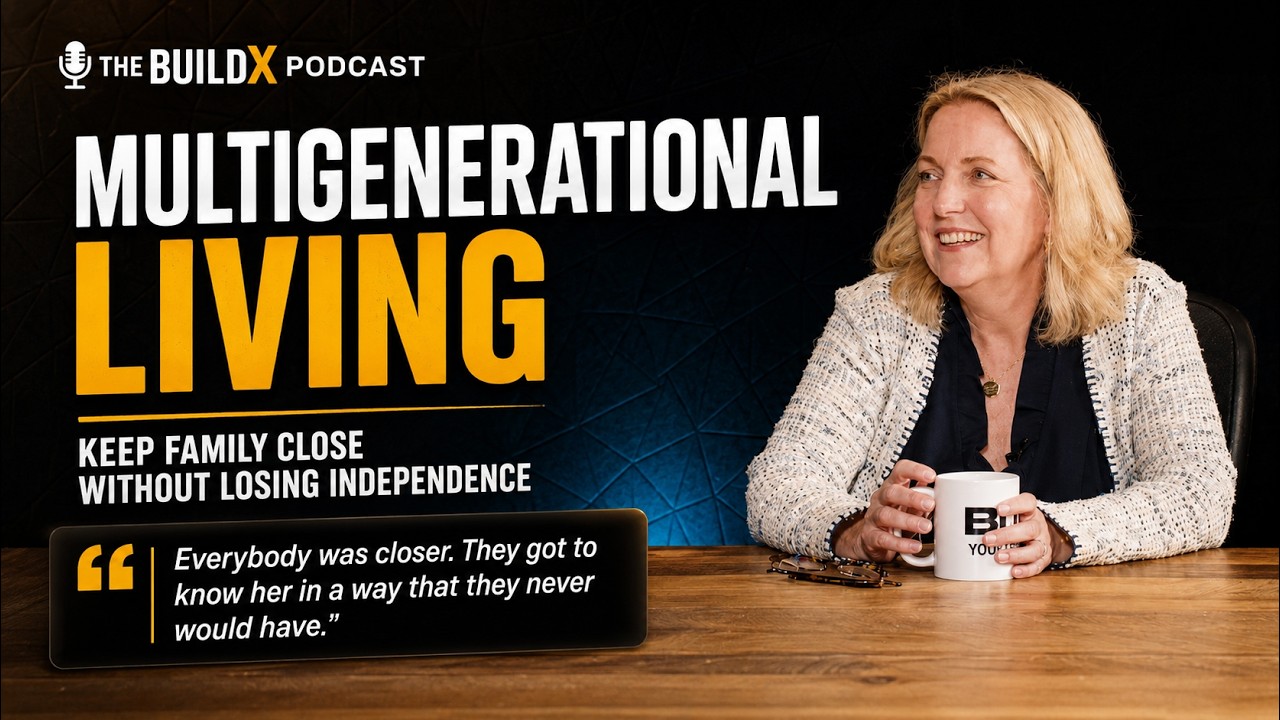
Watch: ADUs, Aging Parents, and Family Planning with Juli Ford
When you read about multi-generational living, the idea is almost always the same. Either a parent moves into their child's backyard or a family builds an ADU so that grandma can live close. If you're single, divorced, or don't have any children, it's easy to stop reading and decide that the information was written for someone else. You want the same things those families want: more support, lower costs, someone nearby, but the usual way to get those things involves relatives you may not have.
My name is Buz Artiano, and I am the founder of BuildX. We've built dozens of ADU projects across Massachusetts, mostly around the South Shore and Plymouth County areas. We are the only team you need: we do the design, permitting, and construction. So we see every phase of a project from the first site visit up until you move in. We evaluate septic constraints, zoning issues, utility connections and the requirement to get a permit from the city. We've built ADUs for parents, adult children, and people managing a health change. But until recently, we hadn't thought much about building for two friends who decide to grow old together instead of alone.
So can you? Yes, and it's one of the most overlooked ideas in the conversation about aging in place. Our viewpoint is simple. No one should have to grow old by themselves just because they didn't follow the normal path. That same design and construction we build for families, which is a private unit with its own entrance close to a shared home, would work just as well for two friends who want independence and company at the same time.
Quick Answer: Yes. Multi-generational living and ADUs aren't limited to blood family. If you're single, divorced, or widowed, you can combine households with a friend just like families do, either by sharing one home or by building an ADU on property that you share. This is a new idea, so there are more house-hunters than there are finished builds, but real people are already doing it. Multi-generational living expert Juli Ford says about one in five adults over 65 don't have children, and that's a large group with no relatives to combine households with. The necessary things are a compatible partner, honest talks about money and putting all ownership and agreements in writing with a licensed attorney.
In This Article
- Can You Really Share a Home or ADU With a Friend Instead of Family?
- Who Is This Actually For?
- Why Combine Households With a Friend at All?
- What Makes a Friend Arrangement Actually Work?
- What Should You Sort Out Before You Commit?
- Is Sharing a Home With a Friend Right for Everyone?
- What Would This Look Like on an Actual Property?
Can You Really Share a Home or ADU With a Friend Instead of Family?
Yes, and it's already being done. Juli Ford, a Massachusetts multi-generational living expert said it clearly: everything families are doing now, friends could also do in exactly the same way. She described two women who were old friends. One was retiring and one was already retired. One had never married and her friend had just gone through a divorce. They lived in different parts of the country and each were asking the same question: why are we trying to do this by ourselves? So now they're looking at houses together.
That's the whole idea in one story. Two people without a spouse or children decide to put their households together because it makes more sense than staying separate and alone. The couple doesn't have to be romantic and it doesn't have to be family. But it needs to be two people who trust each other and want the same kind of life. When Ford first discussed this idea with us, honestly it was a new concept. We build ADUs for anyone, but we've spent years thinking of the parent in the backyard, not two friends deciding to grow old on the same lot.
Who Is This Actually For?
This choice would tend to work for those people who want the benefits of a shared household but don't have any family to share it with. That's a larger group than most people would think. Ford estimates that about one in five adults over 65 never had children. When you add those who are divorced or widowed and you have a large number of people asking the same question. If you aren't going to combine households with a spouse or a child, then who?
The answer, more and more, is a friend. If there's someone you've trusted for years, someone whose company you already enjoy and whose values you already know, then that is the majority of what a successful household needs. The two women Ford talked about had been friends for a long time before they ever talked about living together. That shared history is the foundation. You're not moving in with a stranger to save money but you're deciding to spend your later years near someone you already care about.
Why Combine Households With a Friend at All?
The case for sharing a household has three things: support, safety, and cost. This is what Ford said about the support aspect: when friends come together, they can support each other. That is the practical reality of aging. Errands, appointments, the day something goes wrong. Two people covering for each other is a fundamentally different situation than one person managing alone.
When it comes to safety this is the question: Who is keeping an eye on you? When you live alone, if you fall or have a health crisis it can go unnoticed for too long. If there is another person living on the property that will change. It's often the difference between staying independent and losing that independence entirely.
And then there's the part people aren't comfortable talking about out loud. Aging alone is hard on more than your budget. When we talk with people about this, our question is why do you want to get old alone? Isolation and loneliness aren't just unpleasant, they also wear a person down after a while. Sharing a home with a friend deals with that problem and at the same time it splits the cost of living between the two of you.
What Makes a Friend Arrangement Actually Work?
There are two things that make the friend arrangement work: the right living configuration, and the right practical fit.
Let's begin with the configuration because this is where our building experience matters. In every ADU we design we have the same goal: to give each person real independence and at the same time keep them close enough to actually help each other. We build a separate ADU that has its own entrance, its own kitchen, and its own private living space not to keep people apart. It's what makes living close to someone successful for many years. Two adults who each have their own front door don't rub each other the wrong way that two people crammed into shared quarters will eventually do. Closeness is a plus, but privacy is what protects it. We've built enough of these to know that the shared living arrangement that works are the ones where nobody feels like a guest in their own home. For two friends, this principle isn't optional, it's the entire design.
Then there's the practical fit, and the two women Ford worked with are a good example. One of them had adult children who lived close by, so she wanted to stay in her state. The other one was retiring and willing to move to be near her friend. This sort of flexibility, where one person can move and both agree on where to live, is what takes a good idea and turns it into an actual plan. Before you work on the floor plans you and your friend need to agree on location, timing and what each of you is bringing to the arrangement.
What Should You Sort Out Before You Commit?
This is where honesty is more important than enthusiasm. Friends living with friends is still a new idea. There are more people house-hunting together than there are finished houses to tour. So think of the following as questions that need to be answered not a settled conclusion.
First, talk about how the ownership will work. When family combines households, there's usually a normal understanding about who owns what and who inherits what. Two unrelated friends can't use that as a default, they have to decide it on purpose. Will they own the property together? Will one of them own the home while the other one owns or rents the ADU? And what will happen if one wants out of the arrangement in five years, or if one of them dies and then their family has expectations? These are questions that can't be settled with a handshake. The most important thing is to put every agreement in writing with a licensed real estate or estate attorney before anyone puts out money. That's true for families but it's even more important for friends, because the law doesn't give unrelated co-owners many built-in protections.
Second, money needs to be discussed honestly and from the first, who pays for what, how shared costs are split, and how you'll deal with it if one person's finances change. A friendship can survive a difficult conversation about money but it probably won't survive the unspoken resentment about money that builds for years.
Third, there needs to be an exit. Every good arrangement has a plan for the possibility that it ends, not because anyone expects it to, but because planning for it lets both people relax. Both need to be honest about how someone can leave gracefully if life changes, and write that down too.
Is Sharing a Home With a Friend Right for Everyone?
No. And we'd rather be honest about that than try and sell you on something that won't work. Combining households with a friend requires a lot: genuine compatibility, honesty about finances, and willingness to share a property and a daily life with another person for the foreseeable future. If you value complete independence more than company, or if the friendship in question hasn't been tested by anything harder than dinner plans, this might not be the right way to go.
Some people are really better off in their own place, and there's nothing wrong with that. The point is not that everyone should pair up with a friend. The point is that if you don't have the usual family situation you aren't out of options. This one is real, and it's worth an honest appraisal.
What Would This Look Like on an Actual Property?
If the family version of multi-generational living doesn't work for you, then the friend version might. It gives the same support, safety, and shared cost, and it's available to a large number of people who reach later life without a spouse or children to lean on.
The idea is still new, which means the people who plan carefully now are the ones who will do it well. The next step isn't a contract, it's a conversation about your specific situation and, if you want, a chance to see how an independent unit close to a shared home actually looks like in person.
We'll walk your property, show you how an independent ADU works for two adults who each want their own space, and help you figure out what to settle before you commit.
See a finished ADU in person or Request a Free Consultation
Call us: (781) 627-7000