
Is combining households with an aging parent actually worth it financially, or mostly an eldercare compromise?
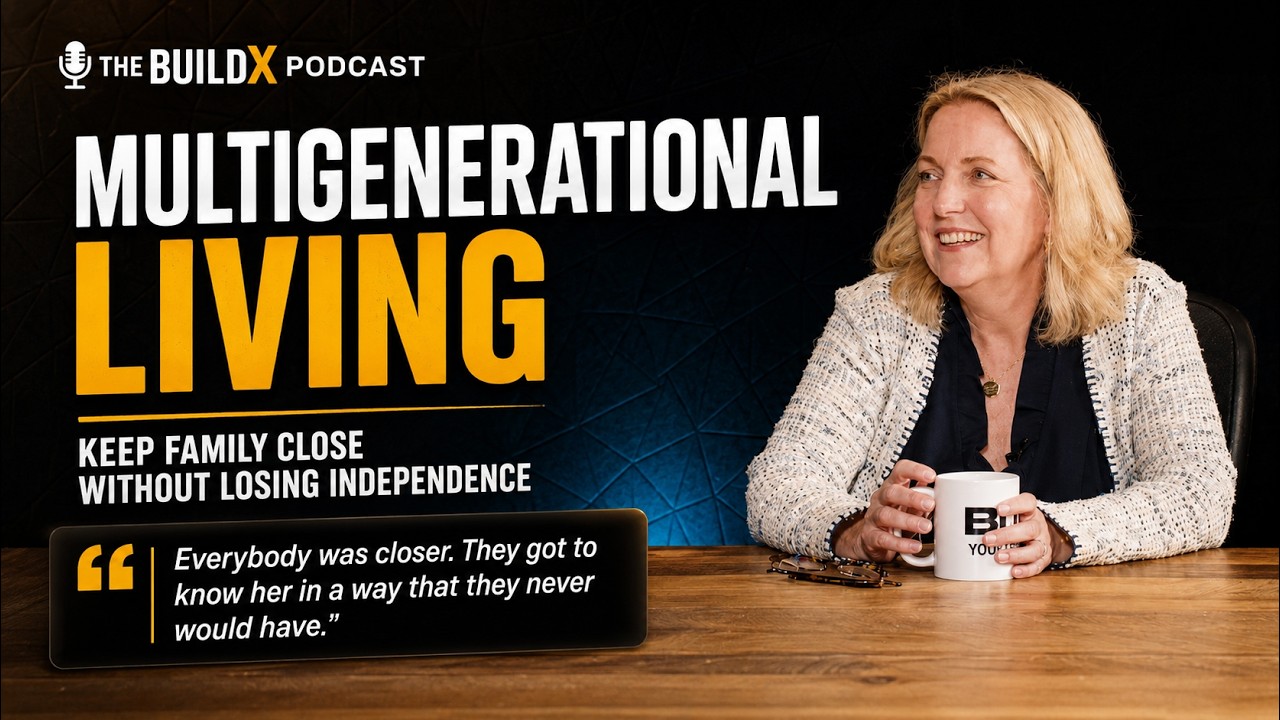
Watch: What Happens When Mom Can't Live Alone Anymore: ADUs, Aging Parents, and Family Planning with Juli Ford
When a parent begins to need help, most families think about the decision as caring for an elder person first and a money problem second. Moving mom and dad into your home can feel like a sacrifice, a loss of privacy and independence for all of you. The financial part is looked at as a cost that has to be paid for rather than a strategy to plan. The underlying question is always the same. Does the money part actually work out well enough to justify the change, or is combining households just a compromise you make because the other choices are worse?
My name is Buz Artiano, and I am the founder of BuildX. We've built dozens of ADU projects across Massachusetts, mostly around the South Shore and Plymouth County areas. We are the only team you need: we do the design, permitting, and construction. So we see every phase of a project from the first site visit up until you move in. We evaluate septic constraints, zoning issues, utility connections and the requirement to get a permit from the city. We've dealt with many families that are combining households and learned that the financial side isn't usually the reason for doing so.
On our podcast, we sat down with Juli Ford, founder of Home After 50 and a longtime supporter of multi-generational living. Her own family has lived this way for more than 10 years, and the financial part she talked about is a very clear example of the positive side to this arrangement. Her experience and ours come to the same conclusion: for the right family, the money part really works. But it isn't for everyone. The dollar figures depend on your home and your parent's situation, so we deal with three things and the honest tradeoffs instead of a number we can't guarantee.
Quick Answer: Putting a household together with an aging parent can be a long-term financial plan not just a compromise to take care of them. The payoff is real but is measured by quality and not quantity and it depends on your home, the contribution of the parent and how you set up ownership. Three things drive it: a parent's monthly contribution replaces rent so the household can afford more, the parent's retirement lasts longer when they don't have rent or mortgage to pay, and the home that's shared builds equity that compounds for years. It isn't for every family, and the money part only works when everyone agrees openly and the arrangement is put in writing. Dollar amounts will be different for everyone so put the arrangement in writing. Dollar figures vary too much to promise, so treat the levers, not a number, as the answer.
In This Article
- Is Multi-Generational Living Actually Worth It Financially?
- How Much Does a Parent's Monthly Contribution Change What You Can Afford?
- What Happens to Home Equity Over the Years?
- Does the Parent Need a Purpose-Built ADU, or Can You Use Existing Space?
- When Is Combining Households Not Worth It?
- How to Tell If the Numbers Work for Your Family
Is Multi-Generational Living Actually Worth It Financially?
Yes. For families who can make it work, combining households can be a real financial strategy, not just a way to manage eldercare. The reason it gets underestimated is that families walk in focused on the care problem, solve that, and then discover a set of financial benefits they never planned for.
Juli Ford put it plainly when she described her own family's decade-plus arrangement. As she said on our podcast: "the thing that I didn't anticipate were all of the financial benefits that were going to come from it. I mean, we knew going in that there were financial reasons for doing it." The need for care brought the family together. The financial upside is what surprised them.
Here is the honest version, and the part that answers the worry directly. Combining households does feel like a sacrifice going in, and the money does not work out for everyone. But when it works, it works through three specific things and none of them need a spreadsheet to understand.
- A parent's monthly contribution replaces the rent the household would otherwise pay, so the family can afford a better home.
- The parent's own retirement lasts longer because they don't have to pay a rent or mortgage payment each month.
- The shared home builds equity that will stay in the family, and can be borrowed against or passed down.
None of this shows up right away. It grows over time, and it starts with the parent's monthly contribution.
How Much Does a Parent's Monthly Contribution Change What You Can Afford?
The first idea is the simplest. A parent who contributes every month instead of paying rent or a mortgage will improve the buying power of the whole household. Ford's family felt this immediately. In her words: "We could afford a larger house closer to Boston with my mom's contribution than we could have on our own. And my mom could make her retirement last years and years longer by not paying rent every month, making a contribution to us."
Read that carefully and notice how it works both ways. The hosting family gets more house in a better location and the parents get to stretch out their retirement money. The money that used to go toward rent now stays within the family and goes toward something the family owns. The contribution isn't just financial, and that addresses the worry that this is purely a sacrifice for the parent. A parent in this situation doesn't have to deal with the daily upkeep of a home and we've seen what a relief that is to them. The lawn, the driveway, and the seasonal maintenance that wears people down aren't theirs to do alone. Ford described her mother the same way, saying she "doesn't think about a thing." The contribution of the parents keeps them out of the daily grind of running a house by themselves which is also part of the return.
What Happens to Home Equity Over the Years?
The third part of this is where the real long-term wealth shows up, and it's the one families almost never plan for at the start. When a parent contributes to a home they don't own, the equity goes to the host family and that's how Ford's family set it up. As she explained: "my mom didn't want to own a house. She just wanted to make a contribution and live. And that was fine with us. So our agreement was that she doesn't have ownership of the house. She just makes a contribution. And we were the beneficiary of all the equity."
That way of doing it is a decision, not a requirement and it has to be agreed to. In Ford's case, the equity didn't just sit there. It went into a series of financial decisions over more than a decade. Her family had bought their first house in 2004 and spent years underwater on the mortgage after the 2008 downturn. During those years, as Ford put it, they had "zero college savings." This multi-generational arrangement reversed that.
When Ford's brother's family had a crisis, the equity was a lifeline. Ford said: "We took out a home equity loan. We used that to make a down payment on a small house to rent to them." Two years later, she said, the brother's family "had recovered their credit enough to buy the house from us," and did so "at market rate." The equity helped one branch of the family when they needed it, then it was returned to the family when the house sold.
And it kept working. Ford summed up the whole effect: "our multi-gen home has done way more than just benefit us and my mom and our kids. It's helped my brother and his family. It's helped pay for my two kids to go to college." So a family that started with no college savings ended up being able to pay for two college educations, and it was the equity that combining households made possible.
Here is the honest caution. Ford's family never put dollar amounts on any of this on the show and we're not going to invent them. What her story shows is the figures on any of this on the show, and we are not going to invent them. What her story documents is the benefits, such as contribution instead of paying rent, extended retirement and equity that grows. It is not a guaranteed return you can bank on. The benefits will depend on your home's value, your parent's contribution, and how you set up the ownership from the start.
Does the Parent Need a Purpose-Built ADU, or Can You Use Existing Space?
This is where we need to discuss an important part of Ford's story. Her mother didn't move into an ADU we built: she moved into a pre-existing in-law apartment inside a Pembroke home which already existed. The BuildX ADU in Ford's family is a different building entirely, owned by her niece and her niece's wife. We let you know this because the financial benefits we talk about above don't depend on the structure being a brand-new ADU. They depend on the household being combined. An in-law apartment, a converted basement or garage, or a purpose-built ADU can all give someone the same three advantages.
What does change with those options is the cost upfront and the long-term flexibility. This is where building dozens of these ADUs has taught us something most families don't consider. When you convert an existing space it's almost always cheaper to start. But we've seen families outgrow a converted in-law apartment in just a few years, when a parent's needs change or they have to have just a single level. A purpose-built ADU costs more in the beginning but in exchange you are planning for the next fifteen years instead of remodeling for the next two. A single level layout, a foundation and utilities that stand on their own, and the choice to separate or maybe sell the unit later if the family's situation changes may be invaluable. The right answer is not automatic. It's a tradeoff between what you spend now and what flexibility you will have later. It should be decided before anyone starts remodeling.
If an ADU built for a specific purpose is the right direction for you, Massachusetts now makes it easier than it used to be. The state allows a homeowner to build one accessory dwelling unit by right, without a special permit, under the Affordable Homes Act. You can review the requirements at mass.gov. Building code, health code, and your town's dimensional rules still apply, which is exactly the kind of detail we handle for families under one roof.
When Is Combining Households Not Worth It?
We build ADUs for a living, so you would think that we'd tell every family that combining households is the right way to do things. It isn't. Ford, who has become one of the strongest proponents of multi-generational living you will find, said this: "it's not for everybody. Not everyone can combine households with their family."
The financial benefits are real but the most important thing are the family relationships. If the relationship can't deal with daily closeness, no contribution or advantage in the equity will fix that, and the money won't have been worth it. This arrangement also only works when the money situation is discussed openly and the agreement is put in writing, so a contribution, the ownership plan and what will happen if a parent dies are all decided before anyone moves in. Families who don't do that step give up a clear financial plan for a future problem.
And the dollars aren't guaranteed. Ford's family came out ahead over more than 10 years but there was a certain chain of events that happened, including a financial downturn, a family crisis, and a home that was sold back at market rate, that won't be the same for anyone else. If you need the arrangement to give you a certain number to make it worthwhile then combining households isn't for you. If you want a durable, flexible way to house family members while keeping money and equity inside the family, it's one of the best choices there is.
How to Tell If the Numbers Work for Your Family
The financial case for combining households comes down to three things: a parent's contribution in place of paying rent, a longer retirement option for the parents, and shared equity within the family. The one honest question is whether your family relationship, and your willingness to settle the money in writing, can support the arrangement long enough for those three things to work. If the answer is yes, multi-generational living is a financial strategy, not a compromise. The next step is figuring it out for your specific property and finances.
We will look at your home, your parent's situation, and your goals, and give you a clear, honest opinion on whether combining households makes financial sense for your family, and what it would take to build it.
See a completed ADU in person or Request a Free Consultation
Call us: (781) 627-7000