
Why Does a New ADU Need an Energy Recovery Ventilator (ERV)?
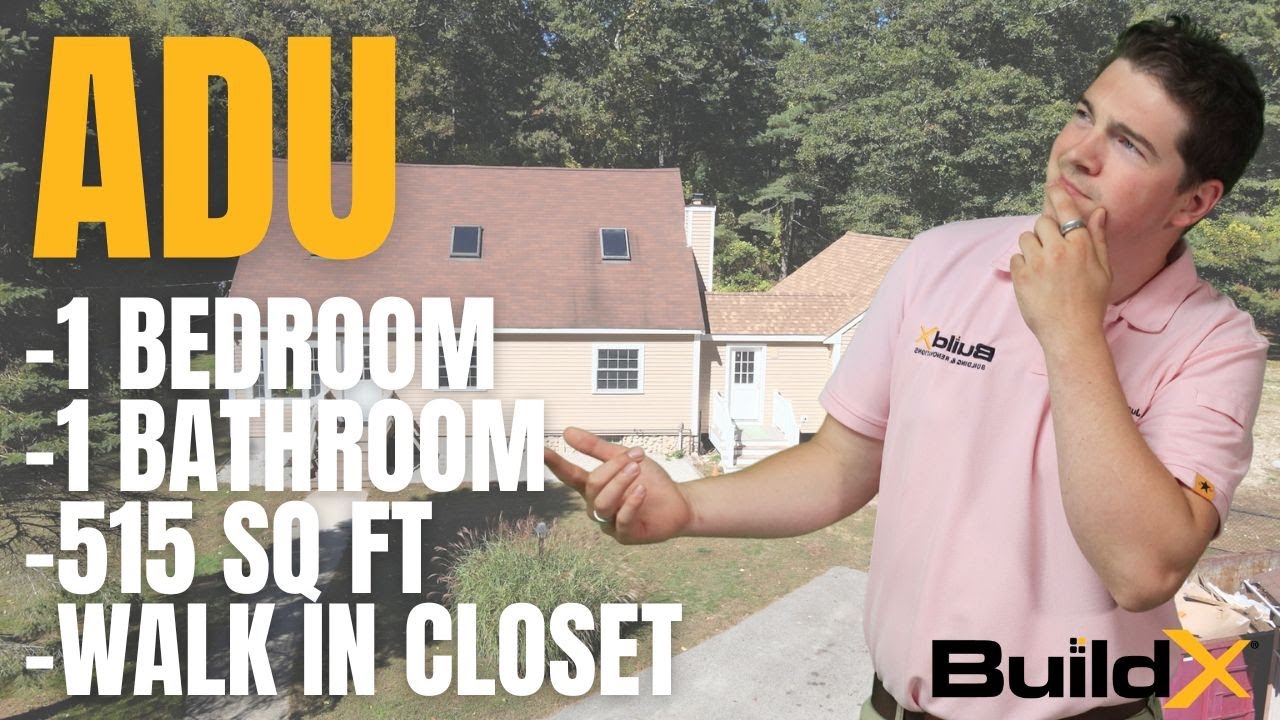
Watch: Move-In Ready Massachusetts ADU Tour | Finished Attached Accessory Unit
When it comes to the mechanicals part of your ADU proposal, there's a line item you never asked for. It's called an ERV, which stands for energy recovery ventilator, and it's basically a metal box that will hang in a closet or a ceiling bay and runs for as long as the building is there. Nobody ever asks for one. The reaction we hear a lot when it's brought up is that it's another piece of equipment to power, service, and eventually to replace, and the house you grew up in didn't have one, so why do you need one now.
My name is Buz Artiano, founder of BuildX. We've built dozens of ADUs across Massachusetts, mostly around the South Shore and in Plymouth County. We handle every step of the process from design to permitting to construction under one roof. That means we make the sizing decision for the mechanical package in an ADU, we go before the building inspector, and we are the ones who have to deal with air sealing and ventilation, and Massachusetts code treats them as one requirement instead of two separate ones.
Our position on that ERV box is not complicated. It is not an upgrade we want to sell you. It's just the necessary equipment that makes a modern, tightly built ADU livable, and the reason it's in your ADU is the same reason your ADU will hold heat much better than the main house. In a finished ADU we walked in Pembroke, the ERV was installed and running before anybody moved in.
Quick Answer: A new ADU is built to a level of air tightness that stops it from cycling in fresh air on its own, so fresh air has to be brought in by a machine. An energy recovery ventilator is what does that. It runs continuously at its designed ventilation rate, filters fresh air coming into the home and pushes stale air out. At the same time it hands off heat between the two air streams so you're not paying to reheat all the air it brings inside. In Massachusetts towns that have adopted the Stretch or Specialized energy code, heat or energy recovery ventilation is required in every home, and the airflow is verified on site.
In This Article
- Why Can't a New ADU Just Breathe on Its Own?
- What Does the ERV Actually Do When It Cycles On?
- What Energy Recovery Means on Your Heating Bill
- Does Massachusetts Code Require an ERV in My ADU?
- What Will I Actually Have to Do to Keep an ERV Running?
- What Should I Ask My Builder About Fresh Air?
- Where an ERV Is Not the Answer
- Ready to See One Running in a Finished ADU?
Why Can't a New ADU Just Breathe on Its Own?
Because it was specifically built not to. A new ADU in Massachusetts goes up with an air barrier around the whole shell, with the insulation installed to excellent quality, and with the breaks and joints in that barrier all sealed up. That's very much on purpose because it's what the energy code requires, and it's the whole reason a small unit can be heated inexpensively.
Massachusetts sits in climate zone 5A. In this climate an older house breathes through the gaps around the windows, unsealed holes, a rim joist that doesn't have foam around it, etc. That air exchange was never part of the design, it just happens because things aren't sealed up properly. And it has cost you extra money to heat your house your whole life because of it.
But if you fix all the leaks, there's no air leaking in anymore. Cooking, showering, laundry, and the people living there all put moisture and smells into the tightly sealed home you now have. So the fresh air gets delivered on purpose, continuously, by a machine, after being filtered and the heat energy saved. That's what an ERV does.
What Does the ERV Actually Do When It Cycles On?
It basically does four things. It runs continuously at its designed ventilation rate rather than waiting for somebody to hit a switch. It filters the air passing through it. It moves that air through the home rather than letting it just sit there. And it works in both directions at once, pulling fresh outdoor air in on one side while pushing stale indoor air out on the other. Creating a healthy and energy efficient air exchange is what it's made for.
That two way air exchange is what balanced means when it comes to ventilation, which is the most important. The amount of air going in and out are the same, so it doesn't create any suction or change in air pressure, it stays perfectly balanced. Any system that moves air in only one direction forces air out of any gap it can find, and in a well-sealed ADU there shouldn't be any gaps, so you have to have something that creates a balanced in and out exchange of the air.
What Energy Recovery Means on Your Heating Bill
The "recovery" part of the name is the part most people don't think about. Getting fresh air into a building in February would usually waste a lot of heated indoor air and you have to pay to re-heat the air inside every time you get fresh outside cold air. You do that all winter long and it adds a lot to your electric bill.
An energy recovery ventilator lets the indoor and outdoor air flow past each other inside a core. The outgoing warm air transfers its heat to the incoming cold air before it goes out. In an ERV the core transfers humidity with the heat. That's the difference: "heat recovery" transfers heat, "energy recovery" transfers heat and moisture.
The Massachusetts energy code puts a minimum on how much heat the equipment has to transfer. In layman's terms, it lets in the fresh air without letting the heat escape.
Does Massachusetts Code Require an ERV in My ADU?
Whether or not you are required to install an ERV depends on your town, and you definitely want to take a few minutes of your time to find out before you sign anything.
Massachusetts has three levels of building energy code. The Base Code applies everywhere in the state, no exceptions. But there are two other versions that are a bit more strict, they're called the Stretch Code and the Specialized Code. Those two are optional, and each city and town decides for itself which one it wants to go by. You can see which one your town uses at mass.gov.
In the communities that have adopted the Stretch or Specialized Code, the residential energy code requires every dwelling unit to have a continuously operating, balanced mechanical ventilation system whose airflow is verified on site. But it gets even more strict than that. Heat or energy recovery ventilation is required for all homes as well. You still have to have one even when a project decides to go by the HERS rating, because it's one of the very few things that stays a requirement even if you decide to go that route.
The code goes even further than just requiring the equipment. It has to perform at a certain level, be a verified installation, run at a certain level of quiet, and the paperwork must be handed to whoever lives there. Cfm is cubic feet per minute, that's the unit of measurement used to measure air movement. "Sensible recovery" just means it only exchanges heat. Enthalpy recovery means it exchanges heat and moisture. A sone just measures sound, a lower number means quieter. A HERS Rater is a certified third-party energy rater, completely separate from your builder and installer.
| Requirement in the residential energy code | What it specifies |
|---|---|
| Ventilation system type | Continuously operating, balanced, mechanical, in every dwelling unit |
| Recovery | Heat or energy recovery balanced ventilation provided for dwelling units |
| Units rated above 300 cfm | Enthalpy recovery ratio of 50 percent or higher at cooling design condition and 60 percent or higher at heating design condition |
| Units rated 300 cfm or lower | Sensible recovery efficiency of 65 percent or higher at 32 degrees Fahrenheit |
| Airflow verification | Tested and verified by a HERS Rater, HERS Rating Field Inspector, or applicable BPI Certified Professional |
| Fan noise | 1.0 sone maximum for whole-building ventilation fans |
| Owner handoff | Ventilation design, system information, and operating and maintenance instructions provided to the owner and the occupant, with controls labeled |
All the rules are at mass.gov.
What Will I Actually Have to Do to Keep an ERV Running?
Day to day, you don't have to do anything with it. It runs continuously at its designed ventilation rate. There's nothing you have to remember to turn on and off. You have to clean or change the filters and follow the manufacturer's other maintenance instructions. We can't tell you at exactly what intervals you have to clean or change them because that depends on your specific ADU and it comes from the manufacturer not from us. That is precisely the question to put to your builder in writing before the mechanical package gets ordered. You need to know which unit, what filter, how often, and what a replacement costs. You also want to ask about the life of service, which can only come from the manufacturer. Ask for it and compare against the model on your spec sheet.
In Stretch and Specialized Code towns that answer is already built into the code. The code says that the design, the system information, and the operating and maintenance instructions have to be provided to the owner and the occupant, and the controls have to be precisely labeled so it's clear what they do.
You are responsible for one job, and it is seasonal. The code requires that ventilation air inlets stay clear of snow, debris, plants, and any other obstruction, and that they stay at least 10 feet from plumbing vents, appliance vent outlets, exhaust hoods, and vehicle exhaust. On a tight ADU lot those specs determine exactly where the outlets can go. After you move in you just have to keep them clear. A hedge planted in front of a fresh air intake, or a snowbank pushed against one, negates the whole job the equipment is there to do.
What Should I Ask My Builder About Fresh Air?
You are putting together a comparison sheet of builders now, and ventilation is the line most people don't think to add. Four questions will tell you if they offer a specially designed system or not:
- Which energy code does the town go by, and does the estimate apply to Base, Stretch, or Specialized code?
- Which make and model of ventilation system will they be using, and what is its rated airflow in cfm?
- Who verifies the installed airflow on site, and when does that happen?
- What documentation and operating instructions come with the unit at handoff?
A builder who answers those four on the spot has designed a system. A builder who says the HVAC contractor will sort it out later is just giving you the price of a box. The difference in a system that is designed correctly is that it's quiet, filtered, and warm. It's not a fan somebody turned down because it was loud when nobody really knew what it was for.
Where an ERV Is Not the Answer
We put energy recovery ventilation in the ADUs we build, so you should expect us to defend it. Here is where the defense stops.
An ERV doesn't make up for a building that wasn't sealed properly. Ventilation equipment gets sized against a building that performs the way the drawings claim. When the blower door comes back saying there's too much air leakage, the answer is finding the leaks, not turning the fan up to make up for it.
It also doesn't replace other small ventilation systems in a home like a bathroom fan or a range hood pulling grease and cooking byproducts out of a kitchen. Those are separate jobs handled by separate equipment.
And we're not going to hand you a ballpark figure on energy recovery versus heat recovery. That is a mechanical design decision, made per project by the person sizing the system against your ADU, your blower door results, and how many people will live there. A builder who gives you a universal answer is not looking out for your best interests. Ask the question about your project, and expect an answer with real numbers.
Ready to See One Running in a Finished ADU?
If you're building a new home in Massachusetts, the ventilation system isn't something you want to negotiate out because it's what lets the rest of the building do its job.
It's not about whether to get one or not. It's whether the builder in front of you can tell you which unit, how much air it moves, who verifies it, and what you get in writing on the day they hand over the keys. That is a question best answered standing inside a finished unit.
We'll size the ventilation against your envelope numbers, specify the unit by make and model, and show you the airflow verification before you ever take the keys.
See a finished ADU with the system running or Request a Free Consultation
Call us: (781) 627-7000