
Do You Have to Pay for a Modular ADU in Full Before It's Set on Your Foundation?
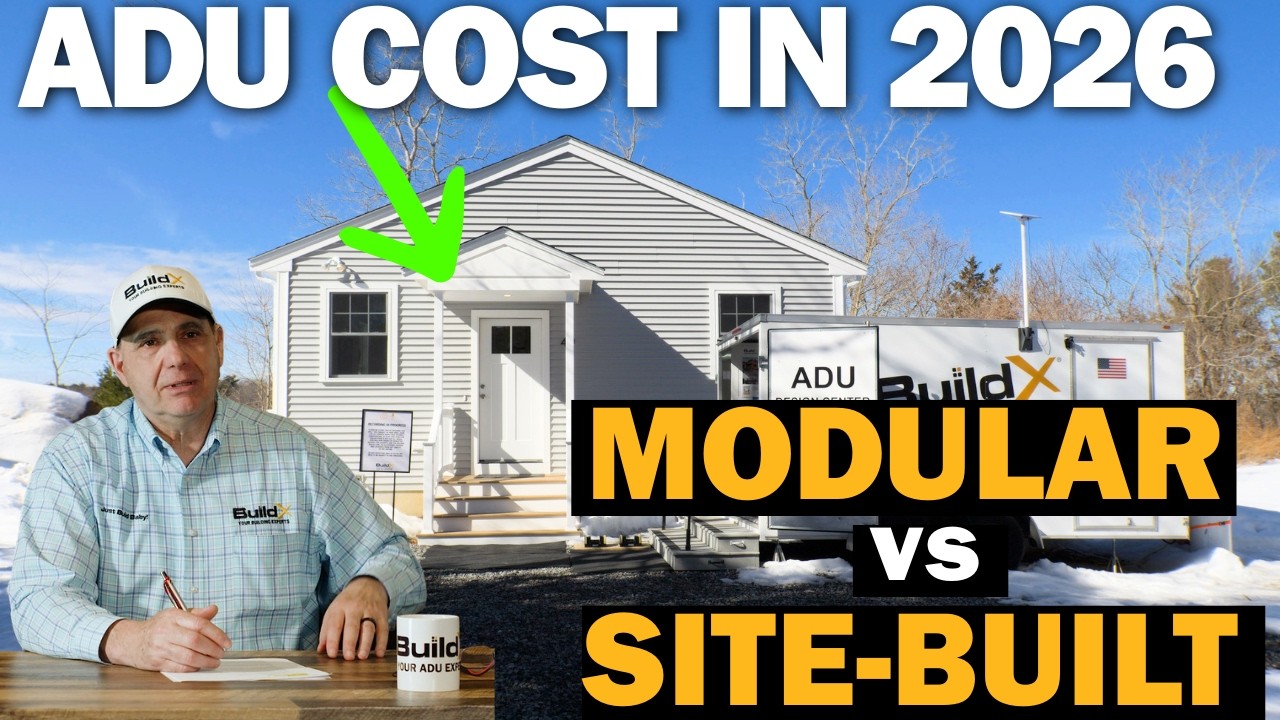
Watch: The Hidden Costs of Modular ADUs (Before You Sign Anything)
You have a quote for a modular ADU and it seems like a very manageable number. The question you really need an answer for isn't about the cost of the ADU, it's about when you have to have the money. Nobody really advertises or talks about that part. Every ad or website you see shows a price front and center, but none of them say when you have to have that amount of money in hand.
My name is Buz Artiano, founder of BuildX. We've built dozens of ADUs all over Massachusetts, mostly around the South Shore and in Plymouth County. We handle everything through the entire process. That means we do the design, the permitting, and the construction. So every day we are dealing with septic evaluations, lot coverage math, and the town-by-town permitting that decides what you're actually allowed to build on your lot. Unfortunately we've had too many families come to us in the middle of a modular ADU purchase with a quote in their hand and a delivery date, and another extra invoice they didn't even know they were going to receive.
Our opinion here is very simple. The payment schedule is a bigger risk than the actual price, because paying in chunks over the time of a build is much different than having to pay everything upfront on the delivery date. The modular purchases we've seen collect basically the whole amount on the delivery day. Then you get a bill for all the site work on top of that later.
Quick Answer: In the modular purchases we've watched, yes, you do have to pay the full amount on delivery. You pay the entire invoice amount before it's ever set on your foundation, which means a very large chunk of money leaves your account at delivery instead of when everything is complete. The whole thing involves months of sales processes, deposit, scheduled delivery, site-readiness invoice, then payment in full when the unit arrives. Site prep, foundation, permits, utility hookups, and finish work are billed separately, and you don't get that bill until after you've paid your deposit. Ask any modular company for written payment milestones before you sign anything.
In This Article
- When Does the Money Actually Leave Your Account?
- Why Does a Low Sticker Price Make the Cash Problem Worse, Not Better?
- What Payment Questions Should You Ask Before You Put Down a Deposit?
- Is Modular Ever the Right Call for Your Property?
- Where a Turnkey Quote Puts the Money Instead
- Get the Payment Schedule in Writing Before You Wire Anything
When Does the Money Actually Leave Your Account?
You pay for the unit in full before it's ever set on your foundation. That's the whole answer, and it is the most important thing to know in the entire purchase process. The unit is not billed as progress is made on the property, it's billed when it arrives. There is a huge investment the moment that house shows up, and you have to pay before the crane sets it on the foundation, before the utilities are hooked up, and before anyone does anything to the inside.
Here's the order that we've seen things go in for a modular unit purchase. Months with a prefab company working through design and pricing, then you pay a deposit, and schedule a delivery date. Then the site-readiness invoice shows up, which is a separate bill for everything that has to happen on your land to get ready for the unit. You need site prep, foundation, permits, utility hookups, and finish work. On top of that you have to make payment in full for the unit itself when it arrives.
Written out in order instead of just a price list, the risk starts to become really obvious. Two of those four stages are huge payments, and they happen back to back.
| Stage of the purchase | What is happening | What leaves your account |
|---|---|---|
| Sales process | Months of design conversations, options, and quoting with a prefab company | Nothing yet |
| Deposit | You commit to the purchase and a delivery date goes on the calendar | The deposit. We cannot state the figure for you, because it is set by the company you sign with |
| Site-readiness invoice | The separate bill arrives for site prep, foundation, permits, utility hookups, and finish work | The full cost of everything that is not the box, on that company's terms |
| Delivery | The unit arrives on your property and is craned into position | Payment in full for the unit, before it is set on your foundation |
Here is the part no sales person or ad or brochure tells you. The reason the unit has to be paid for at delivery has nothing to do with how a company treats its customers. It has to do with where the unit is built. A factory's cost is fully committed the moment that box leaves the warehouse. Everything that happens after that like the crane, the set, the foundation, the hookups, and the finish work, happens on your property as a whole separate process. So the contract covering the box has nothing to do with anything other than the box itself. Site-built works very differently, because the construction happens on the property, not somewhere else off-site, which is why the billing can come after the work is done. That's the entire reason that going the modular route means you are paying everything all at once. Whether a stick build is easier for you or not comes down to the payment schedule you negotiate with your contractor, which is why you should get it in writing from anyone, including us.
Why Does a Low Sticker Price Make the Cash Problem Worse, Not Better?
When you see an ad for an ADU starting at $120,000, it sounds like a really great deal. When a modular company quotes $120,000 or $150,000, what they are selling is just a manufacturer's structure, essentially the shell of the ADU: the walls, the roof, and some interior finishes. None we showed you in the table above are included in that, and that gap in price is exactly where the timing issue is.
The families who came to us had a $165,000 unit on order. The site-readiness invoice that came after that added another $180,000 on top of it. They were wrong about getting a deal, unfortunately. Everything on that site readiness invoice are the things we listed above in the table. It was site prep, foundation, permits, utility hookups, and finish work, all priced out. The project still had the same requirements, it was the date the money was due that was the problem.
When you add everything up, a $150,000 modular ADU becomes $350,000 to $450,000 installed, which is the same price as a fully custom site-built ADU and sometimes even more expensive! The lower the advertised sticker, the more cost they are leaving off the invoice, and your payment requirements are not what you expected them to be.
But let's be straight up about the limits of what we can tell you here. This is just what we saw watching other families go through the modular purchase process, we have not read any specific contracts. We are not calling out a certain company, we are not saying anything about deposit percentages, and we don't know enough to publish anybody's schedule for the whole process. Only the company asking you to sign can give you those numbers, but make sure you are asking for them.
What Payment Questions Should You Ask Before You Put Down a Deposit?
The fix for all of this is not a more educated guess, you have to get something in writing. Before making any payments or deposits, get the payment terms in writing, because a verbal agreement is as good as no agreement. Five questions you should ask are:
- Ask what the deposit is as a specific dollar amount and what that money is applied to later.
- Ask when the balance for the unit is due, whether it's at delivery or completion.
- Ask who issues the site-readiness invoice, when it arrives, and what will be on it.
- Ask what is not included in the quoted price and who will be getting you a price on those things.
- Ask what happens to your deposit if the site-readiness invoice is more than you can afford.
That last question is the one almost nobody asks, but that's literally what tells you how much a surprise is going to cost you. A family got to that point and then walked away from their deposit, because the total had gone way over what a custom ADU would have cost them from the start. It wasn't the size of the project or the work that had to be done, it was about how and when they had to pay.
Ask for all five of those questions in writing from every builder you talk to, and that includes us. You can't budget for anything if a company quotes you one price and then bills you more than twice that much on a separate invoice.
Is Modular Ever the Right Call for Your Property?
We build site-built ADUs, so of course we prefer that option, but here's the honest version.
Delivery-based payment is not automatically a bad thing. If you have the cash, and making one large payment doesn't put your household under stress, and if you've priced the site work yourself before you sign, then the way a modular company does things would be exactly what you expect and what you are told. The issue is when it's a surprise.
Where it stops working is when a household is stretched thin financially. If the deposit is coming out of savings and the balance is coming out of financing that hasn't gone through yet, a delivery date turns into a stressful deadline, and you have no wiggle room if the site-readiness invoice is more than you planned for. That is not a modular problem and it is not a site-built problem. It is a cash-position problem, and you should get honest answers before you fall in love with a floor plan.
Where a Turnkey Quote Puts the Money Instead
At BuildX, we do things differently. We quote turnkey from day one, and our price includes absolutely everything. It covers all the way from permits to paint. Let's be clear on what turnkey means, because the word gets used loosely. It means there is no second invoice for the things a modular unit price leaves out. Site prep, foundation, permits, utility hookups, and finish work are all included in the number you were quoted, no surprises.
That doesn't automatically make the money easier to get. It just makes the quote transparent from the beginning, which is a big deal at this stage of your decision. You're comparing a complete project against a complete project instead of comparing a shell against a finished house. Once a quote is genuinely turnkey, you don't have to worry about a second invoice showing up, you just have to decide whether the quoted price works for your family.
Ask us for our payment terms in writing too. We would rather you compare two schedules side by side than take our word for it.
Get the Payment Schedule in Writing Before You Wire Anything
In a modular purchase, the unit is paid in full before it is set on your foundation, and the bill for everything else arrives separately in its own time. Knowing that changes what you ask for and when you ask for it. You are not trying to find the cheapest sticker. You are trying to find out exactly when the money is due.
Get the schedule in writing from whoever you are talking to, hold it up against a turnkey number for a true comparison, and make the call together.
We will quote your project turnkey from day one, walk you line by line through what is included from permits all the way to paint, and put the payment terms in front of you in writing before you commit to anything.
Walk through a completed ADU in person or Request a Free Consultation
Call us: (781) 627-7000