
What Are the Real Costs of Financing an ADU with a Renovation HELOC?
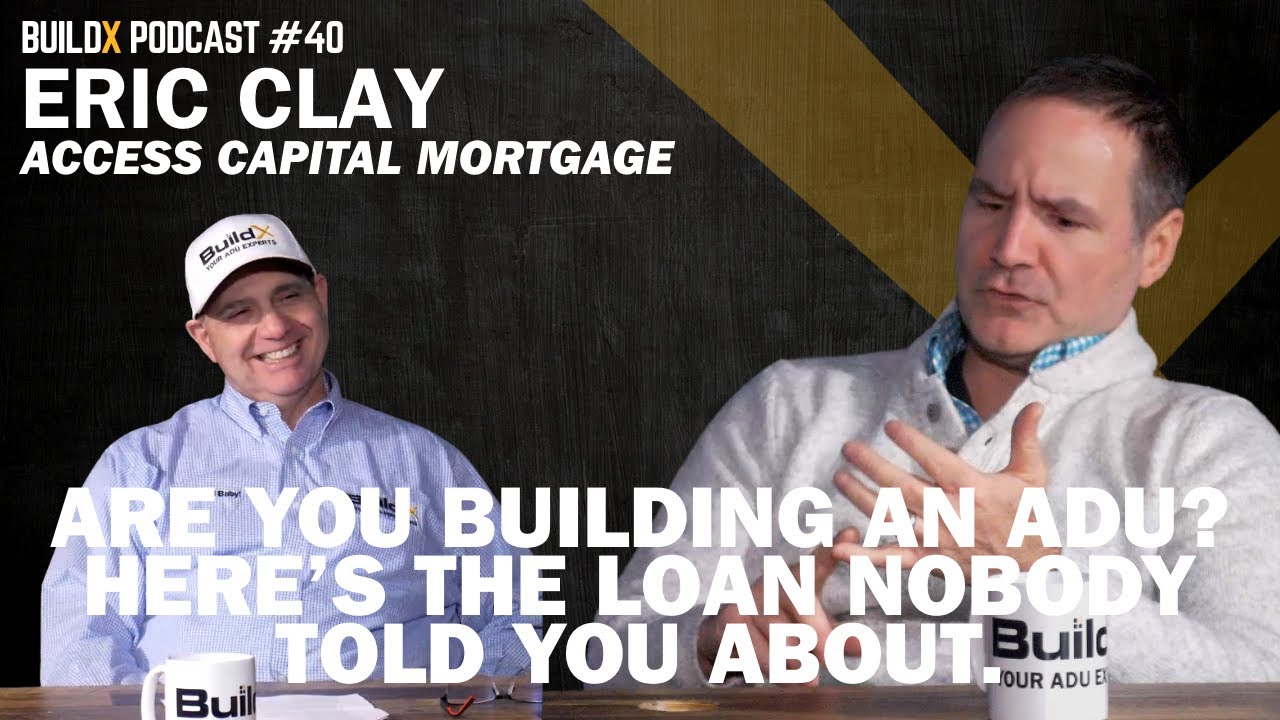
Watch: How to Build an ADU Without Touching Your First Mortgage -- Eric Clay | BuildX Podcast #40
You've been running numbers because you're thinking about building an ADU. You know what the basic price will be, but you still have a lot of questions about the financing. Interest rates, closing costs, monthly fees during construction, appraisal charges. Every time you talk to a bank you discover more costs you didn't know about, and you still don't have a good idea of what the total cost of the financing will be on an ADU project. Not knowing makes it hard to commit.
My name is Buz Artiano, and I am the founder of BuildX. We've built dozens of ADU projects across Massachusetts, mostly around the South Shore and Plymouth County areas. We are the only team you need: we handle design, permitting, and construction. So we see every phase of a project from the first site visit up until you move in. We deal with septic constraints, zoning issues, and the state's new ADU laws. One of the questions we hear in almost every consult is not just what the ADU will cost to build, but what it will cost to finance.
You need a real answer to those questions with real numbers. In this article, we'll talk about every financing cost you deal with when you get a Renovation HELOC, it's a loan that lets you build an ADU without refinancing your existing mortgage. We'll talk about closing costs, construction-phase fees, appraisal costs, and give you an overall example so you can figure out what your costs would be before you commit.
Quick Answer: If you finance an ADU with a Renovation HELOC, it usually ends up costing around $12,000 to $15,000. That's for closing costs, plus interest-only payments at rates that go anywhere from prime plus 0.5% to prime plus 3% depending on your credit and loan-to-value ratio. As of November 2025, the prime rate is 7%, so that means the total interest rate could be 7.5% to 10%. You also have to pay a $150 monthly fee during construction and between $575 and $900 for the appraisal. There's no prepayment penalty, and you only pay interest on money you've already used.
What Does Financing an ADU with a Renovation HELOC Actually Cost?
The total financing cost of a Renovation HELOC breaks down into three categories. You've got upfront costs you pay at closing, there are recurring costs during construction, and there are ongoing interest payments after the build is complete. If you don't understand all three, you might think you have a realistic budget, but it's likely to fall apart in the middle of the project.
Closing costs on a Reno HELOC are about the same as a regular mortgage. It's going to be about $6,000 in closing costs and another $5,000 to $6,000 in prepaids (taxes, insurance escrow, and interest). That means your total closing costs could be $12,000 to $15,000.
While you're still in the construction phase, the bank charges you a $150 monthly monitoring fee, which is basically their fee for managing the loan. Unlike a 203K or HomeStyle renovation loan, the Renovation HELOC doesn't require an inspection every time you need to pull money to pay a contractor. The bank only sends an inspector one time, once construction is finished. That's how they confirm the work is done, and the $150 monthly fee stops.
The other upfront cost is the appraisal. A residential appraisal runs $575 to $675, but for the purpose of building an ADU it runs $800 to $900. The appraisal is the first out-of-pocket expense in the process; you order it after you get your pre-approval from the bank.
How Are Interest Rates Determined on a Renovation HELOC?
Renovation HELOC interest rates are variable; they come out to prime rate plus a couple points usually. The rate you get depends on your credit score and your loan-to-value ratio (LTV). As of November 2025, the prime rate sits at 7%.
For people with good credit (740 or above) and a comfortable LTV, rates can be as low as prime plus 0.5%, which equals about 7.5%. For borrowers with a higher LTV or lower credit scores, rates can reach prime plus 2% to 3%, putting the total rate closer to 9% or 10%.
The interest rate doesn't stay the same though. Because the Renovation HELOC is a variable-rate product, your rate moves with the current interest rates. If the Federal Reserve cuts rates, your payment goes down. If rates go up, so does your payment. For current prime rate data, visit federalreserve.gov.
Every time we have a conversation about financing, people ask us about the rate. But a lot of people don't even know that during construction, you're only paying interest on money that's actually been pulled to pay for work. You start out with a zero balance. If the build costs $400,000, you're not paying interest on $400,000 from the start. You are paying interest on the money your contractor draws as construction moves forward. On a six-month build schedule, your average balance during construction is roughly half the total loan amount. That makes a huge difference in your actual out-of-pocket cost compared to a renovation loan where you pay interest on the full amount from day one.
What Will My Monthly Payment Look Like During and After Construction?
During construction, you make interest-only payments on whatever money you've pulled so far. If you've drawn $200,000 at a 10% rate, your annual interest is $20,000, which means your interest-only payment would be $1,667 per month. As you pull more money, the payment goes up.
Once construction is complete and you've used the full amount, the payment stabilizes as interest-only for the next 10 years. On a $400,000 balance at 10%, that is approximately $3,333 per month in interest-only payments. At a 7.5% rate, the same balance costs about $2,500 per month.
After the 10-year draw period ends, the loan converts to a regular loan with a 20-year repayment term. At that point, you start paying both principal and interest, which will make your monthly payment go up. You can always prepay with no penalties at any time, so if your family's financial situation changes, you can pay the balance down to zero and just keep the credit line open and available for use for the rest of the draw period.
What Does the Total Cost of Borrowing Look Like on a $400,000 ADU?
Understanding individual line items is helpful, but families making this decision need to see how all the numbers work together. Here's an example using round numbers based on a real scenario we come across all the time.
The table below assumes a homeowner with a $600,000 property, an existing $200,000 first mortgage at a low rate, and a $400,000 ADU construction cost. The Renovation HELOC just exists alongside the existing mortgage, which stays untouched.
| Cost Item | Estimated Range |
|---|---|
| Closing costs (lender fees, title, recording) | $6,000 to $8,000 |
| Prepaids (taxes, insurance escrow, per-diem interest) | $5,000 to $6,000 |
| Appraisal | $575 to $900 |
| Construction monitoring fee ($150/mo x 6 months) | $900 |
| Points (if applicable, situation-dependent) | Varies |
| Total upfront/closing costs | $12,475 to $15,800 |
| Monthly interest during construction (average) | $1,667 to $2,500 |
| Monthly interest after completion ($400K balance) | $2,500 to $3,333 |
These numbers assume a rate between 7.5% and 10%. Your actual rate obviously depends on your credit score and LTV. But the main thing to remember here is that on a $400,000 ADU, your total financing costs over the first year of construction will be $30,000 to $45,000 on top of the construction cost. That's not a small amount of money, and most people don't think about this when they are making their budget.
How Do These Costs Compare to Other ADU Financing Options?
The Renovation HELOC is not the only way you can finance an ADU, and it's important to understand the differences in cost so you can make the right decision. The most common alternative is a renovation loan, such as the FHA 203K or the conventional HomeStyle product.
Renovation loans require an HUD inspector, which adds $1,000 to $2,000 to the cost. More importantly, every time your contractor has to draw money it requires an inspection by whoever the bank sends out, which creates delays of a couple weeks every time. With the Renovation HELOC, you are given a checkbook to write checks to your contractor when needed; you don't have to wait for the inspector.
The other major cost difference is interest that accrues. On a renovation loan, you pay interest on the full loan amount from day one. On the Renovation HELOC, you only pay interest on the money you have used. Over a six-month construction period on a $400,000 project, the difference is thousands of dollars.
The main tradeoff is that renovation loans have third-party management with an HUD inspector. If you're working with a contractor you don't know well enough to have full trust in, that oversight can be very helpful. The inspector verifies the pricing and the progress before approving each payment. With the Renovation HELOC, you're managing your contractor and making all the payments yourself. We manage all of this for every BuildX project, but if you're thinking about using a builder who doesn't, it's important to know these things.
Is a Renovation HELOC the Right Financing Choice for Every ADU Project?
No. And we wouldn't recommend it for every situation. The Renovation HELOC works best for homeowners who have a lot of equity, strong credit, and a builder that they know and trust. If you meet those criteria, this type of loan can give you lower payments during construction, faster draws, and the ability to leave your existing mortgage untouched.
If your credit score is below 660 you don't qualify for a reno HELOC. If your equity doesn't meet the LTV requirements (95% of after-repair value or 125% of as-is value), the numbers just won't work. And based on the experience from our lending partners, approximately 70% to 80% of homeowners don't qualify due to credit, income, or asset limitations.
For families who don't qualify for a Renovation HELOC, other options include the FHA 203K (lower credit requirements, with HUD oversight), a construction-to-permanent loan, or a cash-out refinance if the difference in the rate is manageable. Each product has different cost structures, and the right choice depends on your specific financial situation.
Your ADU Budget Deserves Real Numbers, Not Estimates
The cost of financing is just as real as the cost of lumber, concrete, and labor. A Renovation HELOC on a $400,000 ADU will add approximately $12,000 to $16,000 in upfront costs and $2,500 to $3,333 per month in interest-only payments at current rates. Those are real numbers you can plan for. The ones who get through their project easily are the ones who planned for the financing costs from day one, not the ones who discover them later on in the process.
We will walk through your equity position, your rate scenario, and your total cost of borrowing so you have a complete budget before you commit to anything.
See what a finished ADU looks like in person or Request a Free Consultation
Call us: (781) 627-7000