
How Can You Use Home Equity to Build an ADU Without a New Mortgage?
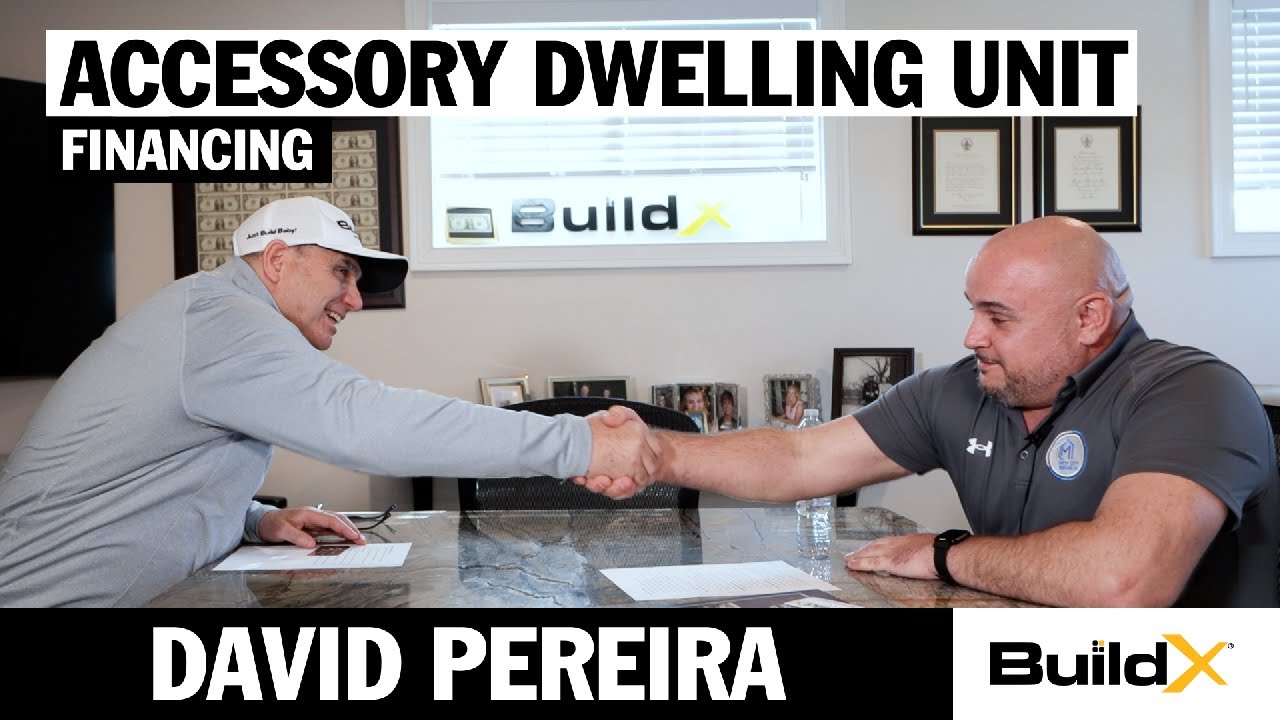
Watch: Mastering Mortgages | David Pereira's Inside Scoop on ADU Financing
You've spent years building equity in your home. Now you want to build an ADU for an aging parent, an adult child, or for rental income. But there's one major question or issue that is stopping you (and lots of other families) from moving forward. You want to know if you'll have to refinance your house and lose the low rate you locked in during COVID. For people who were able to get a 3 percent mortgage rate, it feels like refinancing to a 7% is not moving forward, it's moving backward. But you are right to worry about this, it's literally the number one concern we hear from families who call us.
My name is Buz Artiano, and I'm the founder of BuildX, a design-build firm that has completed dozens of ADU projects across Massachusetts, mostly around the South Shore and throughout Plymouth County. We handle design, permitting, and construction under one roof, and that includes helping families figure out the financial side of things before we start construction. We work closely with mortgage brokers who specialize in ADU financing, so we know what financing options work for real people in the real world, on real Massachusetts properties, under septic constraints, lot coverage limits, and town zoning requirements.
This article breaks down how home equity loans and home equity lines of credit work specifically for ADU construction, who is a good candidate for them, how all the math works, and things you need to watch out for. If you have equity in your home and you don't want to mess with your mortgage, this is probably the best way to go. We'll show you why.
Quick Answer: Yes, you can use a home equity loan or a home equity line of credit (HELOC) to pay for your ADU without touching your existing mortgage. Your first mortgage stays in place and you keep the current rate. You borrow against the equity you have already built, that can be up to 80 percent of your home's current value minus what you still owe. You'll pay no prepayment penalties, and if rates drop later, you can refinance the HELOC and it still doesn't affect your first mortgage.
In This Article
- How Does a Home Equity Loan Work for ADU Construction?
- How Is a HELOC Different From a Home Equity Loan?
- What If You Need to Sell a Parent's Home After the ADU Is Built?
- What Does the Monthly Payment Actually Look Like?
- Do You Have Enough Equity to Fund Your ADU?
- Is a Home Equity Product Always the Right Choice?
- Your Equity Is Already Working for You
How Does a Home Equity Loan Work for ADU Construction?
A home equity loan is a closed-end second lien on your property. You borrow a certain amount, get the money from the bank, and then make fixed monthly payments on that amount until it's paid off. Your first mortgage stays exactly how it is, at whatever rate you originally locked in. You just have two loans with separate terms, payments and rate.
The math is actually pretty simple. Lenders usually let you borrow up to 80 percent of your home's appraised value, minus what you still owe on your first mortgage. So if your home is appraised at $700,000 and you owe $250,000 on your first mortgage, you have $310,000 in borrowable equity (80 percent of $700,000 is $560,000, minus $250,000). That's plenty to cover most ADU construction projects in Massachusetts, because a finished ADU usually runs between $250,000 to $350,000.
Home equity loans can have a fixed rate or variable rate. With a fixed rate, your payment stays the same until you pay it off, it doesn't fluctuate with the market at all. With a variable rate, your payment goes up and down with current interest rates, but most variable-rate loans have an interest rate cap that limits how high or low the rate can go. There's no repayment penalties on either type of loan, so if rates drop in the future, you can refinance or pay down the balance without paying a fee for that.
How Is a HELOC Different From a Home Equity Loan?
A home equity line of credit, or HELOC, is an open-ended second loan. Instead of receiving a lump sum of money, you get a credit line that you can draw from, pay down, and pull money again during the interest-only period. It works a little like a credit card where you only pay interest on what you've spent. The most common interest-only period is 10 years. During that 10 years, you pay interest only on whatever balance you currently owe, not on the full credit line.
That flexibility is what makes a HELOC really useful for ADU construction. You pull money from the line of credit as the ADU is being built, which means you're not paying interest on money that you haven't even spent yet. If your ADU costs $300,000 and you draw $75,000 in the first month for site work and foundation, you only pay interest on $75,000 that month, not the full $300,000. As construction progresses and you draw more, your interest payments increase depending on how much money you've used.
The main difference between the two is that a home equity loan gives you a fixed payment regardless of how much you use or how much you've paid down. Even if you pay the balance from $300,000 to $50,000, your monthly payment stays the same. With a HELOC the monthly payment changes depending on the balance of the line of credit. If you pay the balance down to $50,000, you only pay interest on $50,000. If you pay the balance to zero, the line stays open and available for you to pull more money from, but costs you nothing unless you spend more money.
What If You Need to Sell a Parent's Home After the ADU Is Built?
This is the most common financing scenario we see at BuildX. A family wants to move their parent closer, so they build an ADU on the adult child's property. The parent is still living in their own home, which has a lot of equity but there's no cash available to the family. The family needs to fund construction now and recoup the cost when the parent's home sells later.
But the answer is actually easy. The adult child takes out a home equity loan or HELOC against their own property to pay for the ADU. After they sell the parents' home, the family uses that money to pay down or pay off the HELOC. If the house sale makes enough to cover the full balance, the HELOC goes to zero and stays available as an open line of credit, but costs nothing until you use it. If the home sale only covers most but not all of it, the remaining balance will still have a very manageable monthly payment.
We evaluate this scenario before we write a proposal, because the timing of construction and the timing of a home sale almost never align perfectly. On most of our Plymouth County projects, construction runs 90 to 120 days from foundation to move-in, but the parent's home sale might take 30 to 90 days or more after listing it on the market. The gap in time is important. We structure our project timeline so the ADU is move-in ready before the parent lists their home for sale so that they can move straight from their home to the ADU without having to stay somewhere temporary in between. Doing it this way avoids the family having to pay two monthly house payments and reduces all that stress of having to move twice. It's a detail that only shows up when you've managed enough of these projects to see what causes the most stress.
What Does the Monthly Payment Actually Look Like?
The monthly cost of a home equity loan depends on three things. One, the amount borrowed, two, the interest rate, and three, whether you will have a fixed-payment or interest-only. Here's how that all plays out at current interest rates.
For these examples we will say we're working with $300,000 in ADU construction cost. As of early 2025, home equity loan rates for well-qualified borrowers typically range from 7.5 percent to 10 percent, depending on credit score, loan-to-value ratio, and lender. HELOC rates are variable and tend to be just a tad less than fixed home equity loan rates during the interest-only period. The table below shows the monthly payments under two scenarios.
| Home Equity Loan (Fixed) | HELOC (Interest-Only Period) | |
|---|---|---|
| Amount Borrowed | $300,000 | $300,000 |
| Estimated Rate | 8.5% fixed | 8.0% variable |
| Monthly Payment | $2,611 (principal + interest, 20-year term) | $2,000 (interest only) |
| Payoff Flexibility | Fixed payment stays the same even if you pay down early | Pay down to $0, payment drops to $0; draw again if needed |
These are illustrative examples based on current market conditions. Rates and terms vary by lender, credit profile, and loan-to-value ratio. Confirm current figures with your lender before making decisions.
Do You Have Enough Equity to Fund Your ADU?
The formula to qualify is simple: just take 80 percent of your home's current appraised value and then take away the amount that you owe on your mortgage. This will be the amount of equity that you can borrow. If that amount is equal to or greater than the cost of your ADU construction then a home equity loan is probably your best and easiest option for financing.
Here is an example. Let's say your home is appraised at $700,000 and you owe $250,000 on your first mortgage. Eighty percent of $700,000 is $560,000. So subtract the $250,000 you owe, and that will leave you with $310,000 in available equity. That will pay for a $300,000 ADU with room to spare. Your first mortgage will just stay in place at the rate you already have locked in and then the home equity loan or HELOC is behind that first mortgage as a second lien.
If the equity you have in your first mortgage isn't enough to cover the full cost of the ADU construction, you have other things you can do. Some families will put a smaller home equity draw together with their cash savings. Others will check out a renovation loan from the FHA 203K or Fannie Mae HomeStyle, which will allow a higher loan-to-value ratio but will make you replace the first mortgage with a single new loan. You should understand that tradeoff before you make a decision. With a renovation loan you might be able to borrow more but you will have to give up your existing rate of interest.
Is a Home Equity Product Always the Right Choice?
No. A home equity loan or HELOC is only the right choice if you have enough equity, when your current mortgage rate is low enough to protect, and when you want to keep things simple by having two separate loans. It is not the right choice for everyone's situation.
If you don't have enough equity to pay for the total cost of construction, then just taking out a home equity loan by itself alone won't cover the balance of the construction costs. You would need to check out renovation loans (FHA 203K for attached ADUs, Fannie Mae HomeStyle for detached), that will let you borrow against the after-repair value of the property. These loans take the place of your first mortgage, so you lose the interest rate you currently have, but they do allow higher loan amounts for families who need them.
If your credit score is below 620, it will be difficult for you to qualify for most home equity loans. To get an FHA 203K loan you have to have a minimum credit score of 620, and other conventional loans usually require 680 or higher for rates that would be competitive. A mortgage broker who works with many different lenders can help you understand what your options are depending on your individual financial circumstances.
We encourage every family to talk to a qualified mortgage broker before deciding what financial solution to go with. We work with lenders who specialize in ADU construction loans in Massachusetts, and we'd be more than happy to introduce them. But we also encourage you to shop around and do your own research. The right financing depends on your equity position, your credit, your existing rate, and when you want to have it paid off. There isn't a cookie cutter solution for everyone.
Your Equity Is Already Working for You
If you've built equity in your home and you want to build an ADU without touching your existing mortgage, a home equity loan or HELOC gives you a clear, well-understood path forward. Your first mortgage stays exactly the same and you borrow only what you need, when you need it, and you pay it back on terms that work for you.
The next step is understanding what your options are with the equity you have. We are here when you're ready to start that conversation.
We will walk through your equity numbers, connect you with lending partners who specialize in ADU financing, and give you a realistic picture of what your property can support before you commit to anything.
See what your investment looks like in a finished ADU or Request a Free Consultation
Call us: (781) 627-7000