
Can the Utility Company Stop Me from Putting Solar on My ADU?
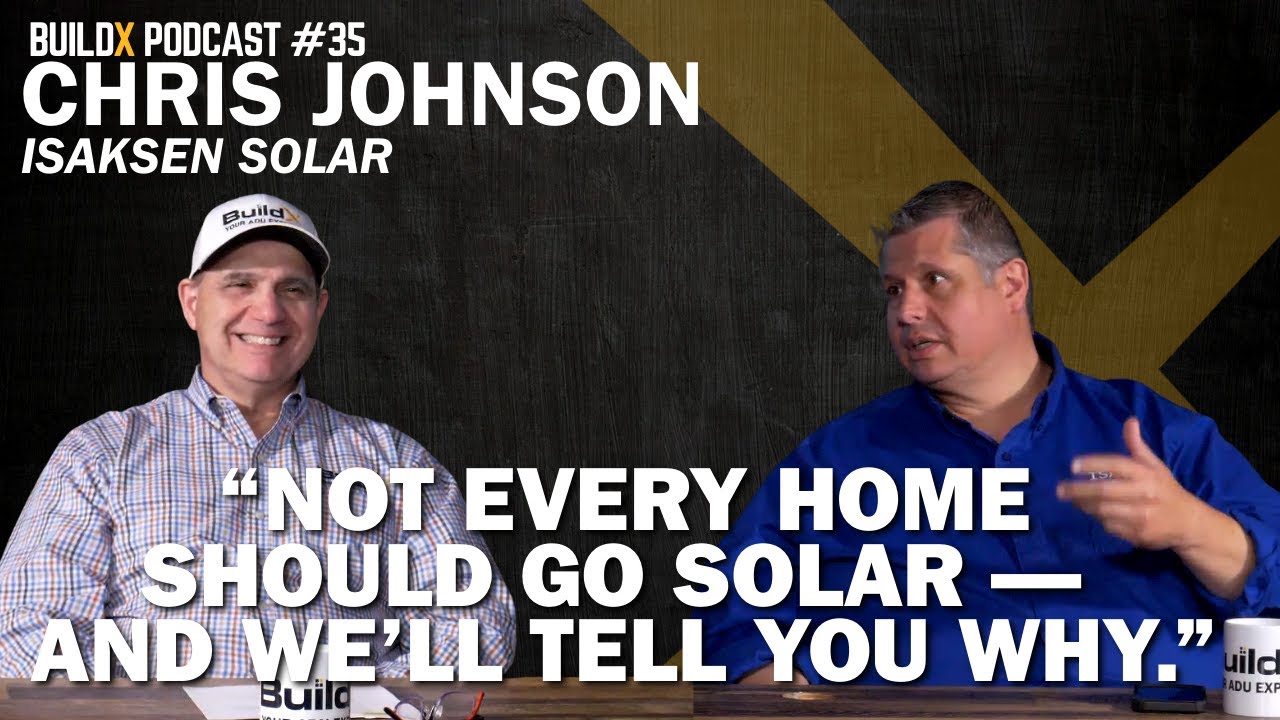
Watch: How Solar Really Works for Builders, Homeowners, and ADUs | BuildX Podcast #35
You've chosen the plane for the roof and you have a proposal from a solar company. The building inspector has signed off on the ADU and you thought everyone involved had given their approval. Then a fourth party you didn't hire, have never met and didn't ask for a quote has decided your ADU can't connect to the grid unless you pay for equipment at the street level. That will cost five figures and it usually comes after the design is already built around the solar panels.
My name is Buz Artiano, and I am the founder of BuildX. We've built dozens of ADU projects across Massachusetts, mostly around the South Shore and Plymouth County areas. We are the only team you need: we do the design, permitting, and construction. So we see every phase of a project from the first site visit up until you move in. We evaluate septic constraints, zoning issues, utility connections and the requirements for a permit from the city. Utility interconnection is something that also needs an approval and it's the one thing that most surprises homeowners.
We treat interconnection as something that needs an approval and has its own price tag. It's not just a formality. The families who are hurt by this are those who learn about it late, after the roof is framed and there's already a budget. The utility does have authority and the cost of a denial is known. But both can be managed when the questions are dealt with before the design instead of after.
Quick Answer: Yes. In Massachusetts, your electric company has to give final approval for your ADU solar system to connect to the grid, and that approval is separate from your building permit. Outright denials are uncommon. The usual answer is a conditional approval that makes you pay for a transformer or line upgrade on your street. Chris Johnson of Isaacson Solar said that upgrade costs about $8,000 to $20,000 and the approval time is four to six weeks. State rules say the full cost of the system upgrade has to be paid by the project that triggered it. So be sure and get the interconnection application filed before you design the ADU around the panels.
In This Article
- Can the Utility Company Actually Say No to My ADU Solar?
- Why Would the Utility Have a Problem With My Panels?
- What Does a Transformer Upgrade Actually Cost Me?
- How Long Before I Know Whether I Am Approved?
- What Happens to My ADU If Solar Gets Denied?
- When We Tell Families to Skip Solar on Their ADU
- How to Settle the Interconnection Question Before You Design Around Solar
Can the Utility Company Actually Say No to My ADU Solar?
Yes. The electric distribution company for your street has the approval authority over the grid connection, and that authority is completely separate from your town's permit process. Massachusetts interconnection standards from the Department of Public Utilities says that a customer putting in a solar system has to get utility approval before the system can be installed. The Department publishes its interconnection resources at mass.gov.
Two terms are the most important so we are discussing those here. Interconnection is the utility's technical and commercial review of connecting your generating equipment to its distribution system. It's not a building permit, or an electrical permit, and no official in your town can give it out. Distributed generation is electricity that you generate from your property instead of at a central power plant. Rooftop solar on an ADU is distributed generation, which means that it has to be reviewed.
Chris Johnson of Isaacson Solar joined us on the BuildX Podcast to talk about what this means for an ADU, and his position was blunt. Even after the homeowner decides to go forward with solar, the project itself doesn't necessarily move forward, because the homeowner isn't in control. The utility company is the one that decides whether you can go.
We called it a power trip on the show, because it is the power company. That made people laugh and it also changed how most homeowners think of the approval process. Your town isn't the last one to sign off on an ADU with solar, it's second to last.
One thing to know here, because it changes what you plan for. A flat, permanent no isn't the common outcome. Chris made it clear that an outright denial doesn't happen very often. The outcome that costs families money is the conditional yes.
Why Would the Utility Have a Problem With My Panels?
No problem with the panels. The problem is out at the street, with equipment you don't own and can't change.
The distribution transformer is the cylinder on the pole or the green box on the pad that brings the power voltage down to what a house actually uses. Each one serves a small number of addresses. Exported power is the electricity your system produces that you're not using at the moment, and that flows backwards through that transformer and onto the utility lines.
Chris put this simply. The issue is the transformers on the street, because any power you produce that you're not using has to go back and the transformer might not be able to handle the excess.
Homeowners hear the word grid and think of something that's for a whole region. The part of the grid that determines your project is just a handful of houses and it's sized for how much electricity those addresses use, not how much they send back. An ADU demand for electricity and then once panels go up and a new source that sends electricity out on the same circuit.changes both halves of that equation at once. That's why an ADU solar application is looked at more closely than just the addition of another panel on an existing roof would be.
Chris also said there are towns where solar doesn't work, because the existing equipment can't use any more exported power without an upgrade. That's something that can vary from street to street depending on the physical equipment. It's not a policy your town voted on, and no zoning approval changes it.
What Does a Transformer Upgrade Actually Cost Me?
Four things determine this and all four have to be resolved before you will know the real cost. Understanding them in order is what separates a family who plans for the cost from a family who gets blindsided by it.
- Whether your circuit already has room for more exported power
- Whether the utility's impact study says your project will require an upgrade
- Who has to pay the upgrade cost under state rules
- Whether your circuit fits within a utility group study that spreads the cost
The first two are science and paperwork. Your installer will submit the application, then the utility examines the circuit, and they either find enough room or they don't. Nothing about the ADU, your budget, or your intentions has an influence on the results.
The third thing to consider is where the money goes and Massachusetts is clear about this. A distributed generation facility whose interconnection triggers a system upgrade pays the full cost of that upgrade. The Department of Public Utilities has also set up a framework that lets electric companies file capital investment project proposals to put a limit on what a single project can be charged. Homeowners would pay for the construction up front and then be reimbursed over a period of time by other projects that use the same circuit. As of August 2026, a project would be eligible for that only if the upgrade brings the cost down to $500 per kilowatt or less for interconnecting homeowners. The program guide is published at mass.gov.
The fourth possibility is one worth checking before any of the others because it's public. Eversource has filed group studies under that framework that covers Plymouth, Cape Cod, Freetown, Dartmouth and Westport, Marion and Fairhaven, and New Bedford. Those are the areas where we build. A family building an ADU in that area is building on circuits that the utility has already said are constrained enough to need an upgrade. That's not a reason to abandon solar, it's just a reason to ask the question sooner rather than later.
With all those things on the table, the cost is good to know. On the podcast, Chris described it this way: the utility says it's nice you want to put in solar, but you'll have to pay for an upgrade to the transformer that costs anywhere from $8,000 to $20,000, which most homeowners aren't going to want to do.
That estimate is one installer's field experience with his own projects. It's not a published utility rate, or a statewide standard, and not a number that we can quote for your own project. Just think of it as an amount to plan around and get your own written cost from the interconnection study before you commit to paying anything.
An interconnection review will give you one of three results, and the cost of each is different. Knowing which one you're at tells you whether solar is a good idea for your project.
| Interconnection review result | What it means for the project | What it costs you |
|---|---|---|
| Approved as submitted | The circuit has room for your exported power | No grid-side cost |
| Approved with an upgrade condition | New equipment is required before your system can export | The upgrade cost is allocated to your project, subject to the state cap framework |
| Not approved at the submitted design | The circuit cannot absorb the exported power as proposed | A redesign, or the ADU proceeds without panels |
How Long Before I Know Whether I Am Approved?
Chris says the approval can take four to six weeks from application. On the show we said that's quite a while, and it is, because it comes in the middle of a building calendar that won't stop for it.
Two things happen at the same time. The interconnection application has been sent to the utility and at the same time the solar company also works on its own building permits that have to be approved as well. Neither process waits for the other one, and they don't wait for your framing crew either.
Your installer sends in the application. Chris confirmed that his company deals with all the pieces, and that's standard in this industry. And that's also exactly why the timing gets overlooked. When nobody on the project is in charge of the calendar, the application will be filed whenever the solar contract gets signed, which usually is long after the ADU design is decided.
Two things protect you from counting on the wrong figure. The four to six weeks that is Chris's estimate for his own company's project history is in an investor-owned utility area in Massachusetts, but is not a written utility service rule. Eversource was mentioned on the podcast as a stand-in for whichever utility serves the address, but not as a claim about that company's specific timeline. You need to check the current facts with your installer and your serving utility before you plan your schedule around it.
What Happens to My ADU If Solar Gets Denied?
The podcast conversation didn't get to this question and on an actual build it's the one that matters most. The answer here comes from how we design, not from the episode.
We build every ADU so the utility's answer can't stop the project. The plane of the roof that would hold panels gets framed so they can carry them whether or not they ever arrive. The electrical service is sized for what the ADU itself needs, not for a generating system that hasn't been approved yet. And the budget is based on the ADU standing alone, because a family who is depending on solar credits to make their monthly budget work is a family that's taking a risk until the utility makes a decision. Panels are an upgrade to a working ADU but you shouldn't assume they are going to pay for your energy costs.
There are three definite things you should do and all must happen before you sign a solar contract.
- File the interconnection application during design, not when you sign the contract
- Ask your installer for the circuit's known conditions in writing before you make a commitment
- Figure the cost of the ADU as though the answer is no, and then treat approval as a bonus
If you do those things in order then a conditional approval is just a line in the budget you already planned for. If you do it backwards and you could end up with an expensive emergency in the middle of the build.
When We Tell Families to Skip Solar on Their ADU
You'd think that a design-build company that frames solar-ready roofs to encourage solar on every project. We don't, and interconnection is one of the reasons.
There are three situations where we tell a family to leave the panels off, at least for now.
- The budget doesn't have room for the initial costs, so that outweighs the savings
- The move-in date is fixed, and waiting on a utility answer can cost the family more than the savings from the solar panels
- The family wants certainty, and solar brings uncertainty that neither we nor they can control
Solar is a good addition to an ADU when the circuit cooperates and the budget has room for it. It's a poor idea if either one is tight. We'd rather say that before the roof is framed than after the interconnection study comes back, and we'd rather forget the solar than give the family a surprise they can't handle.
How to Settle the Interconnection Question Before You Design Around Solar
The real decision here was never if solar is worth it. The decision is where in the order of things will the utility give you an answer. If you ask the question during the design phase when a conditional approval is just a budget line you can plan for, then your project isn't at risk.
We'll look at your service address, get the interconnection application going during design instead of after framing, and show you exactly what your ADU budget will be if the utility responds with a transformer condition attached.
Tour a finished BuildX ADU or Request a Free Consultation
Call us: (781) 627-7000