
Should You Wait for Interest Rates to Drop Before Financing Your ADU?
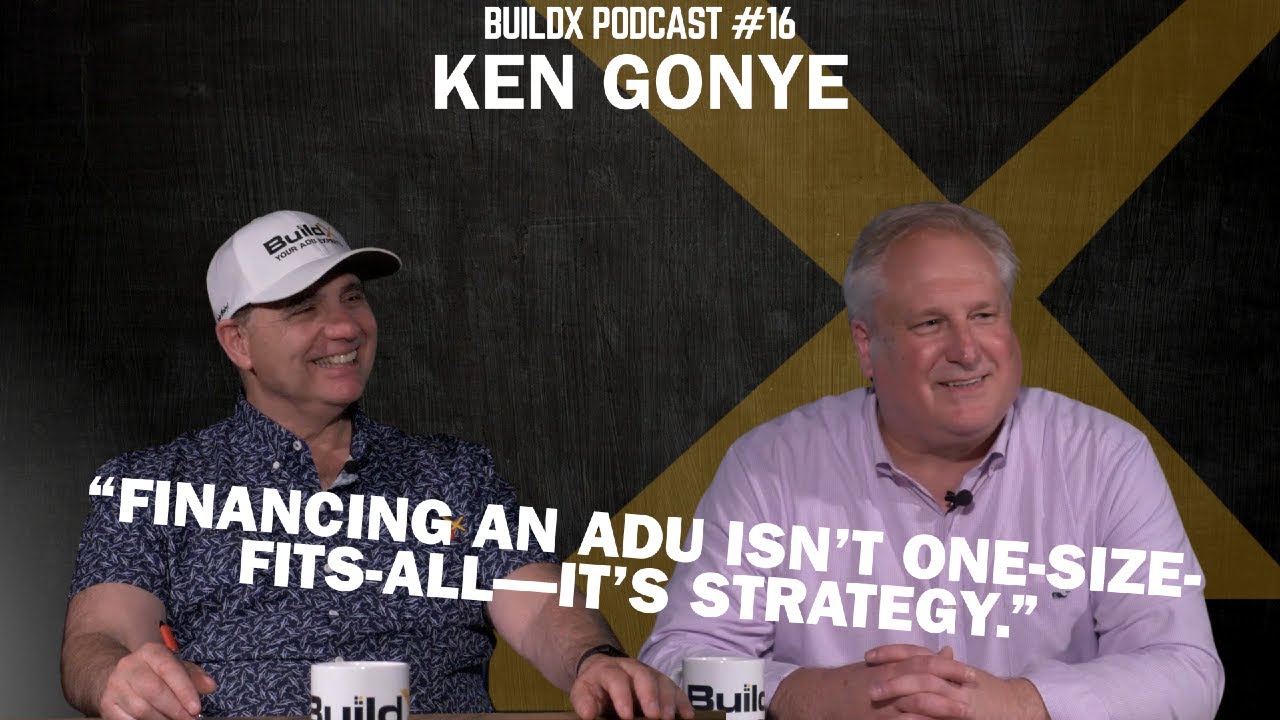
Watch: ADU Financing, HELOCs & Construction Loans Made Simple w/ Ken Gonye | BuildX Podcast #15
You have been watching mortgage rates for months or maybe even years. The interest rates for a mortgage aren't what your parents paid, and every time you check, someone is saying that the rates are going to go down. So you wait. In the meantime, the ADU you need to build for your family isn't getting built. So month after month goes by and your aging parent is stuck in a house that doesn't work for them. Or perhaps an adult child can't find any housing they can afford nearby. The question is not whether rates will eventually come down but if waiting will actually save you money.
My name is Buz Artiano, and I am the founder of BuildX. We've built dozens of ADU projects across Massachusetts, mostly around the South Shore and Plymouth County areas. We are the only team you need, because we handle design, all the permits, and construction. We deal with septic constraints, zoning issues, and the state's new ADU laws. We oversee every phase of a project from the first site visit up until you move in. Financing is one of the most common discussions we have with families before a project begins, and it is the one phase where waiting can be more expensive than going forward.
In our conversation with Ken Gonye, a senior mortgage executive with over 35 years of lending experience, we talked about the real math behind the "wait for rates" decision. Here is what we talk about with every family who can't decide: the specific rate thresholds that make it worth it to refinance, how a HELOC will let you act right now and still keep your current low-rate mortgage, and why the total cost of your ADU is about more than just the interest rate on one loan.
Quick Answer: No. For most homeowners in Massachusetts waiting for interest rates to go down isn't the best idea cost-wise. A HELOC will allow you to borrow against the equity you already have at a variable rate (currently near 7% to 7.5%) without doing anything with your low-rate first mortgage. You pay interest only on the money you take out, and when fixed rates drop below 4.4% to 4.5%, you can refinance both loans into one mortgage with a fixed rate. Building now with a HELOC and then refinancing later gives you the ADU today while keeping the option to get a lower interest rate when it is available.
In This Article
- Should You Wait for Rates to Drop, or Should You Build Now?
- How Does a HELOC Let You Act Now Without Giving Up Your Low Mortgage Rate?
- What Rate Threshold Makes Refinancing Your HELOC Worthwhile?
- What Happens to Your HELOC Payment After Construction Is Finished?
- How Much Equity Do You Need to Qualify for a HELOC?
- What If You Do Not Have Enough Equity for a HELOC?
- When Does Waiting Actually Make Sense?
- Your ADU's Cost Is More Than Just the Interest Rate
Should You Wait for Rates to Drop, or Should You Build Now?
The short answer is that waiting doesn't usually make sense cost-wise and this is why. When you finance an ADU with a HELOC, you are not getting rid of your existing mortgage. You are just opening a separate line of credit that is secured by the equity you have in your home. Your 3% first mortgage stays exactly where it is. The HELOC is also in place, and you only pay interest on the amount you have actually used.
That difference matters because it gets rid of the biggest fear homeowners have which is losing a low fixed rate. A HELOC that is tied to prime rate can go up and down but that is only for a certain period of time. You control how much you take out and when. If it takes four to six months to build your ADU, your payments increase gradually as the project moves forward, not all at once.
The families we work with who decide to wait sometimes find out that construction costs keep going up. Material prices, labor rates, and permit timelines all go in just one direction. A homeowner who waits 18 months for a one-point drop in interest rates might find out that the ADU itself costs $15,000 to $25,000 more than it would have at today's prices. The savings on rates for a $300,000 HELOC balance at one point lower is just about $3,000 per year. It would take five years of that savings to counteract a $15,000 construction cost increase.
How Does a HELOC Let You Act Now Without Giving Up Your Low Mortgage Rate?
A HELOC, or Home Equity Line of Credit, is a revolving line of credit that is secured by the equity you have in your property. Most HELOCs have a 20 year term that is divided into two parts. The first is a 10-year draw period where you can borrow and pay back as you need, and the second is a 10-year payback period where the balance is gradually paid off with fixed principal-and-interest payments.
During the draw period you will only be making payments on the interest, which is figured on whatever balance you still have left. If you have a $400,000 HELOC but have only taken out $100,000 for the foundation and framing phase of your ADU, you are paying interest on $100,000, not the full credit line. As the builder takes out more funds for electrical, plumbing, and finishes, your payment will go up in proportion.
The rate on most HELOCs goes up and down and is connected to whatever the prime rate is. When this article was written, prime was at 7.5%, and Salem Five Mortgage was offering HELOCs at prime minus half a point, which puts it at 7%. A lot of banks also offer a special lower rate for the first six months. Salem Five's introductory rate was 5.99%. But as always, rates and terms are subject to change. You'll want to confirm current figures with your lender before making decisions.
The important thing to remember is that your first mortgage stays untouched. If you were able to score a 2.75% or 3.25% rate during the low-rate window, you get to keep it. The HELOC is a completely separate loan. You're not refinancing or replacing your current mortgage. You're borrowing more money against equity you have already built.
What Rate Threshold Makes Refinancing Your HELOC Worthwhile?
This is the number most homeowners are looking for, and it is more specific than "when rates come down." Based on our conversations with mortgage professionals who work with people building ADUs, the point where it makes sense to combine your first mortgage and your HELOC is when 30-year fixed rates drop below 4.4% to 4.5%.
Here, we'll explain that math a little better. Say you have a $200,000 first mortgage at 3% and a $300,000 HELOC balance at 7%. Your combined rate across the two loans is 5.4%. In order for refinancing to be the right move, the new rate needs to be better than that 5.4% after accounting for closing costs and the loss of your low first-mortgage rate. The 4.4% to 4.5% range is the point where the savings on the HELOC outweigh the cost of giving up the 3% rate on the first mortgage.
We walk everybody through these specific numbers before they ever commit to a financing path. Most homeowners fixate on the HELOC rate on its own and assume they need to wait until that rate is "reasonable." But that's kind of a relative term. A 7% variable rate on a balance that exists for 12 to 18 months during construction costs a lot less in interest than most people think. On a $300,000 draw over 12 months, total interest is roughly $21,000. And yes, that's significant money, but it's predictable and you can plan around it. The unknown cost that can surprise families is what happens to the price of construction, the time table for getting permits, and access to materials while they wait two or three years for better interest rates.
Once rates hit the 4.4% to 4.5% range, that's when you want to roll everything together. The HELOC goes away, and so does your 3% original mortgage and you just have one fixed payment on one loan, and the ADU is already built and adding value to your property.
What Happens to Your HELOC Payment After Construction Is Finished?
This is the part that surprises people who haven't carried a large balance on a revolving line. During the draw period, you only pay interest. You don't have to pay down principal, but you can pay as much on the principal as you want, you just don't have to.
At the end of the 10-year draw period, the remaining balance converts to a regular mortgage. If you still owe $120,000 at that point, the bank divides that balance by 120 months (10 years) to figure out the monthly principal payment, then they add the interest on top of that. In this example, your principal portion would be $1,000 per month, plus interest that will go down as you pay down the balance.
The payment increase at the 10-year mark can be a big deal though. If you've been making interest-only payments for a decade without making any extra payments toward the principal, your monthly payment could double or triple overnight. Nobody wants that, so the way to avoid it is to make principal payments as much as possible during that 10 year draw period. Don't use that 10 years to just defer payments. We recommend families set a timeline for when they want it paid off when they first take out the loan and calculate a monthly payment that keeps them on track.
If you know you can't pay off the HELOC within 10 years, talk to the bank before that time frame ends. A lot of banks will extend the line or work with you on a modified repayment schedule. The worst outcome is doing nothing and getting surprised when the payment goes up overnight.
How Much Equity Do You Need to Qualify for a HELOC?
Most banks will only give you a HELOC for 70% to 80% of your home's current value, minus whatever you owe on your first mortgage. The bank determines your home's value using an automated valuation model (AVM), which is a software-based estimate that pulls from recent comparable sales in your area. They don't even send an appraiser to the property for a standard HELOC.
An example would be if your home is worth $1,000,000 according to the AVM, and the bank only loans up to 70% of that value, so the maximum they will lend you is $700,000 minus the $200,000 you still owe on your existing mortgage. That leaves $500,000 in available HELOC money.
If the AVM undervalues your home because you've made improvements that don't show in the comparable sales data, you can still ask that they do a full appraisal, you just have to pay for it. This is pretty common for people who have lived in the same house for 20 or 30 years and have done extensive renovations that the software can't see.
HELOC closings are fast. From initial conversation to getting the funds, the typical timeline is three to four weeks. Massachusetts requires a three-business-day right of rescission after closing, so plan for funds to be available on approximately day 34 or 35.
What If You Do Not Have Enough Equity for a HELOC?
If you don't have enough equity to qualify for a HELOC large enough to fund the ADU, the other option would be a construction loan. A construction loan works differently from a HELOC in one critical way: the lender underwrites based on the after-improved value of your property, not the current value.
Say your home is worth $600,000 and you owe $400,000. You have $200,000 in equity, which is not enough for a $300,000 ADU through a HELOC. With a construction loan, a licensed appraiser reviews your ADU plans and specs, estimates what the completed property (house plus ADU) will be worth, and the bank lends you money against that future value. If the after-improved value comes in at $900,000, you now have $500,000 in usable equity.
The construction loan pays off your existing mortgage first, so unfortunately you don't get to keep your 3% first mortgage and just add a construction loan on top of it. The bank combines everything into a single interest-only construction loan during the build, then the loan changes to a permanent mortgage when the ADU is complete. This means you lose your low first-mortgage rate, which is why most people who have enough equity prefer going with a HELOC over a construction loan.
When Does Waiting Actually Make Sense?
We are a design-build ADU company. Our business and our livelihood depends on homeowners wanting to build ADUs. So you might expect us to always tell people to go ahead and build, but there are times when it's better to wait.
If you don't have enough equity for a HELOC and you have to get a construction loan, and you would be giving up a first mortgage rate below 3%, sometimes it's better to wait. Replacing a 2.75% fixed rate with a 7% construction loan rate on your entire mortgage balance of the whole property will make your payments during the build a lot higher. In a situation like that, each percentage point that the interest rates go down on your construction loan has a huge effect on your total monthly payment.
If your family's housing need is not urgent, meaning no one's health or safety depends on the ADU being built in the next six months, and you have reason to believe rates will drop significantly in the next 12 to 18 months, it's probably best to wait for that. The risk is that construction costs absorb whatever you save in interest, but if the rates go down by two or more points, the savings can be significant.
If you are not sure where you're at as far as equity and qualification, a 30-minute conversation with a mortgage professional who understands ADU financing will give you a clear answer based on your actual numbers, not just guesses and assumptions.
Your ADU's Cost Is More Than Just the Interest Rate
The current interest rate is one variable in a decision that involves construction costs, permitting timelines, property values, family needs, and equity positions. Homeowners who only focus on the interest rate will miss the big picture, which is the total cost of waiting versus the total cost of building now. For most families who have enough equity, a HELOC gives you a great path to build now, preserve your existing mortgage rate, and refinance when the fixed-rate market reaches that 4.4% to 4.5%.
We will walk through your equity position, explain your HELOC and construction loan options at current rates, and help you decide whether acting now or waiting makes financial sense for your property.
Tour a completed ADU and see the investment in person or Request a Free Consultation
Call us: (781) 627-7000