
How Do Wet or Swampy Site Conditions Affect Your ADU Cost and Feasibility?

Watch: How an ADU Helped Bring Aging Parents Back Home
You've been looking at your backyard, thinking about where an ADU could go, and then you start noticing that the ground stays wet for a long time after the rain stops. You see that water pools in the low spots and maybe a neighbor has mentioned the land used to be swamp. Now you're not even sure if your property can support an ADU, or whether you'll have to spend thousands of dollars on site work before construction is even possible.
My name is Buz Artiano, and I started BuildX. Since then we've built dozens of ADUs all over Massachusetts, but most of our builds have been around the South Shore and Plymouth County areas. We know that the southeastern coastal towns are full of wet soil conditions, it's the norm for that area. From Mattapoisett to Marshfield, we run into high water tables, former wetlands, and slow draining soils all the time. We handle all the design, permitting, and construction ourselves which means we evaluate all site conditions before we give you an estimate.
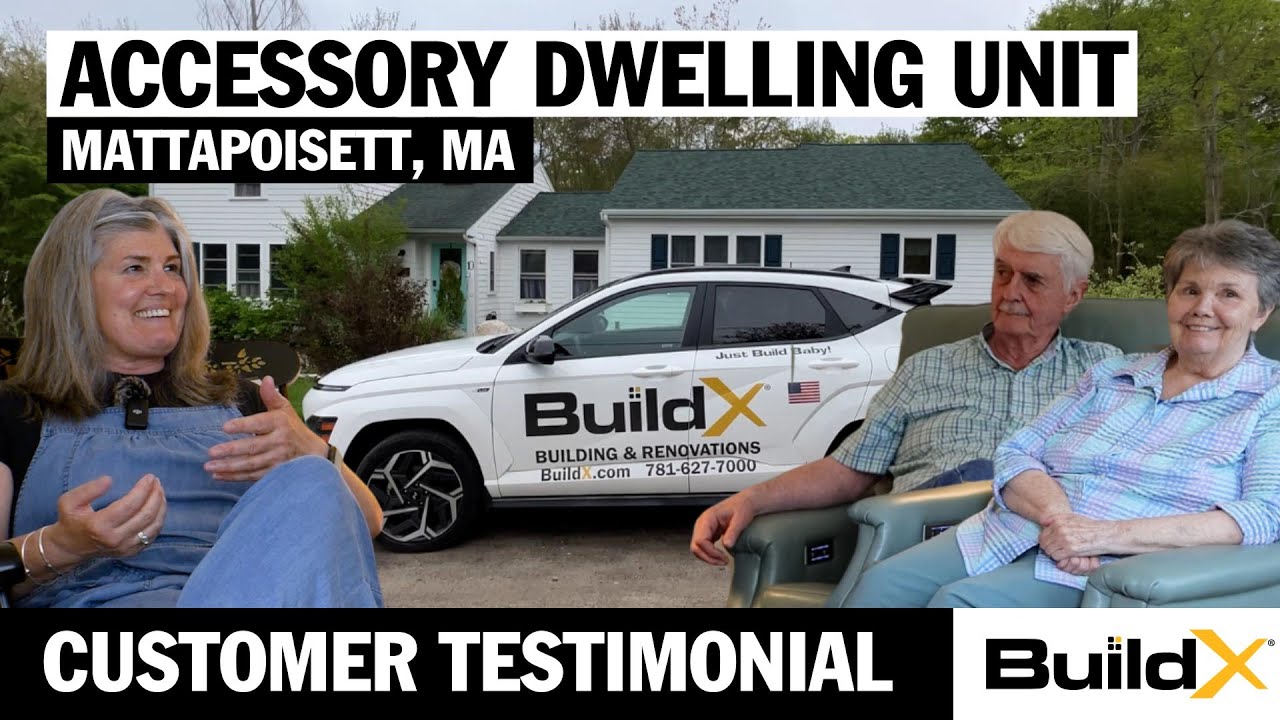
Daphne and John Bradford are BuildX clients. We built their ADU in Mattapoisett so their daughter Alison could bring them closer to the family because they had been living 6 hours away in Maine for decades. The property is on old swamp land, and during construction when we were digging the foundation, we found out how wet the site really was. Their experience is one of the best examples we have of what happens when a builder runs into unfortunate water conditions in the middle of the project and how the outcome depends on how prepared and honest your builder was.
Of course we want to share stories of families who have had great experiences with us, but we want to share the Bradford's story because their lot had some very real challenges, and the way we handled it tells you more about the process than any sales pitch. Their personal view on what went right, what surprised them, and what it cost is probably more helpful to read than anything we could say about ourselves.
Quick Answer: Wet or swampy site conditions don't automatically disqualify your property for ADU construction. It will add to the cost, but a lot of time it's way less than people expect. On the Bradford project in Mattapoisett, when we started excavating for the foundation we discovered two feet of standing water because they were on former swamp land. The solution required a sump pump and ventilation fan, which added less than $2,000 to the total cost. What really matters is whether your builder evaluates and plans for water conditions before breaking ground, it's not about if the water is there or not, it's about having a plan if it is.
In This Article
- Does a Wet or Swampy Lot Mean You Cannot Build an ADU?
- What Causes Wet Site Conditions on Massachusetts Properties?
- How Much Does It Cost to Build on a Wet Lot?
- Why Does Pre-Construction Site Evaluation Matter More on Wet Properties?
- What Does Proper Foundation Waterproofing Look Like on a Wet Site?
- Is Every Wet Lot Worth Building On?
- Your Lot Might Be Wetter Than You Think. Here Is How to Find Out.
Does a Wet or Swampy Lot Mean You Cannot Build an ADU?
No, a wet lot doesn't mean you can't build. It just means you'll need thorough site evaluation, extra foundation treatment, and a builder who is familiar with building in wet conditions.
Southeastern Massachusetts sits on a mix of glacial deposits, sandy loam, and low-lying coastal terrain. Towns like Mattapoisett, Plymouth, Marshfield, Freetown, and Plympton all have properties where the water table is right up near the surface. Former wetlands, seasonal flooding, and poor drainage are common, it's not unusual at all. If wet lots couldn't be built on, half the homes on the South Shore wouldn't even be there.
The Bradfords' property in Mattapoisett is a clear example. Alison Bradford said herself that the land used to be a swamp. When we dug the foundation, it filled with water. Alison said it was "like a swimming pool in there." When winter came, the standing water froze into a sheet of ice with two feet of water underneath. She joked with project manager Kevin Healy about charging admission for ice skating.
Now, all of that sounds pretty dramatic, but really, it's much more manageable than they thought. Buz called Alison, explained the conditions, and explained that the solution would be a sump pump and a ventilation fan to manage moisture in the foundation space. The total extra cost for dealing with the water was under $2,000. The project stayed on track, the estimate was still right on, and the finished ADU has had no moisture issues.
Watch: "I Just Wanted Them Back" -- A Daughter's Journey to Bring Her Parents Home
What Causes Wet Site Conditions on Massachusetts Properties?
Understanding why your lot is wet helps you figure out whether the problem is solvable. Most wet conditions on residential properties in southeastern Massachusetts fall into four categories.
High water table. The water table is the level below ground where soil is fully saturated. In low-lying coastal areas, the water can be just a few feet below the surface. During spring thaw or heavy rain seasons, it gets even higher. A high water table doesn't stop construction, it just requires foundation waterproofing, drainage systems, and in some cases, sump pump installation to keep the foundation space dry.
Former wetlands or filled land. Properties that used to be a swamp, marsh, or cranberry bog and were later filled in with dirt will hold water differently than native soil. The Bradford lot in Mattapoisett is a textbook example. The organic material in the soil holds moisture and it drains a lot differently than undisturbed ground. This is actually very common throughout Plymouth County and Cape Cod.
Poor natural drainage. Soils that have a lot of clay, compacted fill, or properties that are at the bottom of a slope can trap water on the surface or in shallow ground layers. Standing water after rain that takes days to drain is the easiest way to tell.
Seasonal water fluctuation. Some properties are dry in the summer, but very wet in spring. It's pretty common around rivers, ponds, and tidal zones in southeastern Massachusetts. So the time of year we evaluate the site is important. A property that looks dry in August could have standing water in March.
How Much Does It Cost to Build on a Wet Lot?
The extra cost for wet site conditions depends on how bad the issue is and what the solution will be. There is a wide range of scenarios and possibilities, so there's no single answer for every wet lot.
On the low end, a property with a moderately high water table might only need better foundation waterproofing and a sump pump. That's all we had to do for the Bradfords. The entire water problem was solved for just $2,000 above the original estimate. Alison Bradford confirmed that number, she said the extra two items they needed really only were a total of $2,000 together.
But it can go the other way too. Properties with severe water problems could need creative solutions that can get more expensive. Things like perimeter drain systems around the foundation, drainage board installation on foundation walls, upgraded waterproofing systems, or engineered grading to redirect surface water. This type of thing can add $5,000 to $15,000 to a project.
In worst case scenarios, if you're in a designated wetland buffer zone or flood zone, you might have to jump through some extra hoops that add permitting time and engineering costs. Conservation commission review, wetland delineation studies, and environmental compliance can drag the project out months and add $10,000 or more in fees before you can even start building.
The big thing to understand is the difference between a site issue you can solve with construction, and a rule that limits what you're allowed to build in the first place. A high water table is a construction problem. It can be dealt with, it just might cost more or take extra work. But if part of your property falls under wetland regulations, that's not a construction problem, that's a permitting issue. And when you're dealing with permitting, it can limit where you can build or what you're allowed to do. Either one can be dealt with, they just play out very differently and can affect your timeline in different ways.
Why Does Pre-Construction Site Evaluation Matter More on Wet Properties?
If you're comparing builders and one of them does not ask about your site conditions before quoting, that's a huge red flag. On the Bradford project, we knew from experience that Mattapoisett had places with very challenging soil, but we didn't know the foundation excavation would reveal two feet of standing water. But because we always evaluate site conditions on every project, we had a plan in place for a curve ball like that.
We evaluate drainage, soil conditions, and water table before we give anyone an estimate for an ADU. On properties in southeastern Massachusetts, especially in towns near the coast or that used to be on farmland, we just assume water will be an issue until we see otherwise. That's just because in our experience, we've seen what happens when a builder quotes a price on a dry property that then turns to a very wet property in March. The homeowner is then stuck with a change order. With us, the extra cost to deal with the moisture is either in the estimate or listed as a possible variable on the estimate, and we make sure to give you a price range before you sign anything. The Bradford project came in within $2,000 of the original estimate specifically because we made sure to really look at and evaluate the site conditions.
Buz told the Bradfords upfront that he bids high. Daphne Bradford recalled his exact words. He said he would rather estimate high and come in under budget than lowball the bid and deliver surprises. John Bradford, who has a carpenter background, went through the BuildX estimate page by page and concluded there was nothing they could cut. Everything was accounted for. The way we do things made that small water issue cost $2,000, instead of $20,000.
What Does Proper Foundation Waterproofing Look Like on a Wet Site?
Foundation waterproofing is one of those things that people don't really think about until something goes wrong. On a wet lot, it's an extremely important decision, probably one of the most important in the entire project.
Now, there's a big difference between damp-proofing and waterproofing. Damp-proofing is just the absolute minimum you have to do in order to meet the code. It's usually just rolling or brushing a thin asphalt-based coating onto the foundation wall. It's kind of like putting driveway sealer on concrete. It slows down moisture leaking in slowly, but it absolutely won't stop water under any pressure, and it does nothing against cracks as the foundation settles.
Waterproofing is a whole engineered system. On our projects, the waterproofing subcontractor grinds the foundation walls to get rid of any loose concrete, debris, and surface imperfections. Every tiny hole, divot, and pin hole gets patched. The walls are then cleaned, and two coats of a commercial-grade rubberized membrane are applied. The product we use is rated to seal cracks under hydraulic pressure. What that means is that even as the concrete shrinks and develops the hairline cracks that every foundation gets, that coating stretches with it and keeps water out and keeps the whole thing sealed.
On wet-site projects, we add all kinds of extra protection. Insulated drainage board goes against the waterproofed wall before backfilling. We do that for two reasons. One, it protects the membrane from damage during backfill and creates a channel that directs water down to the drain at the bottom instead of letting it push up against the wall. We also spray the footing itself with the rubberized stuff, not just the wall. We all know water comes through walls, but we've seen it come through footings as well, and sealing that joint eliminates a common leak point that most builders don't even think about.
Is Every Wet Lot Worth Building On?
No. We would never say that every wet property is an easy build. Some lots have conditions that make ADU construction impractical or just way too expensive to be worth it.
Properties that are within wetland boundaries might need conservation commission approval, environmental impact studies, and buffer zone setbacks. All of that can reduce the area you can build on so much that it's too small to even put an ADU anymore. Properties in FEMA flood zones could have elevation requirements that would make the foundation extremely expensive. Also, properties where the water table is at or above your planned foundation, and stays that way all year could mean you'll need engineered dewatering systems that add a lot of maintenance requirements.
If your builder tells you that your site is buildable without looking at it first, be very wary of that builder. The honest answer is that most wet lots in southeastern Massachusetts are buildable if you do all the right prep work, but there are definitely some that have conditions that require specialized engineering or a totally different approach to the ADU. Maybe a slab-on-grade foundation instead of a full foundation, or an attached ADU that uses the existing home's foundation. We'll tell you upfront if your lot falls into that category. We'd rather lose a project than build one that we think will have problems.
Your Lot Might Be Wetter Than You Think. Here Is How to Find Out.
The Bradfords didn't know their Mattapoisett lot was former swamp land until we started digging and hit water. Their project still came in within $2,000 of the original estimate because we planned for the unexpected. If you're looking at your property and wondering whether wet conditions are going to kill your ADU plans, the answer for most southeastern Massachusetts lots is no. But the only way to know what your specific property needs is to have someone evaluate it before you commit to a number.
We will evaluate your property's drainage, soil conditions, and water table indicators and give you a clear picture of what your ADU foundation needs before you commit to anything.
Request a Free Consultation or call (781) 627-7000
See our work in person: buildx.com/adu-home-tour/