
How to Finance Your Massachusetts ADU Without Picking the Wrong Loan
You want to build an ADU for your aging parent or for rental income, and the first question that stops most families cold is: how do we pay for this? There are at least four different loan products that can finance an ADU in Massachusetts, and picking the wrong one can cost you tens of thousands in unnecessary interest, force you to give up a low mortgage rate, or lock you into a payment structure that does not match your timeline.
As a Massachusetts ADU builder, we coordinate financing strategy with every client before the first foundation pour. As CEO of BuildX, my job is aligning structural engineering, code compliance, financing, and long-term resale value into one coherent ADU plan. Financing is never just about getting approved for a loan. It is about choosing the product that fits your equity position, your credit profile, and your family's cash-flow timeline so the entire ADU performs as an investment from day one.
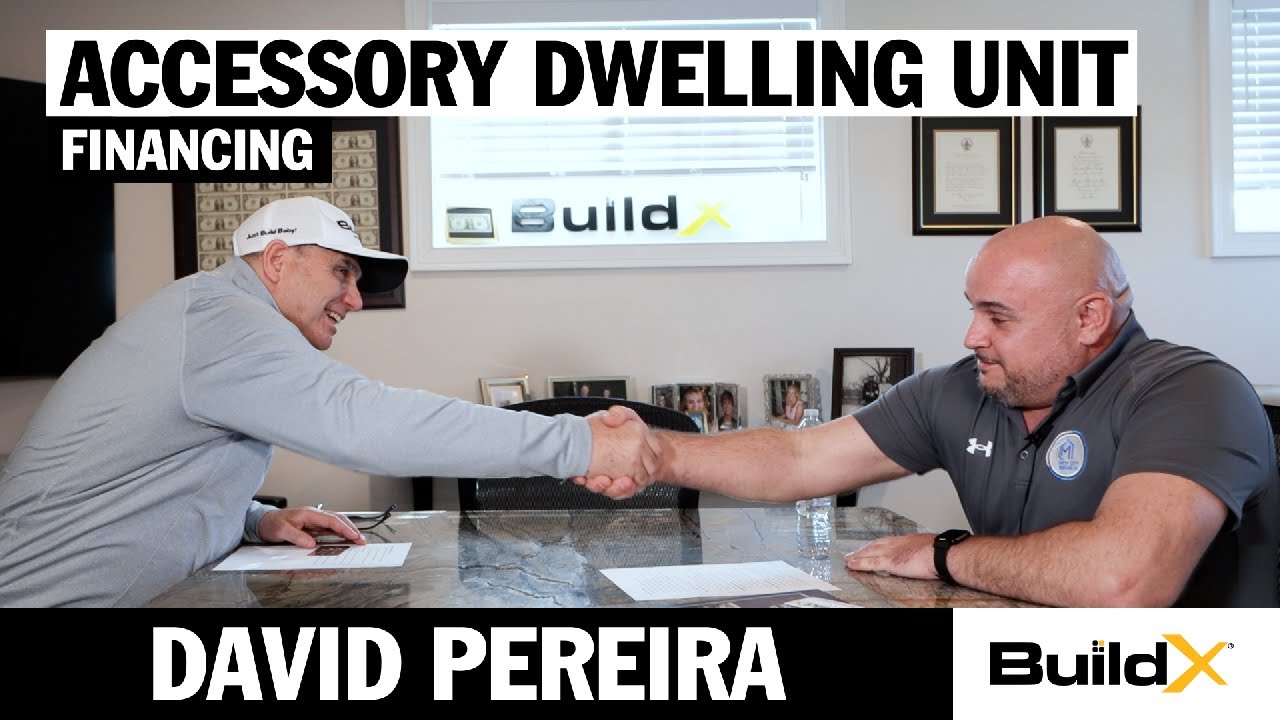
To pressure-test the technical details on every ADU financing product available in Massachusetts, we brought in David Pereira, owner of Troy City Mortgage in Fall River. David has been originating loans since 2003, runs a team of 12 including six licensed loan originators, and has partnered with over 20 lending institutions. He is not paid differently based on which product you choose, which makes him the kind of unbiased source we trust to walk our clients through their options.
Quick Answer: Massachusetts homeowners have four primary ADU financing paths: a home equity loan (keeps your first mortgage intact, borrow up to 80% of home value), a HELOC (interest-only payments, open-ended flexibility), an FHA 203K renovation loan (credit scores as low as 620, finance up to 110% of after-repair value, attached ADUs only), or a Fannie Mae/Freddie Mac HomeStyle Renovation Loan (allows detached ADUs, requires higher credit scores around 680+). The right product depends on your equity, your existing mortgage rate, your credit score, and whether you need an attached or detached unit.
In This Article
- What Are the ADU Financing Options in Massachusetts?
- Can You Build an ADU Without Losing Your Low Mortgage Rate?
- How Does the FHA 203K Renovation Loan Work for ADUs?
- FHA 203K vs. HomeStyle Renovation Loan: Which Fits Your ADU?
- How Do Families Bridge the Gap Between Building an ADU and Selling a Parent's Home?
- What Credit Score Do You Need to Finance an ADU?
- Key Takeaways From the Episode
- FAQ From the Podcast Discussion
- About David Pereira
- Ready to Lock Down Your ADU Financing Strategy?
What Are the ADU Financing Options in Massachusetts?
Massachusetts homeowners have four distinct paths to finance an ADU, and each one carries different rules on credit scores, equity requirements, and which type of unit you can build. The first decision is whether you want to keep your existing first mortgage in place or replace it entirely with a new loan. That single choice determines which products are on the table.
David Pereira breaks the landscape into two categories. If you have enough equity, a home equity loan or HELOC (home equity line of credit) lets you borrow against your property as a second lien while your first mortgage stays untouched. If equity is not sufficient, an FHA 203K renovation loan lets you finance up to 110% of the after-repair value but replaces your existing mortgage with one new loan. The fourth option, a Fannie Mae or Freddie Mac HomeStyle Renovation Loan, works on a similar renovation structure but allows detached ADUs, which the FHA product does not.
From a builder's perspective, we recommend every client start with a pre-qualification call before investing in design. Knowing which products you qualify for shapes the entire project scope, from attached versus detached to total budget. David confirms that initial pre-qualification is free and, with organized clients, can happen the same day.
Key distinction for ADU buyers: FHA 203K loans are limited to attached ADUs only. If you want a detached unit in your backyard, you need the conventional HomeStyle Renovation Loan or a home-equity product. This single rule eliminates an entire loan category for many Massachusetts homeowners planning freestanding units.
Can You Build an ADU Without Losing Your Low Mortgage Rate?
Yes, and for most families this is the deciding factor. If you locked in a 2.5% or 3% rate during the COVID-era refinance wave, giving that up to take on a renovation loan at current rates can add hundreds of dollars to your monthly payment on the primary mortgage alone. We see this fear stall more ADU projects than any zoning question or permitting delay.
David confirms this is the number-one concern he hears from clients. A home equity loan or HELOC sits in second position behind your existing mortgage, which means your first-lien rate stays exactly where it is. You only pay interest on the second loan. David described a specific client who ran the numbers on a renovation loan and discovered the monthly payment increase was too steep because of a large existing balance at a low rate. The home-equity path solved the problem entirely.
We've seen this play out across our own projects. The families who plan financing early, before architectural drawings begin, avoid the painful surprise of realizing their preferred loan product forces them to abandon a rate they cannot replace. This is why we connect every prospect with a lending partner during the feasibility stage, not after the plans are drawn.
"Some people are still locked into their low COVID interest rates and they don't want to get rid of those. It's ideal for them to get a home equity loan or some sort of a second lien to finance the project."
David Pereira, Troy City Mortgage
How Does the FHA 203K Renovation Loan Work for ADUs?
The FHA 203K is the most flexible renovation loan for homeowners with lower credit scores or limited equity, but it comes with rules that directly affect your ADU design. This product lets you finance up to 110% of the after-repair value of your property, meaning the bank lends based on what the home will be worth after the ADU is complete, not what it is worth today. The trade-off is that you replace your existing mortgage with one entirely new loan.
David walks through the specifics. The minimum credit score is 620. The debt-to-income ratio cap is 56%, which is higher than conventional products and can make the difference for borderline applicants. A HUD consultant (a third-party inspector hired by the borrower) reviews your plans and specs, submits a report to the underwriter, and monitors construction disbursements at each phase. HUD consultant fees run $1,500, and the appraisal runs $700. Both are out-of-pocket costs.
The timeline from complete paperwork to closing is 45 days, and one detail catches many borrowers off guard: you start paying principal and interest on the full loan amount from your first scheduled payment, not just interest on what has been drawn. David confirms this is different from construction loans where you pay interest only on disbursed funds. Closing costs on a $700K loan run $8,000 to $12,000, but those can be financed into the loan. The loan is subject to county loan limits, so the maximum amount varies by location.
From our experience coordinating with lenders on 203K projects, the HUD consultant schedule is the variable that most affects the timeline. Their availability dictates when reports get submitted, and delays on their end ripple through the entire closing process. We factor this into every project schedule from the start.
FHA 203K vs. HomeStyle Renovation Loan: Which Fits Your ADU?
These two products look similar on the surface but diverge on three factors that matter for ADU construction: the type of unit you can build, the credit score floor, and the debt tolerance. The right choice depends on your specific situation, not on which product has a lower rate on paper.
David lays out the comparison. The FHA 203K allows attached ADUs only with a minimum credit score of 620 and a debt-to-income ceiling of 56%. The Fannie Mae/Freddie Mac HomeStyle Renovation Loan allows both attached and detached ADUs, but the credit score floor is functionally around 680 even though lenders advertise 620. David explains that running a conventional application through automated underwriting below 680 rarely results in an approval without strong compensating factors like low debt-to-income ratios and cash reserves.
The FHA product also requires a HUD consultant, adding cost and time. The conventional product does not. David puts it directly: the 6% difference in allowable debt-to-income ratio between FHA (56%) and conventional (under 50%) can be the deciding factor for families carrying student loans, car payments, or other obligations alongside their mortgage.
Decision framework: Choose the FHA 203K if you have a credit score between 620 and 680, higher debt obligations, and plan to build an attached ADU. Choose the HomeStyle Renovation Loan if you need a detached unit, have a credit score above 680, and want to avoid the HUD consultant process. If you have enough equity to avoid a renovation loan entirely, a home equity loan or HELOC is the path of least resistance regardless of ADU type.
How Do Families Bridge the Gap Between Building an ADU and Selling a Parent's Home?
The most common ADU scenario we encounter at BuildX involves a family who wants to move an aging parent onto their property, but the parent's home has not sold yet. The ADU needs to be built before the parent can move, and the sale proceeds that would pay for it are not available until after the move happens. This creates a timing gap that stops families in their tracks unless they plan around it.
David describes the exact scenario he works through regularly: a daughter in Middleborough wants to build an ADU for her mom, who currently lives in Bridgewater. The daughter has equity in her home but limited cash. David outlines three strategies. First, take an equity loan on the parent's existing home to raise cash for construction, then pay it off when the property sells. Second, use the daughter's equity through a home equity loan, HELOC, or refinance. Third, if equity on either property is not sufficient, pursue a renovation loan (203K or HomeStyle) that lends based on after-repair value.
David also flags a creative option: the parent can gift equity to the child, and in some cases two loans can be combined. A HELOC is particularly useful here because the interest-only period means carrying costs during construction stay low, and once the parent's home sells, the proceeds pay down or eliminate the balance entirely. If the balance hits zero, the HELOC stays in place but costs nothing.
We coordinate this multi-step financing conversation early in every aging-parent ADU project. The worst outcome is a family that commits to design and permitting without confirming the bridge strategy, then discovers six months later they cannot fund the build.
What Credit Score Do You Need to Finance an ADU?
The minimum credit score depends entirely on which loan product you pursue, and the advertised minimums do not always match what lenders actually approve. We connect every BuildX client with a lending partner for a soft credit check before the design phase begins, because a 30-point gap between where you are and where you need to be can be closed in weeks with the right guidance.
David breaks it down by product. FHA 203K loans require a minimum of 620. Conventional renovation loans technically accept 620, but David recommends a 680 minimum for a realistic approval through automated underwriting. He confirms that Troy City Mortgage runs a soft credit check at no cost that does not impact your score, and their built-in models project where your score could land if you pay down specific balances.
David describes a coaching process: they identify which accounts to pay down, in what order, based on billing cycles. Credit cards and loans report on 30-day billing cycles, so a strategic payment made at the right time can move your score within a week. For time-sensitive situations with contracts already in place, a rapid rescore (an account update process) can reflect changes in two days. David notes that in the past 60 days, three ADU inquiries came in, and the first prospect did not qualify because their score was below 600.
"We can tell you step-by-step what to pay down. We do it with all our clients."
David Pereira, Troy City Mortgage
Key Takeaways From the Episode
- Four financing paths exist for Massachusetts ADUs: Home equity loan, HELOC, FHA 203K renovation loan, and Fannie Mae/Freddie Mac HomeStyle Renovation Loan. Each has different rules on credit, equity, and ADU type.
- Your low mortgage rate is not at risk if you choose a second-lien product: Home equity loans and HELOCs sit behind your existing mortgage, leaving your first-lien rate untouched.
- FHA 203K is limited to attached ADUs: If you want a detached unit, you need the conventional HomeStyle product or a home-equity option.
- Credit score floors vary by product: FHA accepts 620, but conventional loans functionally require 680+ for approval through automated underwriting.
- Closing costs on a $700K renovation loan run $8,000 to $12,000: Most of this can be financed into the loan, with the appraisal (~$700) and HUD consultant fee (~$1,500) as the primary out-of-pocket costs.
- Pre-qualification is free and can happen the same day: Organized clients can receive a qualification letter within 24 hours at no cost or obligation.
- Bridge financing solves the aging-parent timing gap: Using a HELOC or equity loan to fund construction before selling the parent's home keeps the project on schedule and carrying costs low.
- Mortgage brokers are product-neutral: David's team gets paid the same regardless of which loan product you choose, eliminating bias from the recommendation.
Watch or Listen to the Full Episode:
YouTube: Watch on YouTube
FAQ From the Podcast Discussion
Does it cost anything to find out if I qualify for an ADU loan?
No. David confirms that the initial pre-qualification process, including a soft credit check, review of tax returns and W-2s, and a qualification letter, is completely free. There is no cost or obligation until you decide to move forward with originating the loan.
How long does it take to get pre-qualified for an ADU loan?
For organized clients who have their financial documents ready, pre-qualification can happen the same day. David's team issues a letter telling you how much you qualify for, and the next step is connecting with your contractor for a proposal, plans, and cost breakdown.
How long does the FHA 203K loan take to close?
Approximately 45 days from complete paperwork to closing. The variable is the HUD consultant's schedule. They must review your plans and specs, submit a report to the underwriter, and their availability can extend the timeline.
How much can I borrow with a home equity loan for my ADU?
You can borrow up to 80% of your home's value with a home equity loan. For example, on a $700K home with $250K owed, you would have room for a $300K ADU loan. Your first mortgage stays in place at its existing rate.
What is the difference between a home equity loan and a HELOC for ADU construction?
A home equity loan is a closed-end second lien with a fixed payment. Even if you pay down the balance, the payment stays the same. A HELOC is open-ended with an interest-only period (10 years in most cases). You can draw funds, pay them down, and draw again. You only pay interest on the amount currently borrowed. Neither product has prepayment penalties.
Can a soft credit check hurt my score?
No. David confirms soft credit checks create no credit inquiries and do not affect your score. Troy City Mortgage also has built-in models that project your score potential and identify step-by-step which balances to pay down for maximum improvement.
What states does Troy City Mortgage operate in?
David is licensed in Massachusetts, Rhode Island, Connecticut, Florida, and New Hampshire. If the property is outside these states, you would need a licensed lender in your state.
Do mortgage brokers get paid more for recommending one product over another?
No. David confirms his team gets paid the same dollar amount regardless of which loan product the client selects. Compensation is based on the loan amount, not the product type, which eliminates financial incentive to steer clients toward a specific option.
Will building an ADU increase my property value?
David confirms an ADU will increase the value, but the exact amount depends on appraisal comparables. Because ADUs are new in Massachusetts, appraisers are getting creative by comparing to two-family and multi-family homes, looking in other towns, and going back further in time for sales data. Cape Cod has some early ADU sales data that appraisers can reference.
Can my parent gift me equity to help finance the ADU?
David mentions that a parent can gift equity to a child as part of a financing strategy, and in some cases two loans can be combined. However, the details around tax implications and documentation requirements are complex and should be discussed directly with your mortgage broker and tax advisor.
"We're not just committed to one institution. We've probably signed up with at least 20 different partners. Nationally, the consumer ends up saving working with a broker as opposed to a direct lender or a bank."
David Pereira, Troy City Mortgage
About David Pereira
Watch or Listen to the Full Episode:
YouTube: Watch on YouTube
Ready to Lock Down Your ADU Financing Strategy?
The financing product you choose shapes your ADU's budget, design, and timeline. Get it right before you invest in plans, and the rest of the project falls into place.
Schedule a site consultation with BuildX to walk through your lot, discuss your goals, and determine the best route to take with your project.
Request a Free Consultation or call (781) 627-7000
See our work in person: buildx.com/adu-home-tour