
Can You Finance Your Massachusetts ADU Without Losing Your Low Mortgage Rate?
You locked in a 2% or 3% mortgage rate during COVID, and now you need to build an ADU for your aging parent or adult child. Every financing option you research forces you to give up that rate. A cash-out refinance at today's rates could cost you hundreds of dollars more per month on a mortgage you already had under control. That fear stops families cold.
As a Massachusetts ADU builder, we deal with this exact financing roadblock on nearly every project. As CEO of BuildX, my job is coordinating structural engineering, permitting, financing, and long-term property value into one coherent ADU plan. Financing is never just about the interest rate. It's about how the entire ADU performs as an investment while protecting the financial position you already have.
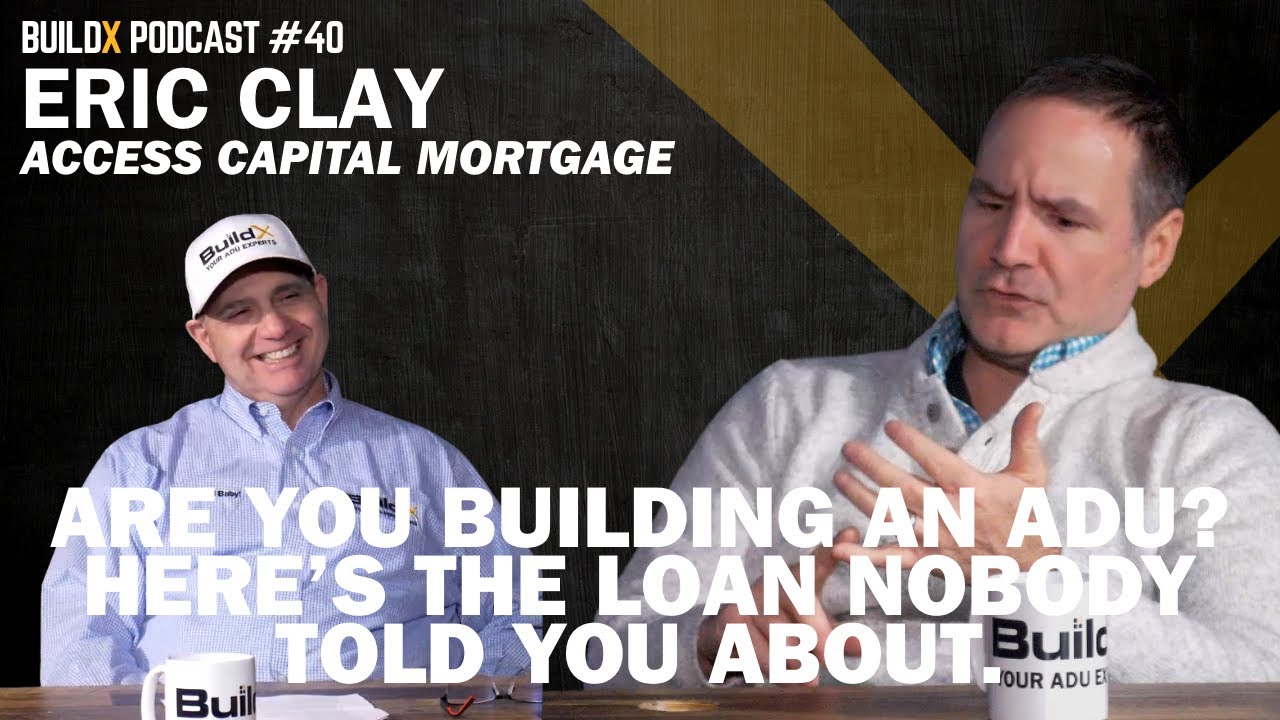
To pressure-test the best financing path for ADU homeowners, we brought in Eric Clay, Principal at Access Capital Mortgage, with 21 years in the mortgage industry. Eric specializes in a product called the Renovation HELOC (home equity line of credit), a second-position loan that uses the after-repair value of your property to fund ADU construction. He breaks down the exact mechanics, costs, and qualification requirements so you can make the financing decision with real numbers, not guesswork.
Quick Answer: Yes, you can finance your Massachusetts ADU without refinancing your existing mortgage. A Renovation HELOC sits in second position behind your current loan, leaving your low rate untouched. The product uses your property's after-repair value (the appraised value with the ADU completed) to calculate how much you can borrow. Interest rates run prime plus 0.5% to prime plus 3% depending on credit score and loan-to-value ratio. You pay interest only on the money you draw during construction, closing takes 30 to 45 days, and there is no prepayment penalty. The loan cap ranges from $500,000 to $750,000 depending on your situation.
In This Article
- Can I Keep My Low Mortgage Rate and Still Build an ADU?
- How Does a Renovation HELOC Actually Work for ADU Construction?
- What Will ADU Financing Actually Cost Me?
- Renovation HELOC or 203K: Which Is Better for an ADU?
- How Much Equity Do I Need to Finance My ADU?
- Key Takeaways From the Episode
- FAQ From the Podcast Discussion
- About Eric Clay
- Ready to Run the Numbers on Your ADU Financing?
Can I Keep My Low Mortgage Rate and Still Build an ADU?
The answer is yes. A Renovation HELOC sits in second position behind your existing first mortgage, which means your current loan stays exactly where it is. If you locked in at 2.85% during COVID, that rate does not change. The new financing for your ADU is a completely separate line of credit secured by your home's equity, including the future value of the ADU itself.
Eric Clay confirms this is the core advantage of the product. The Renovation HELOC differs from a traditional renovation loan because it takes the second position. With a 203K or HomeStyle loan, you would need to replace your first mortgage entirely, forfeiting that low rate. Eric notes that homeowners with rates in the 2% to 3% range treat that mortgage like a financial asset they refuse to surrender.
We hear this from customers constantly. The first question in nearly every ADU consultation is whether they have to give up their existing rate. It has become the single biggest financial barrier to getting ADU projects started. From a builder's perspective, the financing conversation has to happen before the design conversation, because the budget drives every decision that follows. This product removes that barrier entirely.
"That's one of the reasons why I really love the program, because prior to the last couple of years, people are in the threes."
Eric Clay, Access Capital Mortgage
How Does a Renovation HELOC Actually Work for ADU Construction?
The Renovation HELOC operates differently from both a standard HELOC and a traditional renovation loan. The product uses the after-repair market value of your property to determine borrowing capacity. That means the appraised value includes the completed ADU, even though it does not exist yet. You pay interest only on the money you draw, not on the full loan amount from day one.
Eric Clay explains the draw process is immediate. The homeowner receives a checkbook tied to the home equity line. When the contractor needs a draw, the owner writes a check. There is no HUD inspector, no appointment scheduling, no two-week delay waiting for an underwriter to review photos. During the construction phase, there is a $150 monthly fee that covers monitoring. Only one inspection happens: when construction is complete.
The repayment structure has two phases. The draw period is 10 years. Even after the ADU is finished, you can keep the line open, pay it down, and re-draw for future projects or expenses. After 10 years, the balance converts to a fully amortizing loan with 20 years to pay it back. There is no prepayment penalty, so if the homeowner's parent sells their house and hands over the proceeds, that balance can go to zero on day one.
How the draw process works: The homeowner gets a checkbook for the HELOC. When the contractor needs payment, the homeowner writes a check directly. No HUD inspector delays, no underwriter review per draw, no two-week wait. The only out-of-pocket cost during construction is the $150 monthly monitoring fee. One final inspection happens when construction is complete.
What Will ADU Financing Actually Cost Me?
The interest rate on a Renovation HELOC is variable and tied to the prime rate. At the time of this recording (November 2025), prime was 7%. The effective rate ranges from prime plus 0.5% to prime plus 3%, depending on your credit score and loan-to-value ratio. A homeowner with strong credit and plenty of equity could be looking at 7.5%. A higher-risk borrower with a high LTV could see rates closer to 10%.
Eric Clay breaks down the closing costs: expect $6,000 in closing costs plus another $5,000 to $6,000 in prepaids. He tells borrowers to budget $12,000 to $15,000 total for closing. There is no prepayment penalty. The first true out-of-pocket expense is the appraisal, which runs $575 to $675 for a conventional property or $800 to $900 for an investment property. Everything before that, including the discovery call, application, and credit pull, costs the borrower nothing.
We always tell ADU homeowners to run the monthly payment math before committing. On a $400,000 balance at 10% interest-only, that works out to $3,200 per month. That sounds steep until you factor in the equity you are building, the rental income potential, and the fact that the rate adjusts downward as prime drops. From a builder's perspective, the real comparison is not the monthly payment in isolation. It is the monthly payment against the cost of not building the ADU at all: lost rental income, rising construction costs, and the family member who still needs housing.
Renovation HELOC or 203K: Which Is Better for an ADU?
For most ADU homeowners with low existing mortgage rates, the Renovation HELOC is the stronger choice. The 203K (FHA) and HomeStyle (conventional) renovation loans both require you to replace your first mortgage. That alone eliminates them for anyone protecting a sub-4% rate. Beyond that, the Renovation HELOC wins on speed, flexibility, and cost structure during construction.
Eric Clay walks through the key differences. A 203K requires a HUD inspector costing $1,000 to $2,000. Every time the contractor needs a draw, the inspector must schedule a site visit, take photos, submit them to the underwriter, wait for approval, and then a check gets issued. That process can add two weeks per draw. With the Renovation HELOC, the homeowner writes a check. Eric also notes that with a 203K, you pay interest on the full loan amount from day one, while the HELOC charges interest only on the money you have actually drawn.
There is one scenario where a 203K makes more sense. If you have never managed a large construction project and you do not have anyone in your family to advise you, the HUD inspector provides a layer of third-party oversight. That inspector verifies the contract is legitimate, the pricing is reasonable, and the work matches the specs. We've seen homeowners who bought on price alone or skipped reference checks end up in bad situations with shady contractors. The 203K's oversight is a built-in safety net for those situations.
"Usually the biggest delay in the whole process of a renovation loan is the contractor. The ones that have experience working with renovation loans, they're usually the better ones to work with."
Eric Clay, Access Capital Mortgage
How Much Equity Do I Need to Finance My ADU?
The Renovation HELOC calculates your borrowing capacity using two limits, whichever is lower: 95% of the after-repair appraised value or 125% of the as-is value. The after-repair value includes the completed ADU, which is why this product works for new construction. The loan cap ranges from $500,000 to $750,000 depending on the specifics of the deal.
Eric Clay and Buz walk through a real scenario. Sally owns a home worth $600,000 and owes $200,000 on her mortgage. The ADU will cost $400,000. Take $600,000 times 1.25, which equals $750,000 in maximum borrowing capacity. Subtract the $200,000 she owes, and Sally has $550,000 available. The ADU costs $400,000, so she qualifies with room to spare. But if Sally owed $500,000 instead of $200,000, the math falls short. The minimum credit score for the product is 660 to 680.
This is why we coordinate financing conversations with the design phase from the very start. On our ADU projects in Massachusetts, we run these equity calculations before we draw a single plan. If the numbers are tight, we adjust the scope. If there is plenty of room, we can design to the homeowner's full wish list. The financing feasibility check takes one phone call and costs nothing, but it saves months of wasted design work if the equity is not there.
Key Takeaways From the Episode
- Your low mortgage rate stays untouched: The Renovation HELOC sits in second position behind your existing first mortgage. No refinancing required.
- After-repair value unlocks bigger budgets: The lender appraises your property based on what it will be worth with the completed ADU, not just its current value.
- Interest-only during construction: You pay interest only on the money you have actually drawn, not the full loan amount from day one.
- Closing costs run $12,000 to $15,000: Budget for $6,000 in closing costs plus $5,000 to $6,000 in prepaids. The appraisal ($575 to $900) is the first out-of-pocket expense.
- Draw process is immediate: The homeowner gets a checkbook. No HUD inspector, no two-week draw delays. One inspection at completion.
- 10-year draw period plus 20-year repayment: The line stays open for 10 years after construction. After that, it converts to a fully amortizing 20-year loan with no prepayment penalty.
- 70% to 80% of callers do not qualify: Credit, income, and asset issues disqualify most applicants. Run the discovery call early to avoid wasted time and design costs.
- Credit card scores run 20 to 30 points higher than mortgage FICO: The score your credit card app shows you is not the score your lender will pull. Best rates require a score above 780.
FAQ From the Podcast Discussion
Do I need to refinance my existing mortgage to build an ADU?
No. The Renovation HELOC sits in second position behind your current mortgage. Your existing rate and payment stay exactly the same. The ADU financing is a separate line of credit.
What is the minimum credit score for a Renovation HELOC?
The minimum is 660 to 680. For the best interest rates, you want a score above 780. Rates are structured in 20-point tiers, so each bracket affects your pricing.
How long does it take to close on ADU financing?
The Renovation HELOC closing process takes 30 to 45 days. A 203K loan takes closer to 60 days. The speed depends on how quickly the borrower submits documents and how experienced the contractor is with renovation loans.
Does the contractor need to be approved by the lender?
Yes. The contractor must be pre-approved by the lender before the loan can proceed. Once a contractor is approved with a particular lender, they stay approved for future projects. Eric Clay recommends selecting a contractor who has experience working with renovation loans because inexperienced contractors are the biggest source of delays.
What documents does the lender need from the contractor?
The lender requires a full breakdown of the work including materials, labor, plans, and specs. A lump-sum quote will not be accepted. The contract, payment terms, and detailed cost breakdown all need to be submitted for underwriting.
Can I use a Renovation HELOC on a vacation home or second property?
Yes, the program works on both primary residences and second homes for additions and renovations. It does not cover investment properties.
Why is my credit card score different from what the lender sees?
Credit card companies give you a FICO 8 score, which runs 20 to 30 points higher than the traditional FICO model mortgage lenders use. A homeowner who thinks they have a 720 based on their credit card app could pull a 690 to 700 on a mortgage credit report.
Does a hard credit pull hurt my score?
A hard pull can reduce your score by 1 to 2 points if your credit is strong (800+), or up to 10 points if your score is on the lower end (640 range). A soft pull does not affect your score at all. Eric offers soft pulls as an option for initial assessments.
How long does it take to repair my credit if I do not qualify?
It depends on the severity. A rapid rescore can take as little as two weeks. Standard credit improvements take two to three months. In more serious cases involving collections, charge-offs, or bankruptcies, Eric has told borrowers they are one to three years out from qualifying.
Is there any cost for the initial discovery call or pre-approval?
No. The discovery call, electronic application, document review, and credit pull are all free. Eric absorbs the cost of the credit report until closing. The first out-of-pocket expense for the borrower is the appraisal, which runs $575 to $900.
"Most people don't fail because they're irresponsible. They fail because they never knew their options."
Eric Clay, Access Capital Mortgage
About Eric Clay
Ready to Run the Numbers on Your ADU Financing?
The equity math, the credit qualification, and the financing structure all need to line up before your ADU design goes any further. One phone call to your lender and one conversation with your builder will tell you exactly where you stand.
Schedule a site consultation with BuildX to walk through your lot, discuss your goals, and determine the best route to take with your project.
Request a Free Consultation or call (781) 627-7000
See our work in person: buildx.com/adu-home-tour