
How a Home Inspection Protects Your Massachusetts ADU Investment
You are about to commit $250,000 or more to an ADU on your property. You know the roof on your main house is aging. You have a vague memory of someone mentioning "aluminum wiring" at your last Thanksgiving dinner. And you have no idea whether the electrical panel in your basement can handle a second dwelling pulling power from it. These unknowns do not go away when you start building. They get more expensive.
As a Massachusetts ADU builder, we have learned that the most costly surprises on an ADU project do not come from the ADU itself. They come from the existing property. Termite damage hiding behind a front stoop can range from $2,000 to $50,000 to repair. An outdated electrical panel can derail your utility connection plan entirely. As CEO of BuildX, my job is coordinating structural engineering, energy code compliance, financing, and long-term resale value into one coherent ADU plan. A home inspection is never just about checking boxes. It is about knowing exactly what your property needs before a single dollar goes toward construction.
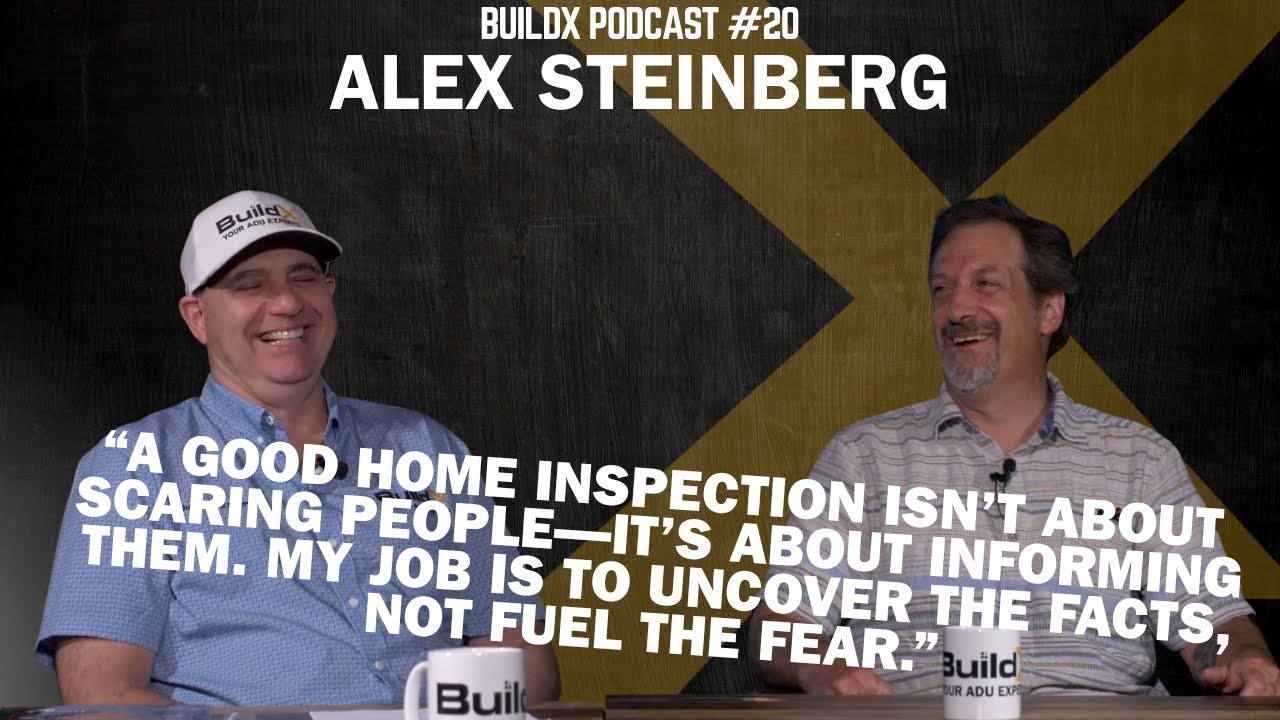
To pressure-test the details on what inspections actually uncover and how they connect to ADU planning, we brought in Alex Steinberg, owner of JBS Home Inspections and a 25-year veteran of the inspection industry in Massachusetts. Alex has inspected thousands of homes across the state, and we had him walk through one of our own completed ADUs to see what a professional inspector finds when the builder invites scrutiny.
Quick Answer: Yes, you need a thorough home inspection of your existing property before building an ADU. Inspectors check 500 to 600 points across structure, electrical, plumbing, HVAC, and pest damage. Hidden problems on your main house, from Federal Pacific panels to termite damage to knob-and-tube wiring, can add tens of thousands to your ADU project if they surface mid-construction. A pre-build inspection costs around $875 for a 2,500-square-foot home and takes three to five hours. That is a fraction of what a surprise electrical panel replacement or structural repair costs once your ADU project is underway.
In This Article
- Do I Need a Home Inspection Before Building an ADU?
- What Electrical Panel Problems Should I Fix Before Adding an ADU?
- Can Heat Pumps Handle a Massachusetts ADU in Winter?
- What Does a Professional Inspector Find on a New ADU?
- How Much Does It Cost to Run an All-Electric ADU?
- Why Did Massachusetts Ban Home Inspection Waivers?
- Key Takeaways From the Episode
- FAQ From the Podcast Discussion
- About Alex Steinberg
- Ready to Know What Your Property Needs Before You Build?
Do I Need a Home Inspection Before Building an ADU?
A home inspection on your existing property before ADU construction is not a formality. It is a budget-protection strategy. We have seen termite damage, failing electrical panels, and deteriorating plumbing add five figures to a project budget because nobody looked first. When we built our own ADU, we brought in an outside inspector specifically to catch what we could not see from the builder's seat.
Alex Steinberg describes his role as a "primary care physician" for houses. He arrives 30 minutes early, starts with the exterior, assesses the property's condition before the client even shows up, and then works through structure, all mechanical systems, and every accessible component. His reports cover 500 to 600 inspection points, and he writes them in plain English so homeowners can hand specific sections to their plumber, electrician, or contractor.
Alex confirms that termite damage is one of the most unpredictable cost variables he encounters. A split-level home with damage behind the front stoop can range from a $2,000 fix to a $50,000 structural repair. The first step is always a pest inspector to determine whether the infestation is active, followed by a contractor to scope the repair. For ADU buyers, this matters because termite damage to your main home's sill plate or foundation can change the engineering and connection plan for your new unit entirely.
This is why we recommend every ADU client get a thorough inspection of their existing property before we finalize scope and budget. The inspection cost is a rounding error compared to a mid-project surprise.
What Electrical Panel Problems Should I Fix Before Adding an ADU?
Your ADU will draw power from your property's electrical infrastructure. If that infrastructure has problems, the ADU project inherits them. Older Massachusetts homes commonly have electrical panels with issues that range from inconvenient to dangerous, and every one of them needs to be resolved before you connect a second dwelling.
Alex Steinberg details what he finds when he pulls a panel cover: double taps, improperly sized wires, missing knockouts, sub panels wired incorrectly, burned wires, aluminum wiring, and breakers that are tripped. He also flags the evolution of wiring in Massachusetts homes. Knob-and-tube wiring (common in pre-war homes) has largely been replaced, but the generation after it, BX cable (old armored cable with no ground wire), is everywhere in mid-century homes across the state.
Federal Pacific panels are a fire hazard. Known in the industry as "fire starter" panels, these units have breakers that fail to trip during overcurrent events. Instead, they arc behind the panel and ignite. Insurance companies caught on and began requiring replacement before issuing coverage. If your home still has a Federal Pacific panel, replacing it is not optional before ADU construction. We have seen fires caused by these panels firsthand.
From a builder's perspective, the electrical panel is the first thing we evaluate on any ADU site assessment. Modern all-electric homes are running 1,200-amp services with multiple 400-amp panels. An older home with a 100-amp or 200-amp panel trying to support an ADU will need an upgrade, and that upgrade needs to happen before construction, not during.
Can Heat Pumps Handle a Massachusetts ADU in Winter?
Heat pumps work in Massachusetts ADUs. The reason they work is the building envelope. A properly built ADU with a tight envelope and the right insulation creates a small, efficient space where heat pumps operate within their optimal range. The problems people hear about, the horror stories of electric bills, come from trying to heat large, conventional homes with heat pumps that cannot keep up when temperatures drop.
Alex Steinberg confirms the problem from the inspection side. He reports that clients in brand-new, spray-foam-insulated construction with heat pumps only are paying $9,000 per month in winter to heat their homes. The issue is that when larger units hit their capacity limit, the electric coil backup kicks in. At that point, you are running electric resistance heat, and the meter spins accordingly.
But the math is different for an ADU. We tracked the energy costs at 72 Jordan Road, an 875-square-foot all-electric ADU with three occupants running heat, hot water, cooking, and laundry. The total annual electric bill runs about $5,000 per year, roughly $417 per month. That covers everything. The only other utility is internet.
"Unless you're into gas stoves, let's just do all electric because it's very efficient. Number one. Number two, there's one less thing to break. And it's less expensive because we don't need the plumbing to do all that gas piping."
Buz Artiano, BuildX
We can do mixed fuel in ADUs now. You can add a gas component. But based on the operating data from our completed builds, all-electric is the more efficient, lower-maintenance, and less expensive path for a properly built ADU.
What Does a Professional Inspector Find on a New ADU?
We invited Alex Steinberg to inspect one of our own ADUs. Not because we expected problems, but because every builder has blind spots, and a 25-year inspector is the best way to find them. We told Alex to go through it exactly the way he would any inspection.
Alex's reaction was direct. He called it "really well thought out" and noted that the quality of the build made it clear we had done this before. He specifically praised the floor plan efficiency, noting the laundry placement away from bedrooms and the logical flow of living space. On the mechanical side, he noted the heat pump water heater in a closet with a louvered door to manage airflow, a detail that shows the HVAC system was designed, not just installed.
The one area Alex questioned was the crawl space. He was concerned about the lack of a concrete floor beneath the spray foam. We walked him through the assembly: the crawl space sits on sand, with three-pound spray foam (the same rigid foam used as commercial roofing in other regions) acting as both vapor barrier and insulation. A radon pipe is installed, and the entire space is conditioned and unvented per building code. For clay soils, we pour a rat slab (a thin three-inch concrete layer) before insulating. The decision is made on a job-by-job basis depending on soil type and board-of-health requirements.
For new construction, Alex draws up a punch list rather than a full negotiation report. That punch list goes to the builder for resolution. On our ADU, the punch list was minimal, which is exactly what happens when a builder designs for inspection rather than hoping to pass one.
How Much Does It Cost to Run an All-Electric ADU?
Operating cost is the question every ADU buyer asks after the build price. The answer, from a completed and occupied BuildX ADU in Massachusetts, is about $5,000 per year for all utilities except internet. That covers heat pumps for heating and cooling, a heat pump water heater, electric cooking, and a washer-dryer for three active occupants.
The ADU at 72 Jordan Road measures roughly 875 square feet on the interior and runs 100% electric. It has a full basement (which creates more energy loss than a crawl-space build with spray foam underneath), and the construction predates the current code change requiring measurement from the inside face of the walls, so the exterior footprint is closer to 900 square feet.
Compare that to the $9,000-per-month winter heating bills Alex Steinberg hears about from clients in larger new-construction homes. The difference is envelope size. A tight, well-insulated ADU keeps the heat pump operating in its efficient range. A 3,000-square-foot house pushes the system past capacity, triggering electric coil backup that eliminates any efficiency advantage. This is why ADUs, with their compact envelopes, are the ideal use case for all-electric design.
Why Did Massachusetts Ban Home Inspection Waivers?
Massachusetts passed legislation making all real estate offers "home inspection blind," meaning a seller and their agent cannot require a buyer to waive a home inspection as a condition of considering their offer. The law passed the state Senate 40 to 0. For anyone buying a property with plans to add an ADU, this law matters because it protects your right to know exactly what you are inheriting before you invest in construction.
Alex Steinberg was part of the advocacy effort that pushed this legislation forward. He describes the problem that triggered it: starting around 2017-2018, during the pandemic-era housing frenzy with low inventory and mortgage rates around 2.5% to 3%, home inspection rates flipped. Where roughly 70% of sales once included an inspection, that number inverted to 70-80% of sales with no inspection at all. Inspectors were reduced to doing "cattle call" pre-offer walkthroughs, one-hour partial inspections, or drive-by consultations with no written report.
The result was predictable. Buyers were purchasing homes and discovering $20,000 to $50,000 or more in repairs they never saw coming. For the average buyer committing 30-40% of their salary to a mortgage, that is devastating. The legislation came out of the same Fair Housing bill that included the ADU legislation, which means the legal framework protecting your right to inspect and your right to build an ADU share the same origin.
The connection between inspection law and ADU law matters. Both came out of the same Massachusetts Fair Housing legislation. If you are buying a property specifically to add an ADU, you now have legal protection to inspect that property first. Use it. An inspection that costs $875 can reveal problems that would add tens of thousands to your ADU budget if they surface after you have already committed to construction.
Key Takeaways From the Episode
- Inspect your existing property before committing to an ADU build: Hidden issues on your main house, from termite damage to electrical panel failures, can add $2,000 to $50,000+ to your total project cost if they surface during construction.
- Federal Pacific panels must be replaced before ADU construction: These "fire starter" panels have breakers that fail to trip, cause arcing, and have resulted in house fires. Insurance companies require their removal.
- Heat pumps work in Massachusetts ADUs because of envelope size: A tight, well-insulated 875-square-foot ADU keeps heat pumps in their efficient range, unlike larger homes where electric coil backup drives winter bills to $9,000/month.
- All-electric ADU operating costs run about $5,000 per year: That covers heat, hot water, cooking, laundry, and all electricity for three occupants. The only additional utility is internet.
- Massachusetts home inspection waiver law passed 40 to 0: Sellers can no longer require buyers to waive inspections. This law came from the same Fair Housing bill that includes ADU legislation.
- A professional inspection covers 500 to 600 points: Structure, electrical, plumbing, HVAC, pest, and every accessible component. Reports are written in plain English and take three to five hours to complete.
- Crawl-space foundation decisions depend on soil type: Sandy soil gets spray foam directly over dirt. Clay or expansive soils require a rat slab (three-inch concrete pour) before insulation. Board of health setbacks from leaching fields can also mandate a slab.
- A standard home inspection costs about $875 for a 2,500-square-foot home: Older homes and larger properties cost more. That expense is a fraction of what a surprise repair costs mid-construction.
FAQ From the Podcast Discussion
How long does a home inspection take?
Alex Steinberg completes a full home inspection in three to five hours. He arrives 30 minutes early to walk the exterior and assess conditions before the client arrives, then works through the basement, structure, and all mechanical systems systematically.
How much does a home inspection cost in Massachusetts?
For a 2,500-square-foot single-family home, expect to pay around $875. Larger homes cost more; an 8,000-square-foot home runs about $2,800. Older homes (pre-1800s construction) add roughly $150 because the inspector is spending more time in crawlspaces and dealing with historical construction methods.
Can my home inspector open the electrical panel in Massachusetts?
This is a gray area. Massachusetts electrical code states that only licensed electricians can remove the panel cover, but the home inspector's standards of practice require them to take the cover off. In Rhode Island, electricians lobbied successfully to bar inspectors from opening panels, which means buyers there need to hire both an inspector and an electrician for a thorough assessment.
What is knob-and-tube wiring, and should I worry about it?
Knob-and-tube is an early electrical wiring method common in pre-war Massachusetts homes. Alex notes that most of it has been replaced, but the generation after it, BX cable (old armored cable with no ground wire), is now the most common outdated wiring he encounters during inspections. Both types require evaluation before connecting ADU electrical systems.
What happens if an inspector finds termite damage?
The inspector identifies the damage and the potential cost range, but does not tell you how to negotiate the deal. Alex describes a two-step process: first, a pest inspector confirms whether the infestation is active and what treatment costs; second, a contractor scopes the structural repair. Costs can range from $2,000 for minor damage to $50,000 for extensive sill and structural work.
Does an ADU need a concrete floor in the crawl space?
Not always. On sandy soil, BuildX uses three-pound spray foam directly over the ground, which acts as both vapor barrier and insulation. The crawl space is conditioned, unvented, and includes a radon pipe. On clay or expansive soils, a rat slab (a three-inch concrete pour) goes in first. Board of health requirements, such as proximity to a leaching field, can also mandate a slab regardless of soil type.
Can I add gas heating to an ADU, or does it have to be all-electric?
Massachusetts allows mixed-fuel ADUs. You can add a gas component if you want gas cooking or a gas heating element. However, the operating data from completed BuildX ADUs shows that all-electric is more efficient, has fewer components to maintain, and eliminates the cost of gas piping. For most ADU owners, all-electric is the better financial path.
What is the connection between the home inspection waiver law and ADU legislation?
Both came from the same Massachusetts Fair Housing legislation. The home inspection waiver ban and the ADU by-right legislation were embedded in the same bill. This means the legal framework that protects your right to inspect a property before buying it is the same framework that expanded your right to build an ADU on it.
Should I buy a house without a home inspection if I plan to build an ADU?
No. Skipping an inspection on a property where you plan to invest $250,000+ in an ADU is the highest-risk decision you can make. During the pandemic housing frenzy, 70-80% of buyers skipped inspections and many discovered $20,000 to $50,000 or more in unforeseen repairs. The Massachusetts waiver law now protects your right to inspect. Use it.
How does a home inspection differ for new ADU construction versus an existing home?
For new construction, the inspector creates a punch list rather than a full negotiation-style report. That punch list goes directly to the builder for resolution. The scope is the same (structure, mechanical, electrical, plumbing), but the framing is collaborative, identifying items to address before the buyer takes occupancy.
"We are like your primary care physician. We go in, you've got a knee ache, you got to go see this person. It could be X, Y, or Z."
Alex Steinberg, JBS Home Inspections
About Alex Steinberg
Ready to Know What Your Property Needs Before You Build?
The inspection happens before the budget is locked. If your existing property has electrical, structural, or pest issues that will affect your ADU project, the time to find out is now.
Schedule a site consultation with BuildX to walk through your lot, discuss your goals, and determine the best route to take with your project.
Request a Free Consultation or call (781) 627-7000
See our work in person: buildx.com/adu-home-tour