
How Elder Law Protects Your Massachusetts ADU Investment Before You Break Ground
You are about to invest $300,000 to $400,000 in an ADU on your family's property. You have picked the floor plan, lined up financing, and started talking to builders. But here is the question nobody asks until it is too late: what happens to that ADU when you die? What happens if your child gets divorced? What happens if you end up in a nursing home? Without a legal plan in place before construction starts, your family could lose the entire investment to probate court, Medicaid, or a family dispute that tears everyone apart.
As a Massachusetts ADU builder, we have watched families walk into these traps for years. About 30% of our ADU conversations never make it past the initial meeting because of unresolved family dynamics and legal uncertainty. As CEO of BuildX, my job is coordinating structural engineering, permitting, financing, and long-term asset protection into one coherent ADU plan. Estate planning is never just a legal formality. It is how the entire ADU performs as a multi-generational family asset.
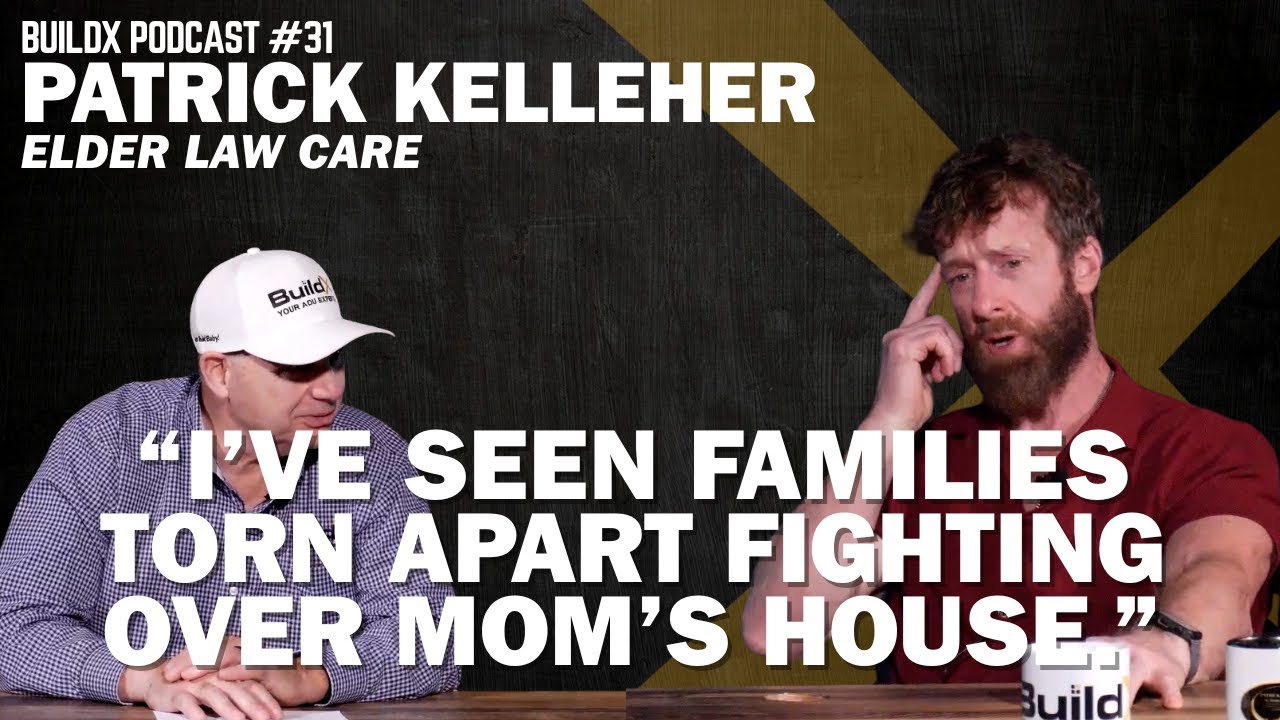
To pressure-test the legal side of ADU ownership, we brought in Patrick Kelleher, an elder law attorney with 23 years of experience at Elder Law Care Center in Hanover, Massachusetts. Patrick has helped hundreds of families protect their homes from what he calls the "four-headed monster" of elder law: probate court, estate taxes, financial creditors, and nursing home costs. His perspective on how ADUs fit into estate planning, special needs trusts, and even condo law confirmed what we have seen on the ground: legal planning is not something you do after you build. It is something you do before.
Quick Answer: If you are building an ADU in Massachusetts, you need an estate plan in place before construction begins. Without a trust, your ADU goes to probate court when you die, is exposed to $18,000-per-month nursing home costs, and can trigger the Massachusetts estate tax if your total assets exceed the $2 million threshold. A properly structured trust protects the ADU, prevents family disputes, preserves government benefits for disabled family members, and keeps the property out of probate. The legal planning comes first. The construction comes second.
In This Article
- What Happens to Your ADU If You Have No Estate Plan?
- How Do You Prevent Family Disputes Over Your ADU Inheritance?
- Can You Build an ADU for a Disabled Family Member Without Losing Their Benefits?
- How Does a Trust Protect Your ADU from a Nursing Home?
- Should You "Condo-ize" Your ADU to Separate It from Your Main House?
- Will Building an ADU Push Your Estate Over the Massachusetts Death Tax Threshold?
- Key Takeaways From the Episode
- FAQ From the Podcast Discussion
- About Patrick Kelleher
- Ready to Build Your ADU the Right Way?
What Happens to Your ADU If You Have No Estate Plan?
The majority of families building an ADU have no legal plan protecting it. When your ADU sits on your property and your name is on the deed, that ADU is legally part of the primary residence. It follows the house wherever the house goes. If there is no trust in place when you pass, the house and the ADU go straight to probate court. That means a judge decides what happens to your $300,000-plus investment, not your family.
Patrick Kelleher puts the scope of this problem in hard numbers. He estimates that 70 to 80% of his clients arrive with no estate plan at all, and nationally, six out of ten Americans do not have a will. Patrick calls the default outcome "the government plan," which means probate court controls everything. A will alone does not solve the problem either. Patrick confirms that a will is "woefully insufficient" because it still goes through probate, does not protect against estate taxes, and offers zero protection from nursing home costs.
From a builder's perspective, we see the consequences of this every week. Families spend six months planning an ADU build, and then the project stalls because nobody has addressed who owns what, who inherits what, and how the investment is protected. A trust is not paperwork you file after the build. It is the legal foundation you pour before the physical one.
The Four-Headed Monster: Patrick describes four threats that consume unprotected assets: probate court (public, slow, expensive), estate and death taxes (Massachusetts kicks in at $2 million), financial creditors and predators (including in-laws during a divorce), and nursing home costs ($18,000 per month in Massachusetts). A properly structured trust is the only instrument that addresses all four.
How Do You Prevent Family Disputes Over Your ADU Inheritance?
Family dynamics kill more ADU projects than zoning boards. Across our ADU consultations, 30% of deals never move forward because of unresolved family conflict about who gets the house, who gets the ADU, and how the other children are made whole. The scenario plays out the same way almost every time: one child moves into the ADU or the main house to care for aging parents, and the other children who live out of state start asking how they get their share of the equity that has already been spent on construction.
Patrick addresses this head-on with a process he uses at Elder Law Care Center. He recommends a formal family meeting where all parties sit at the table before any construction begins. In that meeting, Patrick maps out the full trust design on a whiteboard, covering four timelines: parents alive and well, parents alive but incapacitated, first parent passes, and second parent passes. He then walks through every asset, including IRAs, life insurance, brokerage accounts, and the ADU itself, to create a distribution plan where every child is made whole.
Patrick confirms the alternative asset-balancing approach works for most families. If one child gets the house and ADU because they are the caregiver, the other children receive a larger share of life insurance, retirement accounts, or other liquid assets. The key is that all parties sign off on the plan while the parents are alive and can speak to their intentions. We have seen this single step save ADU projects that were dead in the water.
"At the end of the day, we love you all equally. And that's what the kids need to know in their hearts, regardless of their age when their parent dies."
Patrick Kelleher, Elder Law Care Center
Can You Build an ADU for a Disabled Family Member Without Losing Their Benefits?
Yes, but only with the right legal structure in place first. ADUs are a game-changing housing solution for families with disabled members. A 600-square-foot, one-bedroom, one-bath ADU can give a disabled child independent living with family nearby, replacing a group home they hate with a home they love. But if that child is receiving SSI (Supplemental Security Income) or Medicaid benefits through MassHealth, the asset limit is brutal: $2,000 in their name, and they lose everything.
Patrick explains that if a disabled child inherits the house, the ADU, a life insurance policy, or an IRA without proper planning, Medicaid immediately says spend down the entire inheritance before benefits resume. He has handled cases where a $500,000 inheritance wiped out a disabled person's benefits entirely. The legal solution is a third-party supplemental needs trust (a trust created by the parents while they are alive, not by the disabled person). The disabled child is the beneficiary but never the trustee. A sibling or other family member manages the trust assets.
The third-party trust is the only vehicle that lets a disabled family member live in the ADU, keep receiving government benefits for needs-based care, and use the trust funds for extras that Medicaid does not cover. Patrick confirms that when the beneficiary passes, the remaining trust assets go to other family members. That is the critical difference from a first-party special needs trust (one created by the disabled person themselves), where leftover funds must be repaid to the government.
This topic is personal. Our involvement with ADUs started when a friend called and said she wanted to build an ADU for her nonverbal autistic son who was aging out of his current program and facing a group home placement. She could not sleep at night. That conversation is why BuildX exists in the ADU space today. Every family in this situation deserves a builder who understands the legal side, not just the construction side.
How Does a Trust Protect Your ADU from a Nursing Home?
A nursing home in Massachusetts runs $18,000 per month. If you or your spouse becomes incapacitated and enters long-term care without a trust in place, Medicaid will look at everything you own, including the ADU you just built. The five-year lookback period (the window Medicaid examines for asset transfers) means you need the property transferred into a trust at least five years before you need care. Transfer it too late, and the nursing home can claim it.
Patrick speaks from direct experience. His own father took a bad fall, was transported to the hospital, moved to a rehab facility, and then ended up in a nursing home. That personal experience drove Patrick to specialize in elder law. He confirms that when the primary residence transfers into a trust, the ADU transfers with it automatically because the ADU is legally part of the same property. He calls the ADU "the cousin or the little brother" of the main house. Wherever the deed goes, the ADU follows.
From our experience building ADUs for aging-in-place families, timing is everything. Most of our clients over 55 have a home worth close to $1 million with little or no mortgage. They have accumulated enough equity to fund an ADU build. But that same equity makes them a target for the four-headed monster Patrick describes. We always recommend detached ADUs for aging-in-place scenarios because the separation creates a feeling of independence, even if a breezeway connects the two structures. But the physical design does not matter if the legal protection is not in place first.
Trust Protector Language: Patrick emphasizes that the trust must include a trust protector provision. This newer legal concept in trust law allows limited changes to be made to an irrevocable trust when laws change. Between the day you sign a trust and the day you die, tax codes shift, Medicaid rules update, and family circumstances evolve. A trust protector provision keeps the plan flexible enough to adapt without starting over.
Should You "Condo-ize" Your ADU to Separate It from Your Main House?
One of the most forward-thinking strategies we are exploring at BuildX is condo-izing an ADU. The concept is straightforward: instead of the ADU being legally attached to the main house on one deed, you convert the property into two separate condominium units under Massachusetts General Law Chapter 183A. Condo A is the main house. Condo B is the ADU. Each has its own legal identity, its own deed, and its own estate-planning flexibility.
Patrick confirms the legal framework exists. He sees Chapter 183A condo deeds regularly when transferring condos into clients' Medicaid trusts. The benefits for inheritance are immediate: when the parents pass, the siblings can sell Condo A (the main house) and split the proceeds equally while the child living in the ADU keeps Condo B. Patrick confirms this eliminates the probate problem where the entire property has to be sold to divide the assets. He calls the concept "brilliant" and "creative" because it separates and creates further protections for the family.
We are actively looking for a property to test this strategy. The plan is to buy a house, renovate it, build an ADU, condo-ize the two units, and sell them separately. If that test case works, it sets precedent for every ADU family in Massachusetts. Patrick notes that executing this requires a specialized team: not just an elder law attorney, but a real estate attorney with specific condo-law expertise under 183A. This is an emerging strategy, not a proven playbook yet, but the potential to reshape ADU ownership in Massachusetts is real.
Will Building an ADU Push Your Estate Over the Massachusetts Death Tax Threshold?
Massachusetts is one of 12 states with its own estate tax, and the threshold is $2 million. That number sounds like a lot until you add up a home worth close to $1 million, an IRA, a 401(k), investment accounts, life insurance, and a second property. Patrick calls these families "middle-class millionaires," hardworking people who do not consider themselves wealthy but have accumulated a $3 to $4 million estate without realizing it. Now add a $300,000 to $400,000 ADU to that total.
Patrick confirms the tax consequence is real. Without proper tax-planning language in a revocable trust, a family could owe a couple hundred thousand dollars to the Massachusetts Department of Revenue at death. Capital gains tax is an additional concern when heirs eventually sell the property. He walks clients through every asset to calculate the full estate value, and the result surprises almost everyone.
This is why we raise the estate-tax question during our initial ADU consultations, before the first shovel goes in the ground. Most builders never mention it. But when you are adding six figures of value to a property that already sits near the $2 million line, the ADU does not just change the house. It changes the tax picture for the entire family. The trust is the instrument that addresses it, but only if the tax-planning language is built into the trust from the start.
Key Takeaways From the Episode
- Estate plan before construction: Transfer your property into a trust before building an ADU. The ADU follows the deed, so if the house is in a trust, the ADU is protected automatically.
- 70-80% of families have no plan: Patrick estimates the vast majority of his clients arrive with what he calls "the government plan," which is no plan at all. Six out of ten Americans do not have a will.
- 30% of ADU deals die from family disputes: BuildX has seen nearly one in three projects stall because siblings cannot agree on who gets the ADU, the house, or the equity. A family meeting with an elder law attorney before construction starts solves this.
- $18,000 per month nursing home exposure: Without a trust in place at least five years before you need care, Medicaid can claim the home and the ADU to cover long-term care costs.
- $2,000 SSI asset limit for disabled family members: A disabled child who inherits even a small amount can lose all government benefits. A third-party supplemental needs trust is the only vehicle that preserves benefits while allowing them to live in an ADU.
- $2 million Massachusetts estate tax threshold: Adding an ADU to a property already worth close to $1 million can push the total estate over the state tax line. Proper trust language is the fix.
- Condo-izing is an emerging strategy: Separating the ADU from the main house under Massachusetts Chapter 183A condo law creates independent ownership, cleaner inheritance, and avoids forced sales through probate.
- Annual trust reviews are required: Laws change, health changes, and family circumstances change. Patrick recommends an annual meeting with your elder law attorney to update the plan.
FAQ From the Podcast Discussion
Do I need a trust or is a will enough to protect my ADU?
A will is not enough. Patrick confirms that a will goes through probate court, does not protect against estate taxes, and offers zero protection from nursing home costs. A trust is the only instrument that shields your ADU from all four threats: probate, taxes, creditors, and Medicaid.
What happens to my parents' ADU if my spouse and I get divorced?
If your parents built an ADU on your property and you get divorced, a court could order the sale of the house, which includes the ADU. Patrick recommends two protections: a lease for life (recorded at the registry of deeds, giving parents a legal right to stay) and a promissory note (placing a lien on the property for the ADU's construction cost). These encumbrances make a forced sale impractical.
What is the "four-headed monster" Patrick describes?
Patrick's framework for the four threats to unprotected family assets: probate court (public, slow, and expensive legal process), estate and death taxes (Massachusetts threshold is $2 million), financial creditors and predators (including in-laws during a divorce), and nursing home costs ($18,000 per month in Massachusetts). A trust is designed to defeat all four.
What is the difference between a third-party and first-party special needs trust?
A third-party supplemental needs trust is created by the parents while they are alive for a disabled child. When the beneficiary dies, remaining funds pass to other family members. A first-party special needs trust is created with the disabled person's own assets, and any remaining funds must be repaid to the government. For ADU families, the third-party trust is the right vehicle.
How long does a trust design meeting take?
Patrick's typical trust design meeting runs about two hours. He whiteboard-maps four pages of timelines covering every scenario: both parents alive and well, alive but incapacitated, first parent passes, and second parent passes. Clients photograph the whiteboard and receive printed copies as their trust blueprint.
What legal team do I need before building an ADU in Massachusetts?
At minimum, you need an elder law attorney (for trust and estate planning), a builder who handles permitting (the "quarterback" of the project), a surveyor, and engineers. For families considering condo-izing, add a real estate attorney with specific 183A condo-law expertise. Patrick emphasizes the team must work collaboratively to evaluate both current and future family needs.
How often do I need to update my trust after building an ADU?
Patrick recommends annual reviews. Between signing a trust and the day it needs to perform, three factors change: law (Congress and Medicaid rules), life (health, finances, relationships), and the third L is the compounding effect of both. Elder Law Care Center runs an annual Client Care Alumni Program with trustee training workshops for clients and their adult children.
Can a backup trustee protect the ADU if the primary trustee is incapacitated?
Yes, and Patrick says this is non-negotiable. He asks every client: "If you were hit by the bus of life, who would step into your shoes as the future trustee?" The backup trustee is the person who runs the playbook if the primary trustee cannot. Without one, the trust can stall in a crisis.
Can in-laws create legal problems for my ADU after I die?
Patrick warns this is one of the most common sources of conflict. After parents pass, in-laws sometimes pressure the surviving children to claim their "legal share" of the estate, creating friction that was never there while the parents were alive. The family meeting and signed agreement process prevents this by documenting everyone's understanding while the parents can speak to their intentions directly.
Is condo-izing an ADU a proven strategy in Massachusetts?
Not yet. The legal framework exists under Massachusetts Chapter 183A, and Patrick regularly sees 183A condo deeds in his practice. But no ADU has been formally condo-ized as a test case yet. BuildX is actively seeking a property to test this strategy. The concept has strong support from both elder law and real estate law perspectives, but families should treat it as an emerging approach until a precedent is established.
"Sadly people die, but trusts do not. So the trust is where the rubber meets the road."
Patrick Kelleher, Elder Law Care Center
About Patrick Kelleher
Ready to Build Your ADU the Right Way?
The legal plan comes first. The construction plan comes second. If you are considering an ADU in Massachusetts, start the conversation with a builder who understands the full picture, from trust protection to foundation pour.
Schedule a site consultation with BuildX to walk through your lot, discuss your goals, and determine the best route to take with your project.
Request a Free Consultation or call (781) 627-7000
See our work in person: buildx.com/adu-home-tour